
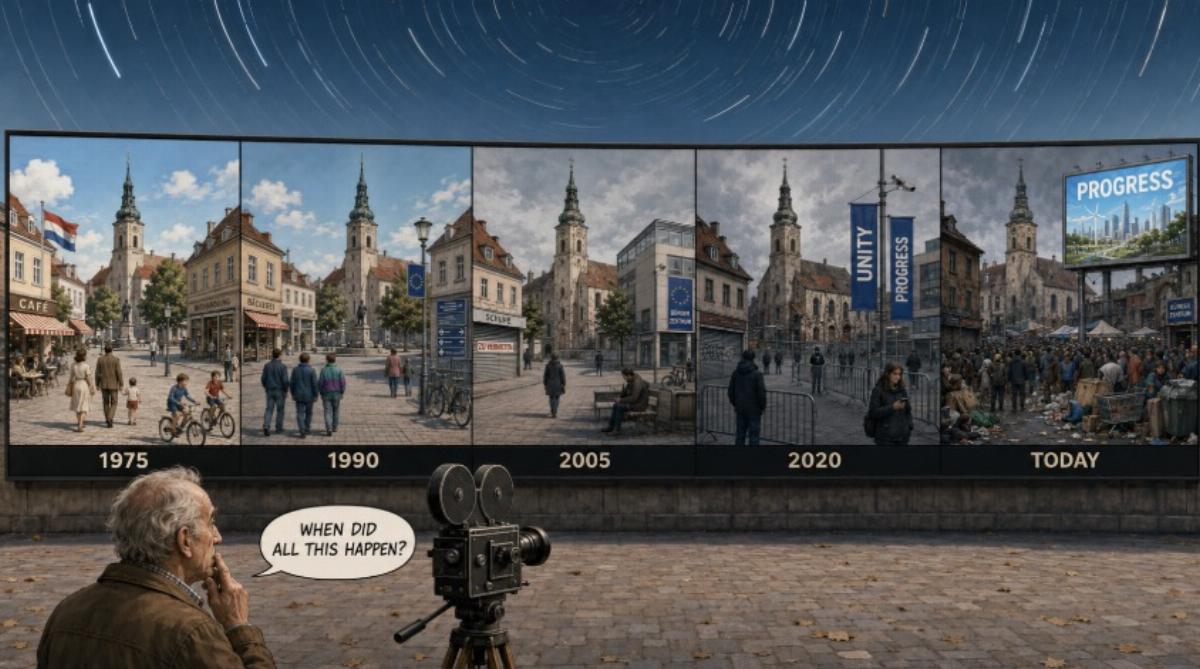
I find time-lapse photography fascinating. One of my favorite examples is when someone in the far north points a camera at the North Star during winter and leaves it there overnight. The result is typically an image of silhouetted trees surrounding an array of circles made by the stars traveling across the sky as the Earth spins. Although that picture captures reality, there’s no moment when you could ever actually see it simply by looking up. It doesn’t actually exist as a single moment; it’s only by seeing the time-lapse that you can perceive it.
Read more The Mohammunist Manifesto—The World as a Binary
A more consequential example, although I’m not sure it technically meets the definition of time-lapse, is when a parent takes an image of a child every day, or every Monday, for a series of years and then puts the images together so that they run in sequence. While each individual image might tell a story—“That was Janie at 12, when she first got her braces,” or “That was Timothy at 8, when he decided to cut his own hair”—taken in aggregate, the sequence tells a completely different story, as a daughter grows from a scared kindergartner to a smiling college graduate in minutes.
The funny thing about such time-lapses is that they often show us things that we simply don’t see in real time. Think of the time in 11th grade when, because you saw your son every day, you didn’t realize until your visiting mother-in-law pointed it out that his hair had grown from a buzz cut to a mop-top in one semester. Sometimes, it’s only when we step back and see things from a larger perspective that we can perceive the big picture or recognize what’s going on.
The point of time-lapse is that it tells a story in the relative blink of an eye.
That same thing holds true for cultures. Billy Joel did something of a cultural version of that with “We Didn’t Start the Fire.”
The time in time-lapse is relative, of course. It can chronicle the carving of the Grand Canyon over millions of years, or it can show the life cycle of a bacterium that lasts a few days. Or it can depict the collapse of a civilization over a week.
That last one is a bit of an exaggeration—but not by much. This week, we’ve had the bad fortune of watching something resembling the collapse of Western society over the course of a single week. I am, of course, talking about Ceuta, the African outpost of Spain, population 80,000, that was overrun by 50,000 or more Moroccans last week.
The outpost’s officials called for the Spanish military to come to their aid, but by that point, the damage had already been done. The population increased by 75% in a matter of days. Sixty-seven people died trying to make their way into the enclave. As soon as the invaders made their way in, they wrought havoc. They looted stores, fought with locals, and left massive amounts of…chaos in their wake. And now, the Spanish government is claiming that most have returned home.
No doubt, some have returned home, but the claim that most have is questionable, particularly because it comes from Pedro Sánchez, the communist who runs the Spanish government and who is facing a political firestorm, both internally and externally. This, of course, comes on the heels of his legalizing half a million illegals earlier this year.
That amnesty was likely the catalyst for this invasion, just as Ronald Reagan’s amnesty in 1986 led to 50 million illegals invading the United States over the next 40 years.
Read more Abdul El-Sayed wins in Michigan, but primary voters are not ‘pivoting to the left’
But here’s the thing: Even if all those Moroccans eventually go back home willingly or are sent back—either of which is unlikely—no doubt, thousands of them will make asylum claims and seek to be sent to Europe at the first opportunity. Whatever the number of Moroccans who stay in Ceuta, the outpost is likely changed forever. Even if only 10,000 stay, you can’t increase your population by 15% overnight without remaking the face of your community.
This week-long invasion of Spain, along with the country’s globalist, communist leadership, is like a time-lapse of Europe over the last 25 years. Like a time-lapse of a daughter from the time she’s 3 until she’s 23, when you put the first and last images side by side, you recognize the dramatic change that you never see when moving from one to the other by flipping through them all.
Ceuta, going from a quaint but robust Western trading center to a dystopian nightmare in a matter of days, is the West today. The difference is that Ceuta was relatively easily rescued because Spain belatedly sent thousands of armed troops to try to eject the invaders. The West in general, and Europe in particular, will not be so lucky.
Why? Two reasons. The first is that the United States cannot rescue the continent from another suicide, as it did in World Wars I and II. America, led by communists in Democrat clothing, has traveled a similar path over the last half-century and is only now starting to address the cancer within.
The second reason, which dovetails with the first, is that, unlike events during those previous wars, the enemy is not easily identified by different uniforms and front lines that can be drawn on a map. No, today, Europe’s leaders have forced its invaders right into its heart.
From capital cities to fishing hamlets, European leaders have forced their citizens to accept millions of invaders into their communities, bringing with them violence, behaviors, and cultures that are utterly foreign to Europe. What’s worse, these globalist clowns are forcing their own citizens to pay to support those very invaders in their midst.
Not surprisingly, over the course of this last quarter-century, much of Europe has lost its understanding of who its people are and what put them at the top of the mountain in terms of civilization, power, and prosperity in the first place: Christianity…on its last legs. Freedom of speech…a distant memory. Capitalism…a smoking husk on the side of the road. Equal application of the law…a joke with no punch line. And, perhaps most of all, their national identities, which they have traded in for the laughably amorphous moniker “European,” if not in word, most certainly in deed.
Ceuta, even if it gets back to something resembling normal, has pulled back the curtain on the reality of the civilizational suicide that globalists are inflicting on their citizens. It exposed the chaos behind the Potemkin façade that globalist Western leaders have been maintaining for the last 25 years while pontificating about progress and unity, hoping we wouldn’t notice the incremental destruction of the greatest civilization in human history.
Some of us have recognized the lie. Most haven’t. Perhaps Ceuta will be the wake-up call they need. Only time will tell.
Read more Romeo and Mohammed?
Image created using AI.
Follow Vince on X at: @ImperfectUSA