
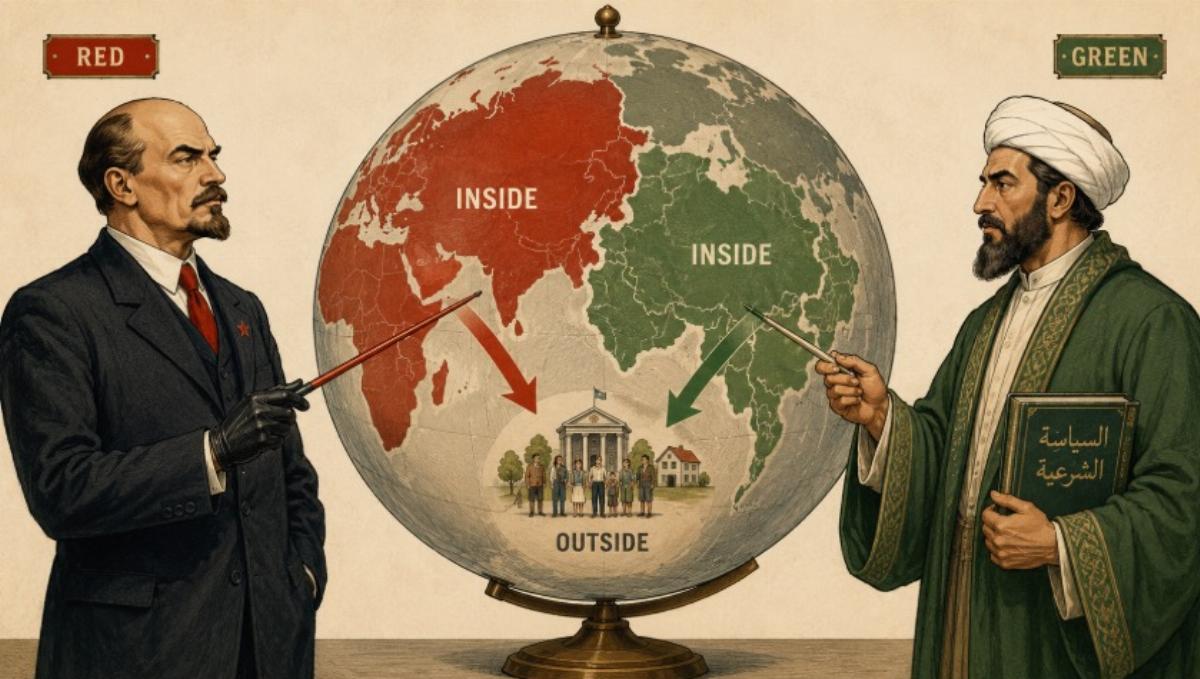
In revealing the commonalities of the Reds and the Greens in the Red-Green Axis, we have elucidated their shared goals of violence, wealth redistribution, and inequality before the law. Here we explore their binary worldview.
Read more Abdul El-Sayed wins in Michigan, but primary voters are not ‘pivoting to the left’
Both Islamic political systems, as developed in classical jurisprudence, and Marxist-Leninist communism organize the world into a permanent binary division. One domain is the legitimate, correctly ordered sphere; the other is the external sphere that remains incomplete, illegitimate, or hostile until it is transformed or subordinated.
This division is not a temporary phase or a pragmatic map of power; it is a structural feature that generates a standing external mission, an ongoing obligation toward the outsider domain. The parallel is practical and political, not rhetorical.
Both systems reject a world of permanently equal, mutually recognizing sovereigns under neutral international law. Instead, they treat the external realm as the field of unfinished work, and both built durable institutions to prosecute it.
In classical Islamic political theory, the world is binarily divided into dar al-Islam, the domain in which Islamic rule and law prevail, and dar al-harb (harb: “war”), the domain of war or unbelief. The terms are juristic rather than directly Quranic, but they codify Quranic commands and the practice of the early community into permanent law.
Quran 8:39 instructs fighting “until there is no fitnah [strive or conflict] and [until] the religion, all of it, is for Allah.” Quran 9:29 establishes the demand for submission and payment from those outside the faith.
Whatever the immediate occasion of these verses, the classical jurists did not treat them as closed to their moment: they extracted a durable legal category, applied it prospectively to every future non-Muslim polity, and encoded it in manuals of law that governed for centuries. A text tied to one campaign cannot found a permanent legal architecture; only a standing principle can.
The external domain is not recognized as a permanent equal. Truces may be concluded, and intermediate categories such as dar al-sulh (domain of treaty) appear in some treatments, but these are provisional by the jurists’ own account. The long-term orientation remains the expansion of the domain of Islam or the subordination of the external to Islamic authority. The dual division supplies both a map of legitimacy and a permanent mission.
Marxist-Leninist communism constructs an analogous binary. The Communist Manifesto ends with the call “Working men of all countries, unite!” and frames history as the progressive resolution of class antagonism on a global scale. The world is divided into the camp of the proletariat (and later the socialist states) and the camp of the bourgeoisie and imperialism.
Lenin and the Bolshevik tradition treated the capitalist world as the sphere that must ultimately be revolutionized; the dictatorship of the proletariat in one country was never the final end. The Comintern was created precisely to organize and support revolutionary movements abroad.
The 1961 Program of the CPSU, adopted at the height of the doctrine of “peaceful coexistence,” places the chapter on coexistence directly alongside the chapter on the international revolutionary movement of the working class, and states its aim as making it possible, in its own words, to “banish world war from the life of society” even before socialism’s complete victory worldwide.
Coexistence was a tactic for winning without war, not a renunciation of the mission. The socialist system was the historically progressive order; the capitalist system, transitional and destined for replacement. The external domain remained the field of unfinished historical work.
For both ideologies, the functional identity holds at the level of political consequence, whatever the source of authority behind each system. That one draws sanction from sacred text, and the other from a theory of history, is a difference in warrant, not architecture: a permanent binary map produces the same effects whether backed by scripture or by dialectical materialism.
First, both systems generate a standing external obligation: the insider community cannot treat the outsider domain as permanently legitimate and self-sufficient.
Second, the dual map subordinates ordinary diplomacy. Mutual recognition, alliances, and trade become instrumental to the higher mission, not ends in themselves.
Third, the division supplies a permanent mobilizing narrative: internal cohesion strengthens through external contrast, and resources are directed outward under the banner of necessity.
Fourth, the binary resolves the problem of pluralism: competing systems are not equal participants in a neutral order of states but stages awaiting transformation.
Historical practice confirms the pattern: Islamic polities expanded for centuries under the logic of extending dar al-Islam. The Treaty of Hudaybiyyah supplies the paradigm case: a ten-year truce with Mecca in 628, broken after two years once circumstances turned favorable, ending in the conquest of the city—the precedent jurists cite for capping hudna at ten years, since a truce was a tactical instrument, not a final settlement. The juristic framework went on classifying the external world hierarchically and treating agreements with non-Muslim powers as limited in duration, never as recognition of a permanent equal.
Communist states organized the Comintern, later the Cominform, and successive fronts, supporting revolutionary parties as a permanent feature of policy. The Comintern’s own Seventh Congress in 1935 shows the same logic: the Popular Front line allied Communist parties with the social-democratic and bourgeois parties the Comintern had spent the previous decade condemning as class enemies, a reversal announced as tactical necessity against fascism, not abandonment of the revolutionary goal. In both cases the dual division survived every tactical adjustment; when power realities forced restraint, the theoretical map did not change.
Read more Romeo and Mohammed?
Objections that classical law allowed long truces or that Soviet policy emphasized coexistence mistake tactics for principles. Temporary accommodations do not erase a foundational dualism; a truce concluded on the understanding that it is temporary is itself proof of the underlying doctrine, not an exception to it.
A system that regards the external domain as ultimately destined for incorporation or transformation is not operating on the same premises as a system of permanent sovereign equality, whatever a truce’s length. Both traditions treat the current configuration of the world as transitional. The insider domain carries a mission; the outsider is its object. Rights and force are calibrated accordingly.
The binary resolves a second way when a population stops being external. Classical law leaves a conquered population’s fate to the caliph’s choice—death, slavery, ransom, or release for captive men; women and children are enslaved by capture alone.
Communism’s version aims inward: once a country entered the socialist system, the state turned on its own bourgeoisie and “kulaks” with a violence never proposed for export. Dekulakization and collectivization produced the Holodomor, some 3.5 to 5 million dead in Ukraine, and the Great Leap Forward killed 15 to 55 million in China. Neither is the mission executing abroad; both are what happens once a population stops being external.
This permanent dual division with its standing external mission is a core practical mechanism shared by both systems, converting a comprehensive claim about the correct order of human life into a global political orientation. The world is not a collection of equal polities under neutral rules; it is a binary field in which the correctly ordered domain has unfinished business with the rest.
The hierarchy of domains generates the hierarchy of obligations, and the obligations generate continuous external pressure that no truce or tactical doctrine can permanently dissolve. Two systems arrive at the same political architecture, because that architecture is what a comprehensive claim to correct order requires.
Their fight continues until the Other—that would be us—is dead, converted, or subjugated.
Image created using AI.
Endnotes
1. Quran 8:39 and 9:29. Standard translations (Sahih International) frame the fighting until religion is for Allah and until the payment of jizyah by those outside the faith. Primary text at quran.com/8/39 and quran.com/9/29.
2. Classical formulation of dar al-Islam and dar al-harb appears in the major schools of jurisprudence. Representative treatments are found in the legal digests of the Hanafi, Maliki, Shafi’i, and Hanbali traditions; English access to a standard Shafi’i manual is provided by Ahmad ibn Naqib al-Misri, Reliance of the Traveller (Umdat al-Salik), trans. Nuh Ha Mim Keller (Amana Publications, 1994). The dual classification is discussed in the sections on jihad and relations with non-Muslims; the disposal of captives is at o9.13–14.
3. Harb and the Hebrew cherev (חֶרֶב, “sword”) are cognates from a shared Proto-Semitic root *ḥarb-, alongside Aramaic and Syriac ḥarbā (“sword,” “javelin”). The root’s oldest recoverable sense is a blade or cutting instrument; Hebrew, attested in writing centuries before Arabic, preserves that concrete meaning, while Arabic narrowed it to the abstract “war”—the activity the blade serves, rather than the blade itself.
4. Early historical practice and the juristic elaboration of the division are documented in works such as Abu Yusuf, Kitab al-Kharaj, and the conquest narratives preserved by al-Baladhuri and al-Tabari. Modern presentations grounded in these sources include the analysis in Bernard Lewis, The Political Language of Islam (University of Chicago Press, 1988), drawing directly on the Arabic primary materials.
5. Karl Marx and Friedrich Engels, Manifesto of the Communist Party (1848), final paragraph: “Working men of all countries, unite!” Primary text at marxists.org/archive/marx/works/1848/communist-manifesto.
6. V. I. Lenin, The State and Revolution (1917) and related writings on the international character of the proletarian revolution. Primary texts at marxists.org/archive/lenin/works/1917/staterev. The institutional expression appears in the founding documents of the Communist International (Comintern), 1919, available in the Comintern archives collections.
7. “Social-democratic” here refers to the Second International parties of the interwar period—the German SPD, French SFIO, and similar—not to any contemporary organization.
8. On the persistence of the dual framework even under tactical doctrines of coexistence, see Programme of the Communist Party of the Soviet Union, adopted by the 22nd Congress of the C.P.S.U., October 31, 1961, which places Section VIII, “Peaceful Coexistence and the Struggle for World Peace,” alongside Section V, “The International Revolutionary Movement of the Working Class,” within a single program document. Full text at archive.org/details/programmecpsu1961.
9. Holodomor death toll: a 2015 demographic study by the Ukrainian Institute of Demographic and Social Studies and the University of North Carolina at Chapel Hill puts Ukrainian losses at approximately 3.9 million; broader estimates range from 3.5 to 5 million. See Anne Applebaum, Red Famine: Stalin’s War on Ukraine (Doubleday, 2017), on dekulakization and forced collectivization as the mechanism of the famine.
10. Great Leap Forward death toll: scholarly estimates range from 15 to 55 million, with the most detailed archival account in Frank Dikötter, Mao’s Great Famine: The History of China’s Most Devastating Catastrophe, 1958–62 (Walker & Company, 2010).
Read more Is punk Iran feeling lucky?