
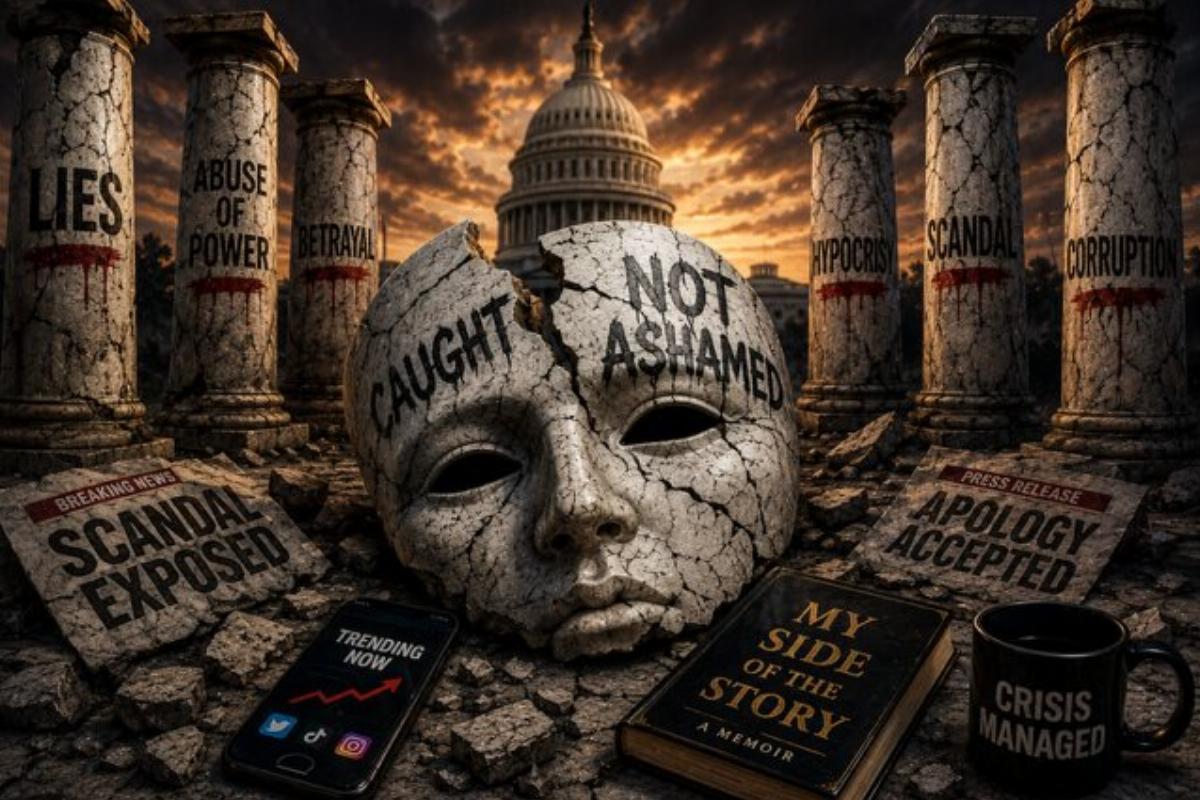
One of the strangest changes I’ve witnessed over the past twenty years has almost gone unnoticed.
Read more ‘The Chilling Stars’
There was a time when public embarrassment carried real weight. If a politician lied, a CEO abused his office, a pastor betrayed his congregation, or a public figure disgraced himself, shame served a social purpose. It wasn’t always pleasant, but it reminded us that character mattered.
Today? The apology is a press release, the scandal becomes a podcast appearance, or the controversy turns into a book deal. And somehow the follower count goes up. We’ve managed to monetize disgrace, which is an impressive achievement, if deeply depressing.
But don’t misunderstand me—I’m not arguing for a return to public humiliation or mob justice. The internet has already given us enough of that. I’m talking about something much older and much more valuable: the internal sense that certain actions should weigh heavily on our conscience even if nobody else ever discovers them. That’s shame, and healthy societies need it.
Somewhere along the way, we replaced shame with public relations.
The question is no longer: “Was it wrong?”
It’s become: “Can we survive the news cycle?”
Those are radically different moral frameworks.
As a conservative, I’ve often heard people argue that character should take a back seat to policy: “Who cares what kind of person he is if I like his agenda?”
I’ve heard the same argument from the Left whenever one of their own gets caught—it’s funny how principles suddenly become flexible when your team is ahead in the polls. Apparently morality now comes with partisan exemptions.
But there’s a deeper problem, and it’s cultural. We’ve raised a generation that confuses exposure with accountability. Getting caught redhanded rarely compels repentance, deleting a tweet to avoid further fallout isn’t the integrity move some pretend it is, and hiring a crisis-management firm isn’t character development.
Today’s villain becomes tomorrow’s guest on a podcast, and yesterday’s scandal becomes next week’s merchandise. Nothing stays shocking because everything is optimized for engagement, and a healthy internal sense of shame seems to be almost entirely missing from the political sphere.
Read more Anthony Fauci Hurt America’s Children … and Her Future
As someone who has worked in mental health advocacy, I’ve learned that genuine change almost always begins with honest self-confrontation. Recovery requires admitting uncomfortable truths. Healing demands humility. People don’t rebuild their lives by pretending nothing happened—and neither do nations.
Conservatives should be especially careful here. For decades we’ve argued that culture matters more than politics. If we actually believe that, then we cannot excuse moral collapse simply because it advances our preferred political outcomes. Character isn’t a campaign strategy. It’s either real or it isn’t, and that standard has to apply to everyone, but especially our own if we claim the moral highground. Otherwise we’ve traded principle for convenience.
One of the great insights of the Founders was recognizing that no constitutional system could compensate for a complete collapse in civic virtue.
Laws restrain behavior, but they cannot manufacture integrity.
Only character does that; in John Adams’s words, “Our Constitution was made only for a moral and religious people. It is wholly inadequate to the government of any other.”
But the modern politico is not the John Adams of the 18th century.
Become better if it helps your image—otherwise deny, deflect, attack, repeat.
It’s a remarkably effective public-relations strategy, but it’s a terrible way to build a civilization.
The republic we were given was a stable and resilient one, but what it cannot survive indefinitely is a citizenry that no longer blushes when it betrays its own principles.
Read more Iran is running out the clock to get a weak POTUS
Image generated by AI.