
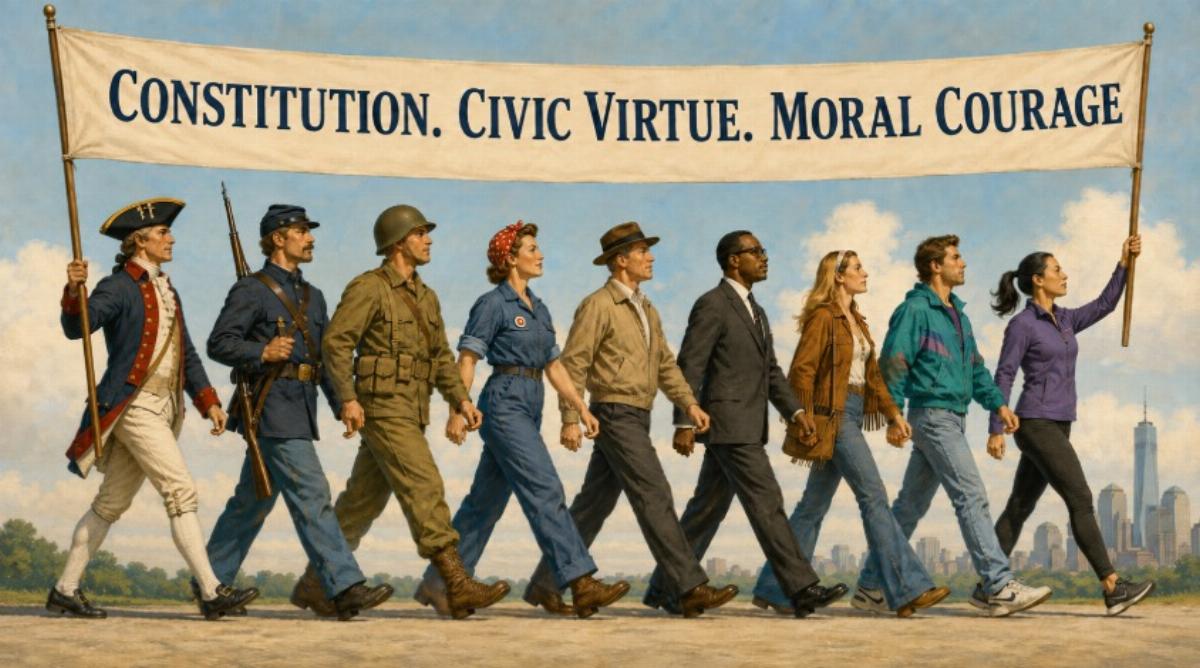
(Note: This essay is not a call for armed resistance. Instead, it examines historical situations that justify such resistance, as well as the non-violent values and actions conservatives can immediately use to prevent the need for armed resistance from arising.)
Read more Argentina’s Milei Ends the Debt State
Throughout history, free societies have wrestled with an uncomfortable question: Is there ever a time when citizens have a moral duty to resist their own government? The question matters because America is not immune from decline. We are retreating, overtaken by what increasingly resembles a cult, one built around the destructive moral impulses Gad Saad describes in Suicidal Empathy.
Not only are the barbarians and lunatics at the gate; many now seemingly seek their “leadership.”
Rigor, reason, and resolve can only take us so far. There comes a moment when simply talking about our problems isn’t enough, and our best thinking virtues can no longer ensure our survival. As a society, we preach one thing and practice another when it comes to applying force to defend essential virtues.
Resistance should not be defined as dissatisfaction with elections, taxes, policies, or political opponents. A free society depends upon vigorous disagreement, constitutional processes, and the peaceful transfer of political power. Neither is resistance the refusal to obey laws simply because one believes them to be unjust or disagrees with those charged with enforcing them; we are beginning to see both.
In a constitutional republic, lawful remedies must be exhausted before the moral question of resistance can even arise. Not every unpopular law is tyranny, and not every political defeat is oppression. The threshold for legitimate resistance is intentionally set extraordinarily high because violence to reassert our constitutional rights carries terrible consequences.
Only when lawful institutions have ceased functioning according to their intended purpose, peaceful remedies have been exhausted, and government itself has become the principal instrument of systematic injustice, not its remedy, does the moral question of resistance deserve, even demand, consideration.
Across both Scripture and our founding traditions, the ethical use of force is never celebrated but is recognized as sometimes necessary to uphold justice and protect the innocent. The Bible consistently distinguishes between violence driven by malice and violence used to restrain evil: the “avenger of blood” in Deuteronomy, the communal defense of the oppressed in Proverbs 24:11, and in Romans 13 all frame force as a grave responsibility, not a license to trifle with. These principles underpin our Judeo-Christian tradition.
America’s Founders embraced a similar moral logic. Drawing heavily on natural law philosophy, they argued that governments exist to secure the people’s God-given rights and derive “their just powers from the consent of the governed.” When government becomes destructive of those ends through a long train of abuses, the Declaration of Independence affirms that the people retain the right to alter or abolish it. If resistance wasn’t exactly what they had in mind, I’m lost.
This principle is not uniquely American. It runs through centuries of Western political thought. John Locke argued that people possess certain rights simply because they are human—life, liberty, and property. Governments do not create those rights; they exist in spite of and superior to government. Citizens establish governments through mutual consent to protect themselves, not in the reverse, to give up agency.
If government becomes the principal violator of those rights, Locke argued, the people retain the ultimate right to alter or abolish it. That principle is the philosophical foundation of the American Revolution and must remain a present-day expectation.
Our Judeo-Christian traditions reached a similar conclusion. Scripture consistently condemns violence undertaken for conquest, revenge, hatred, or personal gain while recognizing the legitimacy of force used to defend innocent life and restrain evil.
Read more Democrats Are Perpetuating The Problems They Claim To Fix
Augustine later developed these principles into Just War theory, arguing that force may become morally permissible only when the cause is just, peaceful alternatives have failed, the response is proportional, and the objective is the restoration of peace rather than revenge. The goal is always justice—not violence. I do disagree with his ideas regarding proportionality; they encourage some bad actors rather than deterring them, but otherwise I concur.
Most people already recognize that rights carry corresponding responsibilities. Parents have a duty to protect their children. Police have a duty to intervene when innocent people are attacked. Soldiers accept a duty to defend our nation. In each case, refusing to act when innocent lives are endangered is itself a moral failure.
That raises an uncomfortable but unavoidable question. If individuals have a duty to protect innocent people from violent criminals, does a free people have a comparable duty when oppression originates from the government itself?
History offers interesting corollaries. During the Second World War, members of the French Resistance sabotaged railroads, gathered intelligence, hid Allied airmen and Jewish families, and fought an occupying regime that had extinguished lawful avenues of dissent. Their actions violated the laws imposed by Nazi authorities. Yet history remembers them not as criminals but as the patriots they were, because the government that demanded their obedience lacked moral legitimacy. We honor them today because they resisted tyranny when peaceful alternatives disappeared.
The lesson of both the American Revolution and the French Resistance is not that violence is noble, but that legitimacy matters more. Governments derive moral authority from protecting justice and liberty. When a government becomes the principal instrument of oppression and peaceful remedies have been exhausted, resistance may cease to be merely a right and become an actual obligation.
Some readers will likely misinterpret me, thinking this is a call to arms. It’s not. Real resistance begins long before physical force ever becomes imaginable. It begins with self-government, civic engagement, moral courage, honest speech, faithful citizenship, and a steadfast refusal to surrender the principles upon which constitutional government rests and the kind of principled engagement too few actually undertake.
Government is not a substitute for personal responsibility. We delegate, as appropriate, those decisions best made by representatives acting within constitutional constraints.
Those representatives must remain mindful of their duty to the citizens they serve, but in an even more profound sense, to the constitutional order and the traditions entrusted to them by our Founders and subsequent generations. Our fealty and fidelity must always be to the Constitution and the liberties it protects, because governments exist to preserve those principles—not to supplant them.
If we ever reach the point where resistance becomes morally necessary and defensible, every institution of self-government will already have failed. Our first obligation, therefore, is not to prepare for that day, but to preserve the constitutional order, civic virtue, and moral courage that ensure that day never arrives.
God Bless America.
Image created using AI.
Author, Businessman, Thinker, and Strategist. Read more about Allan, his background, and his ideas to create a better tomorrow at 1plus1equals2.com.
Read more Anxiety, Fear, And Unanswered Treachery