
In Leonard Wibberley’s 1955 novel The Mouse That Roared, the tiny Duchy of Grand Fenwick declares war on the United States, intending to lose quickly and collect Marshall Plan-style reconstruction aid. One character notes that there is no more profitable undertaking than declaring war on America and being defeated.[1]
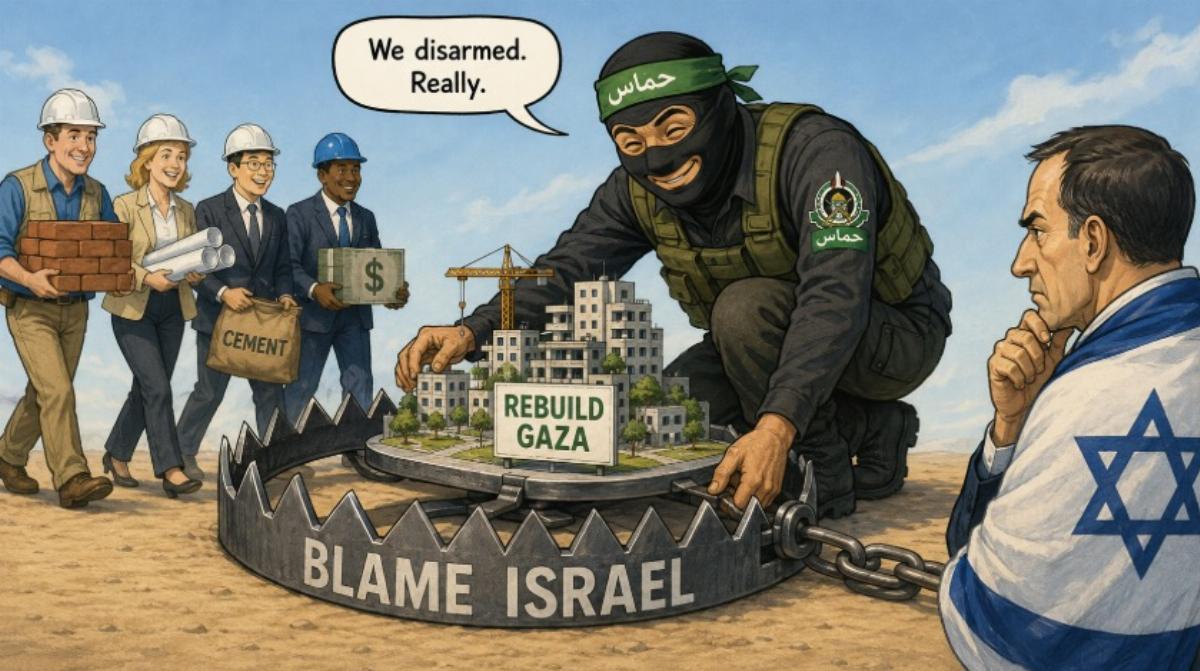
Today Hamas follows a darker version of this logic. After the October 7, 2023, massacre and Israel’s ensuing defensive war, Gaza offers conditional claims of readiness to disarm and cede formal governance to technocrats, inviting the West and Gulf states to rebuild Gaza.
Hamas’s ideology, however, treats the conflict with Israel and the West as a perpetual religious duty. Surface concessions buy time and money; rearmament follows. The United States risks financing its own future adversary.
History confirms the pattern. After the 2008–09, 2012, 2014, and 2021 rounds, donors funded reconstruction only for Hamas to divert materials into tunnels, rockets, and production capacity, all of which Iranian supply lines primarily sustained, with additional funding and facilitation from Qatar and Turkey and historical smuggling routes through Egypt.[2]
The present war has caused far greater damage, with joint World Bank, EU, and UN assessments placing recovery needs near $70 billion or higher.[3] Under the Board of Peace framework, pledges exist, yet disbursement lags pending genuine demilitarization.
Hamas dissolves its formal government while making weapons transfer contingent on Israeli withdrawal, an end to “aggression,” and progress toward a “Palestinian” state. Officials speak of non-visible or frozen arms rather than irreversible surrender and reaffirm the legitimacy of resistance.[4] U.S. descriptions of a “historic” roadmap with complete dismantlement meet Israeli skepticism grounded in continued smuggling, local manufacturing, recruitment, and tunnel repair during the ceasefire.[5]
Hamas is not an isolated elite. In the January 2006 “Palestinian” Legislative Council elections, its “Change and Reform” list won 74 of 132 seats with 44.45 percent of the popular vote, stronger in Gaza.[6] Subsequent polling has shown persistent or elevated public support, including majorities or pluralities in multiple surveys viewing the October 7 attack as correct and opposing full disarmament. The religious incentive to continue war against Israel and the West extends beyond formal Hamas ranks into wider Muslim currents and substantial segments of the population.
The 1988 Covenant of the Islamic Resistance Movement (Hamas) opens by approvingly quoting Muslim Brotherhood founder Hassan al-Banna: “Israel will exist and will continue to exist until Islam will obliterate it.” The document goes on to declare that “Palestine” is a perpetual Islamic waqf and that there is no solution except jihad; peace initiatives are futile.[7]
Leaders reject abandoning weapons for economic projects. Compounding this is the Islamic distinction between permanent peace and hudna. Drawing on the Treaty of Hudaybiyyah, classical Islamic jurisprudence treats hudna as a temporary truce that may be ended once Muslims regain strength.
Hamas frames potential long-term arrangements in these terms. Permanent acceptance of Israel on land regarded as Islamic waqf is theologically rejected, i.e., it is impossible. No doctrinal path reliably prevents future war.[8]
Western diplomacy remains vulnerable because it continues to believe that process and material improvement are paths to moderation. Reconstruction funds therefore underwrite recovery of a territory whose dominant force remains committed to Israel’s (and the West’s) destruction.
The Board of Peace multiplies the danger. Once international capital rebuilds housing and infrastructure, any Israeli defensive strike against a rearming Hamas destroys assets paid for by scores of countries. This frames necessary self-defense as wanton destruction of collective investment, intensifying pressure toward strategic self-negation.
In the extreme, the same contributors can evolve into an entangling alliance treating Israeli counter-action as an attack on their interests. Membership includes Turkey and other Muslim-majority states. Qatar and Egypt sit alongside Turkey as founding members, meaning three of the states most documented as historic financial and logistical conduits for Hamas now also sit in judgment of its disarmament.[2] Turkish President Recep Tayyip Erdoğan has publicly called for the destruction of “Zionist Israel.”[9]
Read more The cornucopia of capitalism
Enduring religious and civilizational hostility toward Jews (and Christians) in the Muslim world raises the prospect that political condemnation of Israeli defense will escalate into kinetic responses or active support for further aggression. The multi-national structure raises the political cost of Israeli self-defense while lowering the cost of the next Hamas round.
A power that confuses tactical statements with strategic conversion repeatedly underwrites its adversary’s recovery. Until Western policy treats perpetual jihad and the preference for temporary hudna over permanent treaty as central facts, the United States will continue to play the role assigned in this lethal version of The Mouse That Roared.
Image created using AI.
Endnotes
[1] Leonard Wibberley, The Mouse That Roared (New York: Little, Brown and Company, 1955).
[2] On Iranian primacy as weapons, training, and military funding supplier: U.S. State Department and Israeli intelligence assessments; Washington Institute for Near East Policy analyses of Iranian smuggling routes (sea, Sudan/Sinai, and knowledge transfer). On Qatar: monthly cash transfers (often $30 million range in peak years) that assessments indicate supported both civilian governance and military infrastructure. On Turkey: IDF/Shin Bet revelations of Hamas financial networks operating in Turkey under Iranian supervision, including money-changing and real-estate channels moving hundreds of millions of dollars (IDF statements and U.S. Treasury designations of related entities). On Egypt: long-standing Sinai tunnel smuggling of weapons, dual-use materials, and goods into Gaza (documented by Egyptian and Israeli security forces prior to major tunnel closures). Supporting reporting includes Times of Israel and OCHA records on cement diversion after 2014, and World Bank/EU/UN Rapid Damage and Needs Assessments covering the successive reconstruction cycles.
[3] World Bank, European Union, and United Nations, Gaza Strip Rapid Damage and Needs Assessment (RDNA), April 2026, estimating $71.4 billion in recovery and reconstruction needs over the next decade ($26.3 billion in the first eighteen months); building on the Gaza and West Bank Interim Rapid Damage and Needs Assessment, World Bank, February 2025.
[4] Ghazi Hamad (Hamas negotiating delegation), remarks to Al Jazeera, reported in Anadolu Agency, “Hamas Says No Disarmament Before Israeli Withdrawal from Gaza,” July 31, 2026, and Axios, “Trump Touts ‘Historic’ Agreement to Disarm Hamas, Rebuild Gaza,” July 30, 2026 (“We will not take any steps regarding disarmament before Israel withdraws from the Gaza Strip”); Khaled Meshaal (Head of Hamas Abroad), interview with Al Jazeera Mawazin, December 2025, describing disarmament as removing “the soul” from the movement; Abu Obeida (Hamas military wing spokesman), statement reported in Al Jazeera, “Hamas Armed Wing Says Disarmament Demands Not Acceptable,” April 5, 2026.
[5] On the roadmap: The National, “Read Gaza Board of Peace’s Hamas Disarmament Plan in Full,” July 31, 2026; Al Jazeera, “Gaza Board of Peace Announces Hamas Disarmament Agreement: What We Know,” July 31, 2026. On Israeli assessments of military reconstitution during the ceasefire: IDF Military Intelligence Directorate and Southern Command briefing to Chief of Staff Lt. Gen. Eyal Zamir, reported in All Israel News, “Senior IDF Officers Warn: Hamas Is Rehabilitating, Prepares for Renewed Fighting in Gaza,” June 29, 2026; COGAT’s March 2026 suspension of UNDP aid shipments after discovering smuggled dual-use engine oil, reported in FDD, “Israel Continues Operations Against Hamas in Gaza, Diplomats Push for Disarmament as Shaky Ceasefire Continues,” March 27, 2026.
[6] Palestinian Central Elections Commission official results, 25 January 2006 Legislative Council elections; Palestinian Center for Policy and Survey Research (PCPSR) polls documenting post-October 2023 public support levels and attitudes toward the attack and disarmament.
[7] The Covenant of the Islamic Resistance Movement (Hamas), 18 August 1988 (preamble, quoting Hassan al-Banna; Articles 11 and 13).
[8] Classical Islamic jurisprudence on hudna versus permanent peace, based on the Treaty of Hudaybiyyah (628 CE); Hamas statements framing arrangements as a temporary truce.
[9] Public statements by Turkish President Recep Tayyip Erdoğan calling for the destruction of “Zionist Israel”; Board of Peace membership lists including Turkey and other Muslim-majority states.
Read more Capitalism = Democracy