
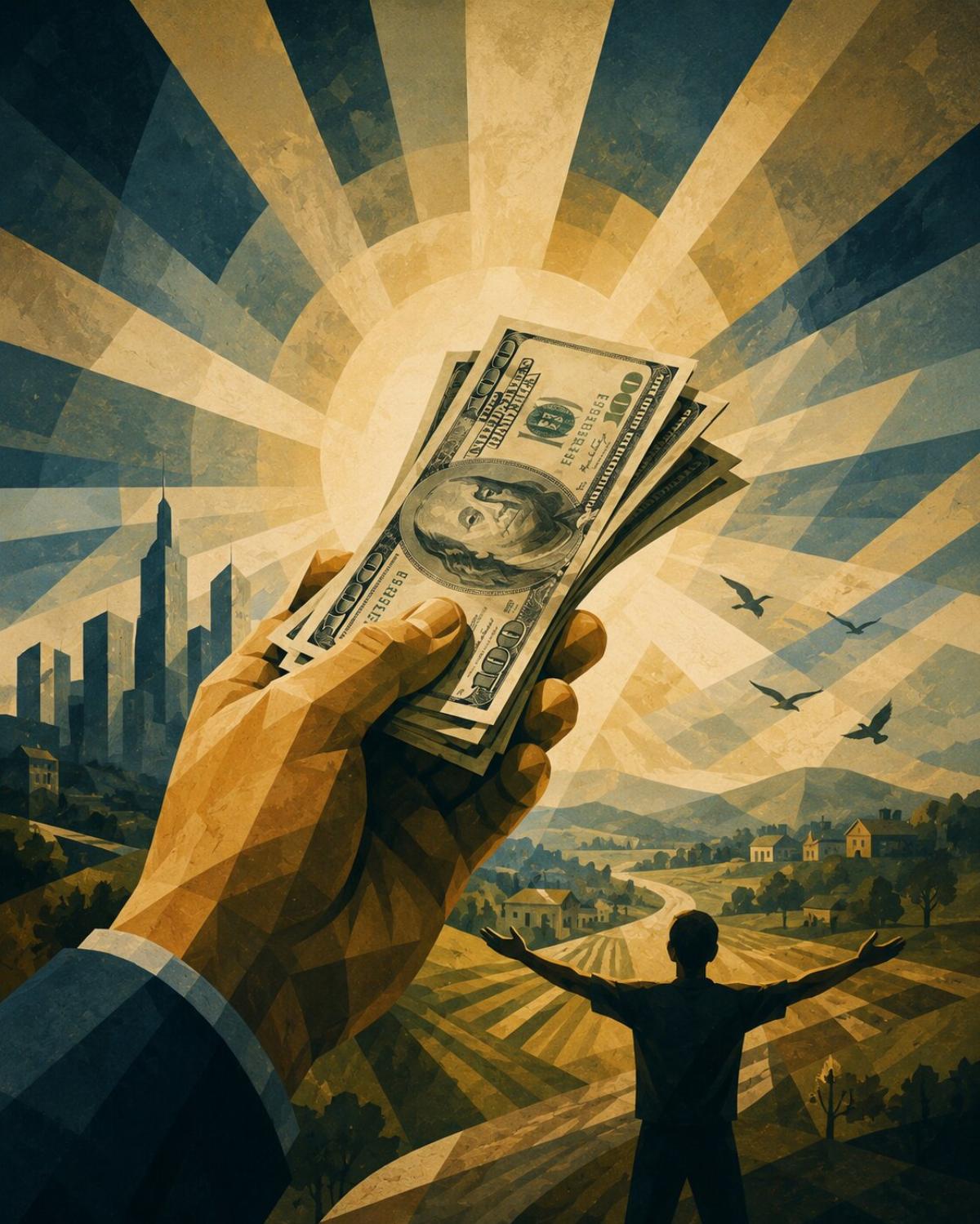
There is a certain kind of progress that always seems harmless right before it becomes mandatory.
Read more MAHA: Bobby Kennedy launches a great new food show
At first, it is merely more convenient to use a card. Then it is easier to tap a phone. Then the restaurant places a little sign near the register announcing that it no longer accepts cash. Before long, the ability to purchase a sandwich, medicine, gasoline, or a bus ticket depends upon having a bank account, an approved card, a charged phone, a functioning app, a stable internet connection, and the continued permission of several institutions that may not know you and certainly do not love you.
We are told this is modernization, but I call it surrendering freedom for convenience.
I am not against technology. I use electronic payments. Most Americans do. Digital banking, debit cards, payment apps, and direct deposit have made financial transactions faster and easier. But there is a difference between offering a convenient option and abolishing every alternative.
Cash is the only common form of payment that allows two people to conduct a lawful transaction without asking a third party for permission. It does not require a password, a corporate policy, a data connection, a credit score, or an algorithmic judgment. It simply works, and is precisely why cash still matters. Cash serves a function no digital system can fully replace—it is direct, immediate, and resilient.
And, perhaps most importantly, it leaves ordinary people with at least one area of economic life that is not automatically recorded, categorized, monetized, or subject to institutional veto.
Privacy is not the same thing as criminality.
A person should not have to explain why he bought a Bible, a political book, medication, dinner for someone, or any other lawful item. Every purchase may not be admirable, but it does not mean it’s criminal. Should every lawful purchase become a permanent data point controlled by banks, technology companies, payment processors, advertisers, and potentially the government?
Americans used to understand that a private life was not evidence of a secret crime but today, privacy itself is increasingly treated as suspicious. The person who says he does not want every transaction tracked is immediately asked what he is trying to hide. That question reverses the proper relationship between the citizen and the institutions serving him. Free people should not have to prove their innocence before being permitted a zone of ordinary privacy—cash creates that zone.
It is also a matter of economic access.
Millions of Americans remain unbanked or underbanked, particularly lower-income households, minorities, and many people living with disabilities. For them, cash is not nostalgic—it is necessary. Those people do not disappear because a coffee shop decides cash is inconvenient, but they do become excluded. An affluent customer sees a cashless sign and taps a watch. The poor customer sees the same sign and discovers that he can’t buy what he came to buy. Is this technological advancement, or economic discrimination dressed in minimalist branding?
Another major consideration is that the cashless movement also assumes an ideal world in which every system works all the time. But…
Read more An admiral is now leading the U.S. Army Europe and Africa command
Phones die.
Networks fail.
Accounts are frozen.
Cards are declined.
Passwords are forgotten.
Payment applications experience outages.
Cash does not need a software update.
That may sound simplistic until a hurricane, cyberattack, electrical outage, frozen account, or damaged phone turns simplicity into survival. When every form of money depends upon the same technological and institutional ecosystem, one failure can become total exclusion. A cash option is not hostility toward innovation, but it is a great measure of independence.
We often say we oppose concentrated power. Yet a fully cashless society would concentrate enormous practical authority in banks, payment networks, technology companies, and government regulators.
We defend the right to speak without permission, worship without permission, own property without permission, and travel without permission.
Why would we casually create a system in which buying food requires institutional permission?
Money is more than an accounting instrument. It is the mechanism through which a person converts labor into choices. Whoever controls access to those choices exercises tremendous power over him. Cash limits that power.
It allows a father to place twenty dollars in his son’s hand.
It allows a church member to help a struggling family quietly.
It allows a homeless man to buy a meal.
It allows someone escaping an abusive home to keep emergency funds outside an account another person controls.
It allows Americans to participate in economic life when technology fails or institutions reject them.
Cash may be old-fashioned, but freedom is old-fashioned too.
We should be careful about discarding either one.
A cashless society does not eliminate money. It transforms money from something a person possesses into something an institution permits him to access. Every citizen can become one accusation, one error, one outage, or one policy change away from economic paralysis.
Read more Canada: The Illusion Of Free Healthcare
Cash is not merely paper, but truly, a fundamental freedom.
Image generated by ChatGPT.