
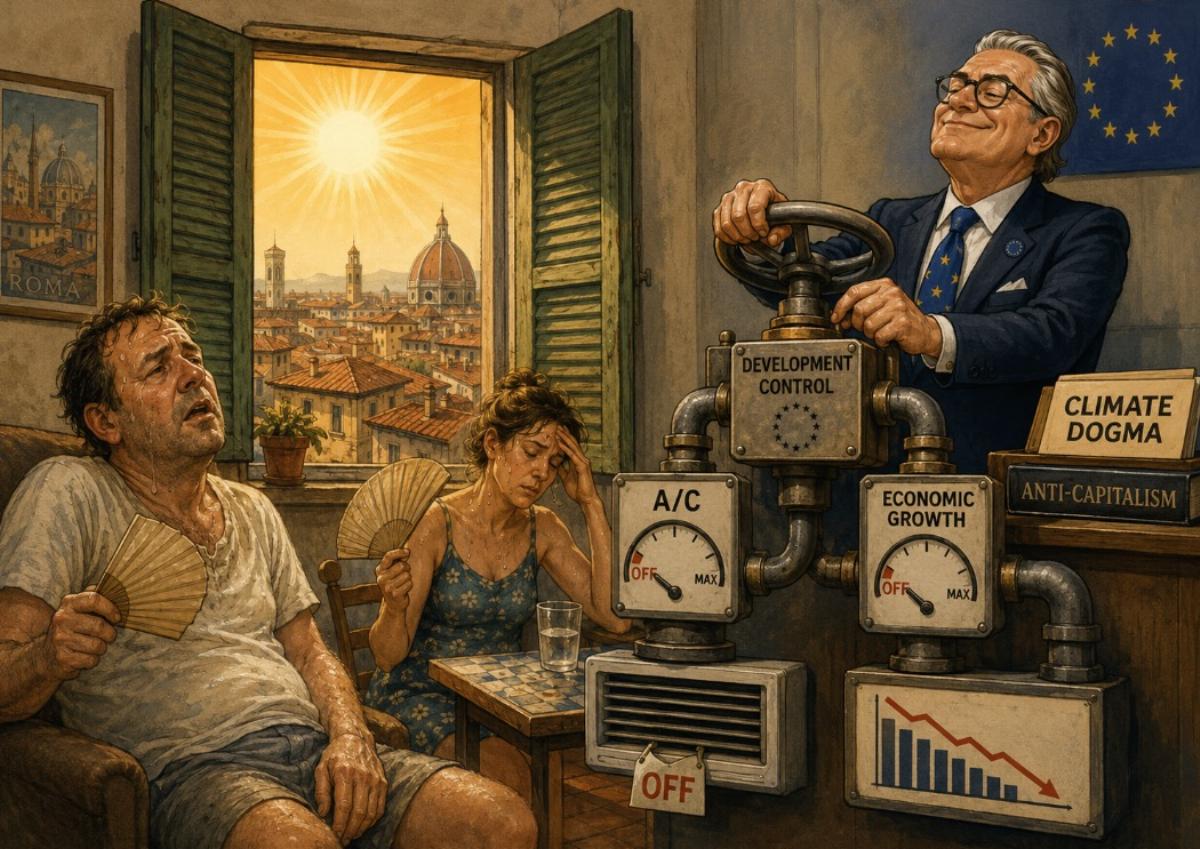
As the North American FIFA World Cup unfolded, many online videos posted on social media platforms featured Europeans overwhelmed by the wonders of American air-conditioning. Outside of a few especially temperate regions, almost every American household owns an A/C, doing homeowners a favor in periods of rising temperatures and extreme heat. In the meantime, most homes in Europe do not have air conditioning.
Read more Quantum Computing Is The Next Technological Horizon
Europe’s lack of A/C reflects how elites in Brussels have, over the past decade, increasingly prioritized climate alarmism, civilizational self-pity, and economic regulation over abundance, competitiveness, and technological progress. In other words, A/C—or the lack of it—symbolizes a continent with a governing philosophy that has shifted away from growth and prosperity.
While A/C doesn’t define the fate of civilizations, its absence in Europe is one of the clearest everyday examples of a broader political and economic philosophy that increasingly favors regulation over production, restraint over abundance, and adaptation to decline over renewed growth. It is through that broader lens that Europe’s current trajectory should be understood.
For some time now, the European Union has made the ‘net zero’ fantasy a core pillar of its economic policy strategy moving forward. That has led to decarbonization policies in the name of reducing CO2 emissions as well as phasing out nuclear power plants (which increases energy dependence on foreign suppliers such as Russia). Europe’s failure to produce its own energy led to exorbitant energy prices due to EU sanctions after Russia attacked Ukraine.
The same governing philosophy that has shaped Europe’s energy policies has also fostered a broader sense of civilizational self-guilt among the left-wing elites in Brussels. To that end, Europe’s leaders have embraced unfettered mass migration, repeatedly atoned for Europe’s colonial past, pushed those far-left environmental policies, and embraced a degrowth agenda manifesting itself through high taxation and overregulation of businesses and industries.
Such policies have made the EU economically dependent on China, and the cost of living has skyrocketed. In the meantime, Europe’s uncompetitive business environment is not conducive to innovation and job creation, undermining and American demands for European self-reliance on matters of security, further fueling a looming Russian threat on Europe’s and NATO’s eastern flank.
The European standard of living, once something to which America’s middle class aspired, has declined due to rising crime and overall urban transformation of cities, which is largely due to mass immigration from North African and Middle Eastern nations. It turns out that importing cultures with fundamentally different principles from yours damages your civilization and poses a threat to your social cohesion after all. Seen through that broader civilizational lens, a Europe filled with African markets, mosques, and Arabic-speaking ghettos is not the Europe we know, nor is it the Europe we are supposed to get used to.
The consequences extend beyond economics alone. They increasingly influence Europe’s strategic position within the West and its relationship with its closest ally, the United States.
Lastly, those same policy choices are increasingly producing geopolitical consequences. At a time of a right-wing surge in the old continent due to popular discontent with Brussels politics, the EU has found itself another critic: the current U.S. administration.
Read more The Strategic Blind Spot
Since January 2025, multiple members of the administration, including President Trump, Vice President JD Vance, and Secretary of State Marco Rubio, have emphasized the civilizational bonds between America and Europe, while reaffirming the need for Europe to preserve Western values and Western culture. In response to Europe’s refusal to move past its current modus operandi, the US has responded with tariffs against European goods and threatened a drastic reduction in American military presence in Europe.
At a time when Europe is vulnerable economically, militarily and diplomatically, there is an urgent need to make the necessary adaptations to retain its traditional ally, the United States, but instead the EU has gone out of its way to foster new relations with China, India and Turkey, breaking away from the decades-long transatlantic alliance with the United States. Europe’s diplomatic sleepwalking towards BRICS will trigger long-term consequences for Europe and its people.
The cumulative effect of these economic, cultural, and geopolitical trends also raises questions about the long-term sustainability of Europe’s broader social model.
Proponents of the European model, including the elites in Brussels and American Leftists, love to talk about Britain’s universal healthcare system, Germany’s tuition-free universities, Denmark’s paid family leave, and a bevy of other policies aimed at consumer and worker protection, strong social safety nets, better work-life balance, and reduced income inequality.
What they’re missing is that it is not sustainable to finance a welfare state with an uncompetitive economy, sluggish economic growth, and American taxpayer money bankrolling your national defense. If Europe can achieve the above with no American military backing, then good for them. If not, they should consider changing their current development trajectory.
Europe’s challenges do not begin or end with air conditioning. Rather, the continent’s relative lack of cooling during increasingly uncomfortable summers has become a visible reminder of a broader governing philosophy; one that increasingly asks citizens to accommodate scarcity instead of expanding the energy, technology, and economic growth necessary to overcome it.
Europe’s lack of air conditioning ought not to be interpreted as an occurrence unrelated to its current development model. The real story is a continent that has increasingly chosen regulation over innovation, managed scarcity over abundance, and ideological ambition over economic pragmatism. Rather than embracing the technological optimism and economic dynamism that once made Western civilization the envy of the world, much of Europe has grown comfortable asking its citizens to consume less, produce less, and expect less. That must change.
Read more Mamdani’s Finger-Pointing At Netanyahu Is Sheer Projection
Image created using AI.