
The newly declassified election records released by the White House, together with President Trump’s speech explaining their significance, should prompt Americans to reconsider what they have been told about the security of the nation’s elections. For years, those who raised questions about election integrity were dismissed as conspiracy theorists or assured that no evidence of serious vulnerabilities existed. These records directly challenge those assurances. Drawing on intelligence assessments, law enforcement records, investigative files, and government analyses, they document weaknesses throughout the election system — from electronic infrastructure and voter databases to poorly maintained voter rolls, foreign influence campaigns and hacking operations, and the institutions entrusted with safeguarding the process.
Read more Texas Highway 287 and the pro-life movement
The first collection focuses on vulnerabilities in electronic voting infrastructure. One intelligence assessment concludes that “U.S. adversaries, including at a minimum Russia, China, Iran, and North Korea, as well as non-state groups, have the capability to compromise U.S. election infrastructure.” Another warns that “centralized election-related data repositories, such as voter registration databases, pollbooks, and official election websites, are most vulnerable to exploitation.”
It is astonishing that banks continually strengthen cybersecurity protections to prevent money from disappearing, yet our country cannot apply the same vigilance to protecting its votes. A June 2026 document shows that bad actors can breach election machines, move through their systems, steal or manipulate election data, and depart without leaving readily detectable evidence of their intrusion.
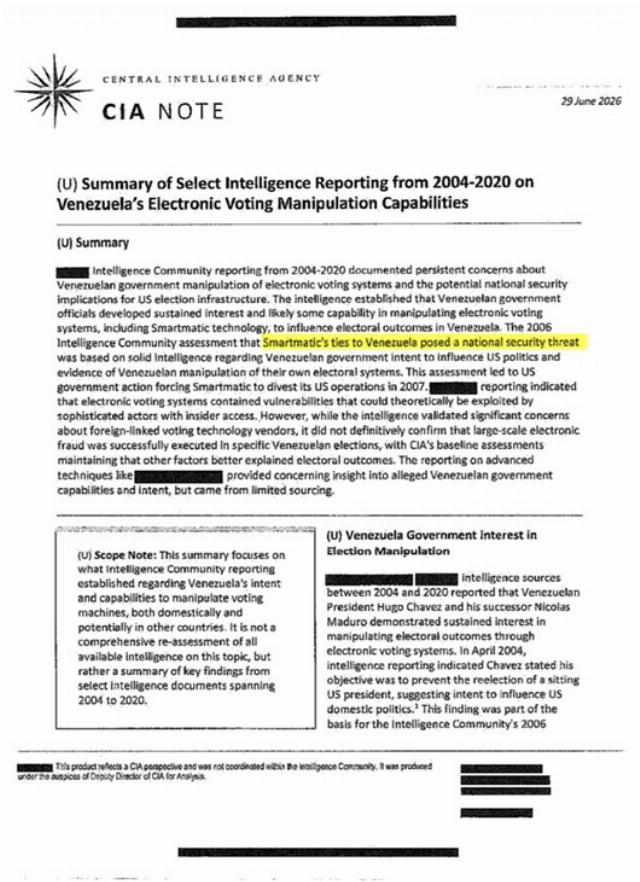
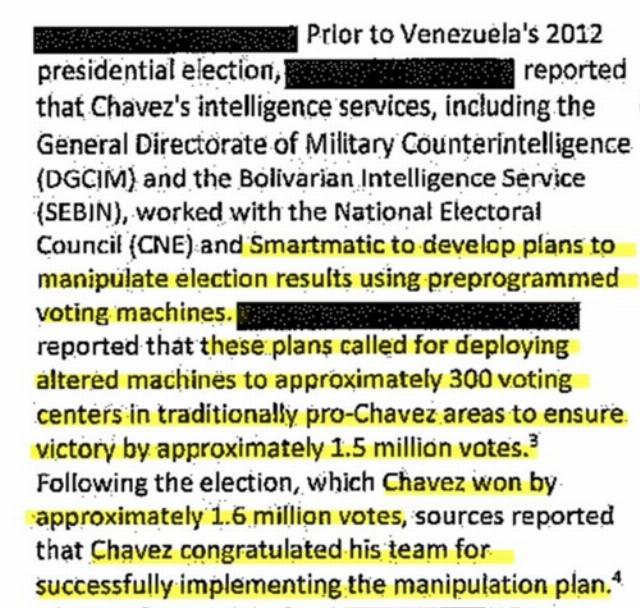
In one case, the documents describe a Venezuelan operation involving Smartmatic and Venezuela’s National Electoral Council, or CNE, between 2004 and 2020. The operation reportedly developed methods of manipulating vote totals while evading detection during audits. The plans “called for deploying altered machines to approximately 300 voting centers in traditionally pro-Chavez areas to ensure victory by approximately 1.5 million votes.” The same document states,
CIA analysts assessed in 2006 that certain capabilities [redacted] regarding electronic voting manipulation were technically possible and operationally feasible. Specifically, [redacted] that voting machines in Venezuela had unspecified artificial intelligence components installed, were designed to alter vote tallies, could detect when they were being audited, and could provide printed receipts without registering, recording, or transmitting those votes.
Informants in the Tina Peters case confirmed that some U.S. voting machines share the same architecture and software as systems used in Venezuela, suggesting that similar vulnerabilities could exist in the United States.
The most damning revelation in the first tranche of documents, however, may be the internal intelligence and FBI correspondence indicating that federal officials worked to keep significant national-security information about election threats and Chinese interference out of presidential briefings and away from Congress, reportedly for political reasons.
Nikki Floris wrote in one communication, “I’m basically running a shadow government across the FBI at this point.” She led the Washington Field Office’s Intelligence Division under Christopher Wray and routinely briefed him on election threats. Her statement takes on greater significance in light of records showing how politically sensitive election intelligence was controlled, recalled, delayed, or withheld within the bureau.

The second collection shifts the focus from voting machines to data. According to the White House, China obtained information on approximately 220 million American voters, including names, addresses, telephone numbers, party affiliations, and other voter information from at least 18 states, not all of which were identified by name. The jurisdictions identified in the released materials included Alaska, Arkansas, Colorado, Connecticut, the District of Columbia, Florida, Georgia, Iowa, Kansas, Maryland, Michigan, New York, North Carolina, Ohio, Oklahoma, and Rhode Island.
Once again, intelligence officials reportedly failed to communicate fully the scope of China’s acquisition of voter data to policymakers or the public. The White House release, together with records released by Senator Chuck Grassley, raises serious questions about whether politically sensitive intelligence was delayed, redirected, or suppressed.
through Grassley’s investigation concerned the alleged “Chinese Government production and export of fraudulent U.S. driver’s licenses to Chinese sympathizers in the United States in order to create tens of thousands of fraudulent mail-in votes for U.S. presidential candidate Joe Biden.”
Internal FBI communications reportedly characterized the source as highly credible. Yet emails released by Grassley show that FBI headquarters recalled the report within minutes of its dissemination. Internal correspondence warned that withdrawing it created the appearance that “one of the reasons we aren’t putting this out is for a political reason.”
Read more Against the left: A time for resolution
Grassley’s records indicate that senior headquarters officials, including Floris, directed the recall shortly after Wray testified before Congress that the FBI had not seen coordinated national voter fraud.
The third collection examines the Muskegon, Michigan voter registration investigation. According to the records, Michigan State Police investigated suspicious voter registration applications after canvassers allegedly admitted signing applications in other people’s names, fictitious individuals appeared on registration forms, and workers received gift cards tied to the number of registrations submitted. The FBI reportedly believed that crimes had occurred, yet the investigation never produced a comprehensive public accounting.
Fraudulent registration applications are not synonymous with fraudulent votes, but registration fraud is hardly insignificant. Registration is the gateway into the election system. False registrations compromise voter rolls, consume investigative resources, and create opportunities for abuse.
Just as troubling is the apparent inability — or unwillingness — of government institutions to explain how many fraudulent applications were submitted, how many entered official voter rolls, whether ballots were issued, and why such investigations so often fade from public view. State election boards are often inexplicably resistant to examining voter rolls and correcting known deficiencies.
The final collection addresses voter eligibility. According to the White House, a Department of Homeland Security review identified approximately 278,000 apparent noncitizens registered on state voter rolls. The actual number is likely higher because more than half the states declined to provide their voter registration records, leaving the review incomplete.
Further investigation can determine how many registrations involve database errors, subsequent naturalizations, or confirmed ineligible voters. Although the figure should not be automatically equated with illegal votes cast, public officials and the press should not use that distinction to insist there is nothing consequential to investigate.
Election officials cannot credibly insist that noncitizen voting is exceedingly rare while lacking comprehensive systems to verify citizenship and maintain accurate voter rolls. Nor can states withhold records needed for verification and then cite the absence of evidence as proof that no problem exists. Yet public officials, legacy media, and political operatives continue to resist reforms that would make elections demonstrably secure.
Debates over whether votes were manipulated, fraudulent ballots were introduced, or systems were hacked obscure the larger issue: The systems are vulnerable. Arguing over whether a particular vulnerability was exploited is like debating the size of a hole in a sinking ship. The essential fact is that the hole exists.
Any election system that depends on computer software is susceptible to error, intrusion, or manipulation. Proof that a vulnerability changed a specific result is not required to recognize the danger. Americans must be confident that every lawful vote was accurately recorded and counted. When voters cannot independently verify that process, the legitimacy of the outcome suffers.
Officials may talk about patching electronic voting systems, but the evidence points to a more fundamental problem: Such systems are simply too vulnerable to patch. The clearest remedy is a voter-verifiable paper system: physical ballots preserved under a secure chain of custody and available for counting, auditing, and recounting.
Read more Trump’s July 16 Speech: The Big Picture
Image via Pixabay, Pixabay License.