
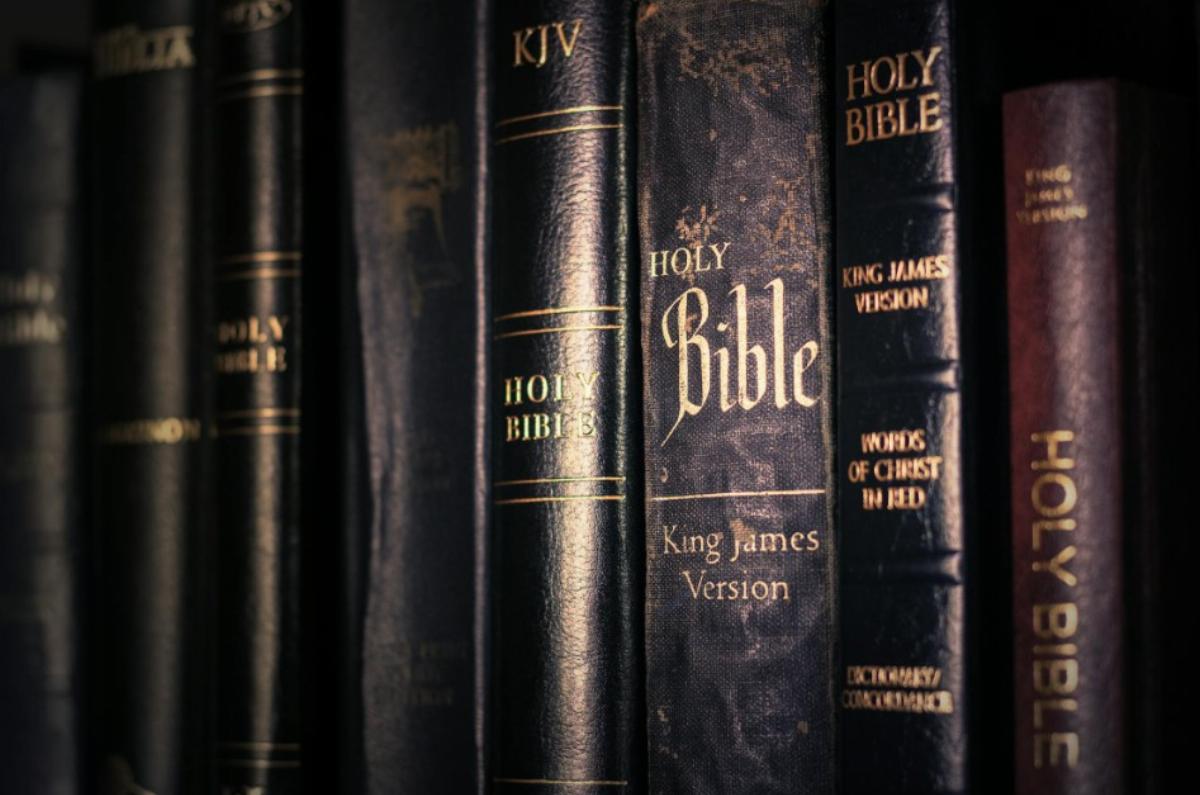
The woke virus that by now has pretty much claimed academia has even spread into the world of religion and Bible translation, wreaking havoc on original texts that have been a mainstay for believers and scholars for over a thousand years.
Read more Iran’s Warning Shot
The contamination of Bible translations has certain blatant earmarks and is easily detectable. Advocates for traditional translations say that if a new Bible text downplays the existence of Hell or judgment from God, you know that it has been modified. After all, we live in an age where all the deceased have “heavenly birthdays,” or become instant angels after death.
Nobody wants to talk about Hell.
Another red flag is downplaying the deity of Jesus Christ, or eliminating altogether the virgin birth.
Bill Muehlenberg, a scholarly evangelical pastor and writer of a blog called “Culture Watch,” calls this “twisted Scripture,” and says the writers of these translations are “revisionists who conflate description with prescription.”
Muehlenberg believes every effort should be made to ensure “that no contemporary political, ideological, social, cultural, or theological agenda is allowed to distort the original meaning of [scriptural] text.”
After all, why should ancient scripture be revised and recast as woke? “Agenda” is the word that comes to mind here. But this agenda is hardly new. As far back as 1895, 18 women on a serious feminist mission came together to work on and publish “The Woman’s Bible.” The driver behind the project was Elizabeth Cady Stanton (1815–1902), one of the leaders (along with Susan B. Anthony) of the women’s rights movement.
Stanton was also a Temperance crusader who believed that women had a right to divorce a drunken husband. She believed that marriage was merely a civil contract and had nothing to do with God or the supernatural. One might describe her religious beliefs as “free form Unitarian.” She maintained that men and women had the right and ability to determine religious truth for themselves.
The Woman’s Bible was an attack on religious orthodoxy and so-called “patriarchal privilege.” It was more of a political treatise/rant than a Bible. It was a Bible without a single consoling spiritual passage, but with plenty of political rhetoric to fire up the culturally disaffected.
The most beautifully translated Bible is the King James Version. Experts say that it has a text that resonates like poetry when read aloud, although some passages are difficult for contemporary readers to understand. Aldous Huxley said that the King James Version, “is written in the noblest and purest English, and abounds in exquisite beauties of mere literary form.” H. L. Mencken said the King James “is the most beautiful of all translations of the Bible; indeed, it is probably the most beautiful piece of writing in all the literature of the world.”
The Revised Standard Version of the Bible (RSV) is respected by scholars, although its translation errs on the liberal side of the Protestant spectrum. In Isaiah 7:14, in the RSV, for instance, we read that “…A young woman shall conceive a son and bear a son.” The missing link here is the replacement of woman for “virgin.”
Muehlenberg comments: “Also, contextually, one would have to wonder how a young woman being pregnant would be a miraculous sign. Young women are pregnant all the time.”
Feminist neutral language in Bible translations was really the beginning of the “woke wave,” and these translations have stirred up a considerable amount of controversy. Muehlenberg brings up a good point when he says that feminist neutral language is the very thing that creates confusion and the alteration of original texts. To illustrate his argument, he cites two major languages that offer no gender distinctions, Turkish and Chinese, and then goes on to evaluate the treatment of women in those countries.
“In fact, I think one would be hard-pressed to find two literate cultures in which women have historically been treated worse than that of the Turks and the Chinese—and I say that as one who otherwise loves Chinese culture, but the way women were (and to a large extent, still are) treated is not the high point of Chinese civilization.”
In the New Revised Standard Version (NRSV), the “Son of Man” when it refers to Christ is not used because it is deemed offensive!
Read more The God Of Process Controls American Elections
“Son of Man’ is offensive because it denotes two gender distinctions. In the NRSV, one can find inserted words not in the original text and omitted words from the original text that alter singular pronouns into plural. All of this is done to avoid the high secular sacrilege of using words with gender distinctions.
Fr. John Whiteford writes in “An Orthodox Look at English Translations of the Bible” that this sort of gibberish is nothing but political correctness gone amok.
In recent decades we have been confronted with the new phenomenon of political correctness, and this has resulted in new versions of the Bible that have attempted to neuter the English text to accommodate the concerns of radical feminists. This is silly for several reasons. For one, radical feminists are not likely to be happy with any translation of the Scriptures no matter how neutered the English in it might be….
Many different versions of the Bible exist. The “New World Translation,” for instance, is published by the Jehovah’s Witnesses. Critics have noted that this work was created by nameless “scholars” who have traded the Greek word “kyrios” (Lord) as Jehovah throughout the text, except when the narrative refers to Jesus Christ because Jehovah’s Witnesses do not believe in the Trinity or in the divinity of Christ. In the world of serious Biblical scholarship, the “New World Translation” does not have a position.
Growing up, my family had one copy of the Catholic Douay Rheims Version (DRV) with its traditional English and extra books (called Deuterocanonical books). The extra books were included in the ancient Latin Vulgate Bible and were, for the most part, accepted as sacred and canonical. The Protestant reformers rejected the extra books because, as one scholar has noted, “The teaching in them seemed to come from Roman doctrine.”
The seven extra books are Old Testament texts. Catholics, at least when I was a child, were not Bible readers. Hearing the Gospel and Epistle every Sunday at Mass seemed to be enough scripture for a lifetime. In our minds, the Bible came to be associated with Protestantism. Reading the Bible, especially being caught reading the Bible, came with a hefty price. You might be accused of being a Bible Thumper or a Bible Fanatic. The assumption then was that anyone who picked up a Bible and read it was a person of low intelligence.
In the summertime my hometown of Frazer hosted several big tent Summer Vacation Bible Schools, all of them sponsored by local Protestant and Mennonite churches.
No doubt we Catholics lost a lot by not learning to appreciate reading the Bible well beyond the self-contained world of the Gospel and Epistle readings we heard at Sunday Mass.
Not too long ago, I ordered a review copy of the RSV Bible with Catholic additions that came to be known as the “Ignatius Bible,” after Ignatius Press that publishes it. The Ignatius Bible is the favorite of real Catholic scholars and serious students of scripture. Over the years I’ve attempted to read other versions of the Bible with the intention of finishing the text but in every case, something was lost along the way.
Either boredom set in, or something about the flow of language failed to inspire my wanting to read more. Scott Hahn, Ph.D. Founder & President of the St. Paul Center for Biblical Theology said that “The RSV, Second Catholic Edition is the most beautiful English translation of the Bible today.”
I would have to agree.
For the first time in my life, I want to keep on reading. The language literally sails across the page. There are no awkward phrases; no words at war with other words, such as you get in the DRV. First published in 2006, the Ignatius Bible comes in several additions. The Large Print Edition (14-font) comes with thicker paper, creamy page coloring, footnotes and maps of the Holy Land. The Bible I have is the Ignatius Note-Taking and Journaling Bible. It’s small, 6.25 X 7.25, with a double-column text layout and a 7-point font. The font is horribly small, and I have to squint like James Joyce (in his thick glasses and bad eyesight) when reading it, but it’s been well worth it.
While ecumenism has been condemned by Christian traditionalists as an attempt to water down or compromise certain inflexible points of Catholic or Orthodox dogma, the Ignatius Bible, as the introduction notes, is really a merging of the RSV with “considerations of Catholic tradition [that] have favored a particular rendering or the inclusion of a passage omitted by the RSV translators.”
Having said all this, I must now ask myself: Have I unwittingly entered the Big Tent of the Bible thumpers?
Read more Observant Jews Want Obergefel Overturned
Image: Pexels.