
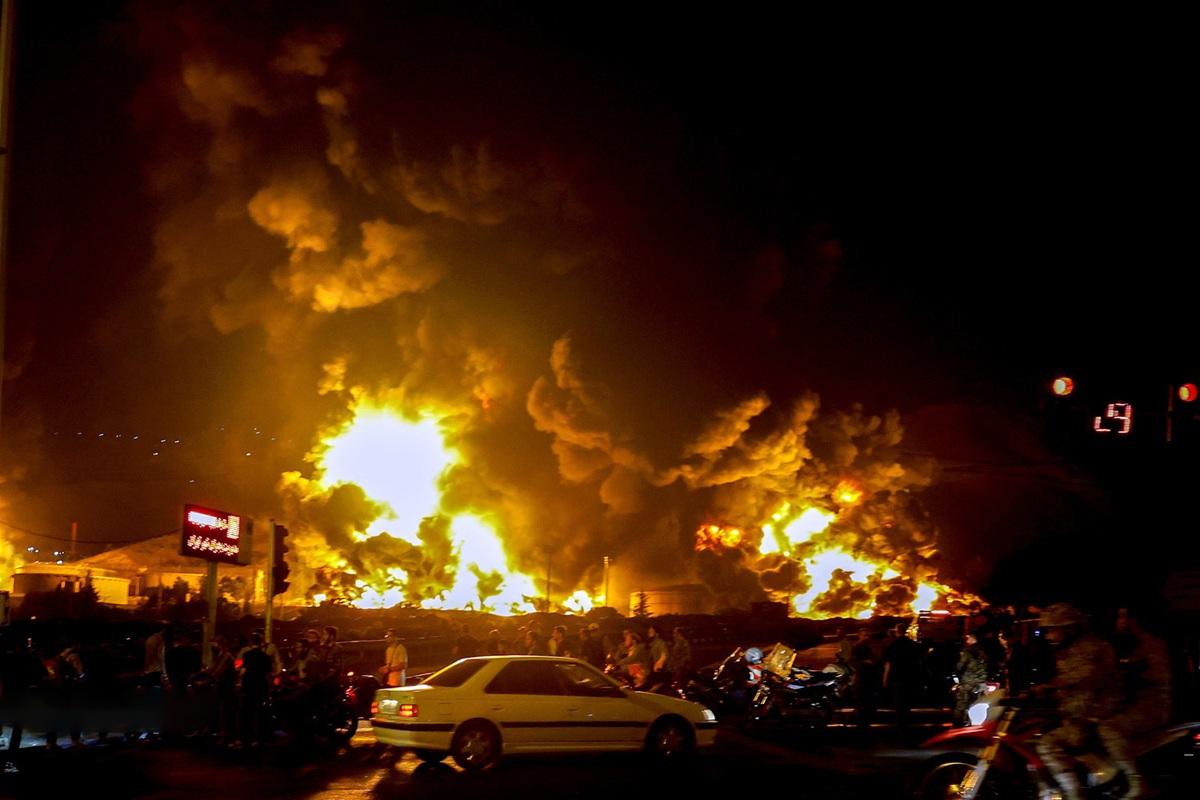
President Trump threatened on Wednesday to unleash the “bridges and power plants” campaign next week, if Iran didn’t cease attacks on shipping in the Strait of Hormuz and return to negotiations.
In response, an Iranian military spokesman said Iran would “crush” all remaining infrastructure in the region that has remained intact.
On Friday, Iran fired its warning shot, targeting a desalination plant in Kuwait.
Desalination plants range from small to enormous, and the big ones are easy targets for Iranian drones and missiles. Kuwait gets around 90% of its drinking water from desalination using reverse osmosis. Oman gets 86%, and Saudi Arabia gets around 70% of its water from similar plants.
Taking out those plants — even just a few of them — would have catastrophic human, economic, and political consequences. And the Iranians know it.
Iran is conducting a master class in asymmetrical warfare. We attack its military targets, it attacks commercial shipping in the Strait of Hormuz, driving up world energy prices. We hit infrastructure targets, it counters by hitting oil and gas fields and refineries in other Persian Gulf countries.
This used to be called “competitive strategies.” In the late 1990s, I took part in numerous executive-level presentations commissioned by the U.S. Army War College at the Department of Energy, the National Defense University, and elsewhere, on how the United States could leverage the Iranian regime’s weaknesses and use our strengths to undo the regime’s grip on power.
The big takeaway from those talks: the Iranian regime has a democracy deficit we can easily exploit. After all, we know quite a lot about the war of ideas.
But instead of hitting them where it really hurts — by empowering the Iranian people to overthrow the regime — we are fighting the “old” war.
Whether it’s missile launchers, drone factories, or bridges and power plants, we are blowing stuff up. And that’s fine. But we should also be doing the harder piece, which is working with the Iranian pro-democracy forces to empower them to overthrow the regime.
Long before this war began, I proposed that President Trump should begin his second term by appointing a “Special Ambassador to the People of Iran,” whose task would be to demonstrate to the 57 flavors of Iran’s pro-democracy movement that they have a friend in Washington who is willing to commit to their success.
I have also briefed government officials in Israel and the United States about my “green orchestra” theory about how the revolution can travel from Iran’s Sunni peripheries toward the center, overwhelming the IRGC and their basiji militia thugs.
But so far, we are still just negotiating with bombs.
Iran’s top negotiator, Parliament speaker Mohammad Baqr Qalibaf, said this week that Iran was engaged “in an essential and existential war with America.”
This is the man President Trump seems to think is the reasonable voice at the table.
He forgets that Qalibaf is also a former Revolutionary Guards general, chief of the IRGC Air Force, and the man who personally flew the helicopter bringing Saad bin Laden and Ahmad al-Zawahri to Tehran in May 2001 to negotiate the fine details of Iran’s cooperation with al Qaeda’s 9/11 plot. (You can find that story in my 2005 book, Countdown to Crisis: the Coming Nuclear Showdown with Iran).
I don’t see any way to end this war without totally crushing the regime. And given the aversion of the JD Vance crew in the White House to any hint of “regime change,” my guess is we will just count on a hope and a prayer for what comes after that obliteration.
Speaking of JD Vance, he made a major blunder this week in my view by appearing on a three-hour talk show with Joe Rogan. Here is a sitting vice-president, a man you would think has access to actual information and information, spouting conspiracy theories about Jeffrey Epstein’s ties to CIA and Mossad.
Either he knows, or he doesn’t know. But he shouldn’t be going on a three-hour show in the middle of a war to air his “thoughts” and “suspicions” with the American people.
And all of that happened while the President was presenting real documents and real information to the public on Thursday about China’s interference in the 2020 election. That’s how you present your “thoughts” and “suspicions” if you are in power: with documents and information.
Sorry, JD, you lost me on that one.
Read more Observant Jews Want Obergefel Overturned
A Nobel Peace Prize nominee in 2006, Timmerman is the author of The Iran House: Tales of Revolution, Persecution, War, and Intrigue, and thirteen other books of non-fiction. He is a senior fellow at the America First Policy Institute. His website is kentimmerman.com
Read more Violence in Canada, believe it or not
Image: Avash Media