
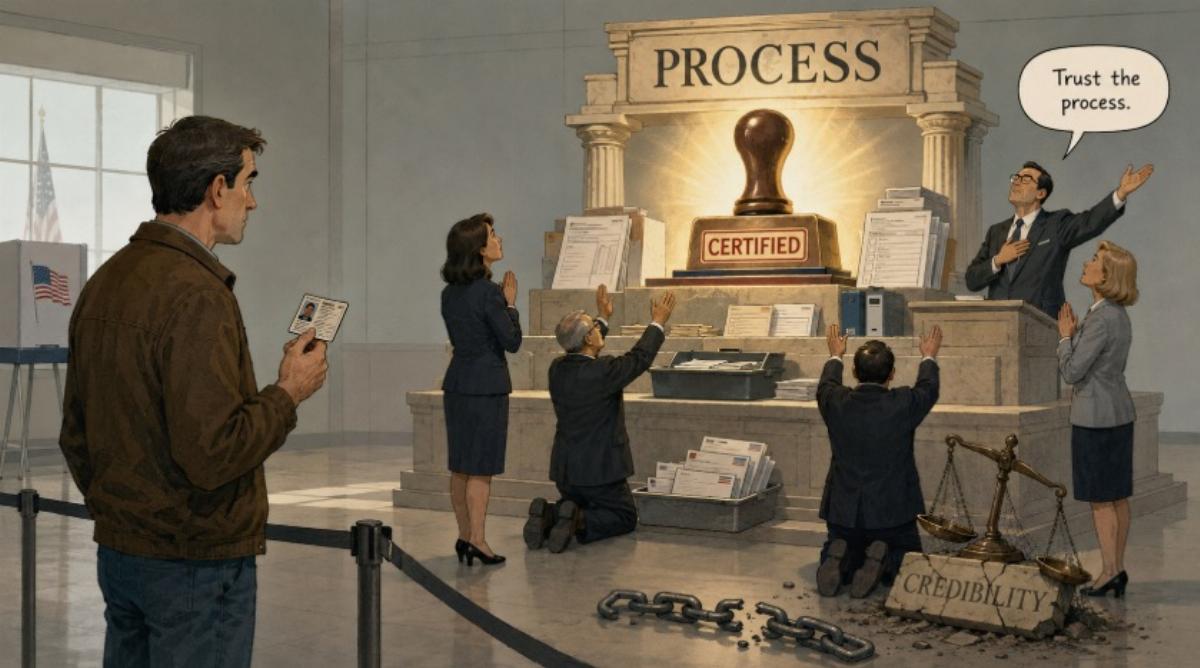
The American election system treats the credibility of the result as an irrelevant criterion. This is embedded in the design philosophy that governs how ballots are accepted, verified, counted, and certified. The premise is that the right to vote must be protected above all else (the false god) and that any barrier to participation is profoundly unacceptable.
Read more Observant Jews Want Obergefel Overturned
Noble sounding? In fact, it is not.
The core problem is that the system is biased toward inclusion. It is designed to accept ballots unless there is clear and undeniable evidence that they are invalid.
Signature verification is treated as a loose, forgiving process. Chain of custody is assumed rather than proven. Mail-in ballots are authenticated through low-information signals that cannot meet the accuracy requirements of razor-thin margins.
What we have today is the reverse of a confidence-based system.
In a confidence-based system, the voter can appear in person, present identification, deposit his ballot directly, and observe that the number of ballots reported cannot exceed the number of people who entered the polling place. Chain of custody would be direct and observable. The voter would be part of the system’s credibility rather than a spectator to it.
But in our present-day, inclusion-biased system, credibility is not something the voter can influence. It is not even something the system tries to measure. To the system and its devotees, measuring credibility is anathema.
Indeed, our present system has elevated the process itself into a hidden object of reverence. The rituals of counting, tabulating, and certifying have taken on a symbolic authority that exceeds their actual epistemic value. The system demands that these rituals be treated as unquestionable, even though they cannot and do not even try to guarantee that the result is believable.
In this sense, the process becomes a false god: something that must be honored, obeyed, and defended even when its foundations are fragile. No one openly acknowledges the transformation, but it governs how officials speak, how objections are dismissed, and how the public is instructed to accept outcomes without regard to whether the underlying mechanisms can be credibly established.
The system has thereby drifted away from its constitutional purpose, replacing the pursuit of a trustworthy result with the worship of purported procedural completion.
This elevation of process over credibility explains why the simple expression of doubt is treated as heresy.
The system responds not with analysis, but with moral pressure: accusations of undermining democracy, attacking the right to vote, or spreading suspicion. These reactions are not grounded in the facts of election administration; they are grounded in the need to protect the authority of the hidden god.
The irony is that the modern system demands trust in the process even when the result cannot be verified.
This leads to a deeper structural issue: certification has become a ministerial act. The official should exercise judgment, weigh evidence, evaluate credibility, and consider uncertainty, but does not. He simply checks whether the required forms have been submitted, the deadlines have been met, and the totals reported.
In an inclusion-biased system, it cannot be otherwise, because the system is designed to accept ballots even when their credibility cannot be established.
This creates a trap for anyone who wishes to object. The only legally recognized basis for challenge is proven fraud. Suspicion, uncertainty, lack of believability, razor-thin margins, structural weaknesses, and mathematical impossibilities are all declared irrelevant. The only legally recognized basis for challenge is proven fraud.
But fraud cannot be proven without investigation, investigation cannot occur without time, and time does not exist before certification or the January 6 deadline.
It is unsettling to consider how invisible this structural bias is. The assumptions are so deeply embedded that almost no one notices them. The reverence for process, the irrelevance of credibility as a criterion, and the treatment of certification as ritual—all have become part of a civic religion.
Read more Violence in Canada, believe it or not
To name the idol feels almost transgressive. Yet, once the structure is seen clearly, it becomes impossible to unsee. The system’s weaknesses are not mysterious, nor are they necessarily partisan.
The contradictions are plain. The voter is told that his ballot is sacred, but not that the credibility of the result is irrelevant. He is told that certification is final, even when the facts surrounding the election are so irregular as to make the outcome unworthy of belief. He is told that objections must be based on proven fraud, but not that the deadlines make such proof impossible.
Legislatures have the constitutional authority to address the problem, but they rarely exercise it. Under Article II, state legislatures determine the manner of appointing presidential electors. Secretaries of state and election boards exist only because legislatures have delegated those functions. Legislatures are the principals; secretaries are the delegates.
Over time, however, legislatures have forgotten their role. They have ceded operational control to executive-branch officials and now hesitate to reclaim it. They fear offending the hidden gods.
Legislatures should evaluate the credibility of every election result, and they have a special duty to do so when the margin is extremely close, as it was in Georgia in 2020, which was decided by a quarter of one percent. In such cases, they should reclaim their constitutional authority and, if necessary, appoint the state’s electors by their own legislative vote—a step that is historically grounded and constitutionally permissible.
A legislative vote has a perfect chain of custody, eliminates the uncertainties of signature verification, mail handling, and adjudication, and removes the need for investigation under impossible deadlines. This is not a license to override results arbitrarily; it is the proper exercise of legislative responsibility when the ordinary system cannot produce an outcome worthy of belief.
A system in which trustworthiness is an alien concept cannot and should not be trusted.
Contrary to the usual rhetoric, a credibility-based system is no less fair. It is fairer because any voter can meet the requirements that make his vote count: obtain identification, vote in person, and participate in a process whose chain of custody is observable and whose outcome is verifiable.
Nothing in such a system prevents a voter from voting; it simply requires that the vote be cast in a manner that contributes to the believability of the result.
The voter deserves a system that produces results worthy of belief—one that treats credibility as a central value rather than an afterthought and that measures fairness by the trustworthiness of the final tally, not solely by the ease of casting a ballot.
The current system does not meet that standard. It is structurally incapable of producing results worthy of belief whenever the margin falls inside its own uncertainties. Once that is seen clearly, the path forward is not mysterious.
Restore credibility as the central design criterion. Return to legislatures the constitutional authority they have allowed to atrophy. Design a process in which the ordinary voter can again contribute to the legitimacy of the outcome rather than remaining a passive subject of an unexamined ritual.
Until those changes are made, the system will continue to demand trust it has not earned.
Image created using AI.
Tadas Klimas, the author of several books, is a former U.S. intelligence officer who was awarded the National Intelligence Medal of Achievement (NIMA). He was also a law professor and, at one time, was chief legal counsel to Vytautas Landsbergis, the Speaker of the Lithuanian Parliament and the first chief of state of the Republic of Lithuania.
Read more It’s harder to get endless pasta at Olive Garden than to vote in 26 states