
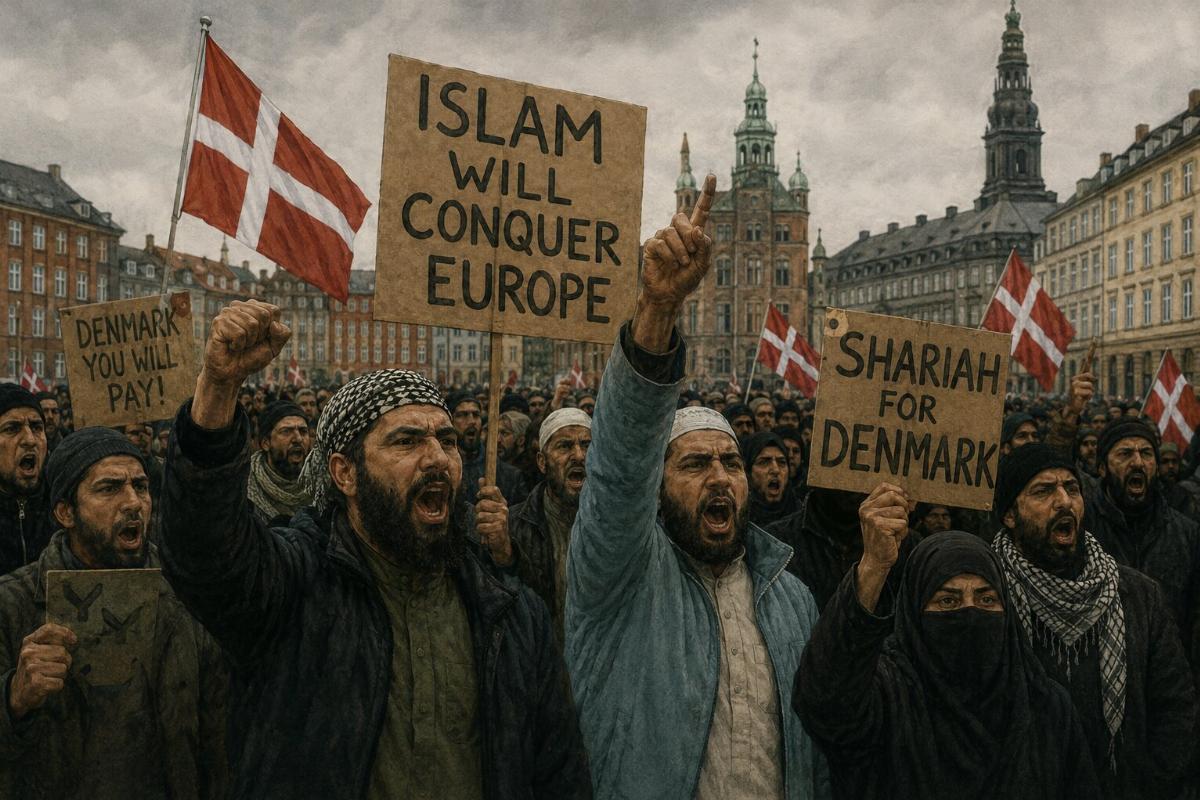
Hollywood used a misquote from an aborted 1975 moon landing—“Houston, we have a problem”—to make the movie “Apollo 13,” and in doing so, it became memorialized; the movie demonstrated NASA’s success in using teamwork to solve an issue that could have devastated the mission. It is an approach Denmark’s politicians adopted to tackle their own problem.
Read more Communism Hasn’t Been Done Right. (Yeah, That’s The Ticket.)
In 2018, Danish leaders had an “aha” moment, recognizing a major issue. In Apollo 13, the astronauts and NASA operated as a team from the outset; however, it would take a few years for the Danes to be able to mirror that dynamic on a political level to solve the issue about to devastate their own mission.
The problem Denmark faced was only recognized after its leaders analyzed what immigration data were telling them. A podcast by Dr. Steve Turley does an outstanding job of highlighting both Denmark’s problem and its solution.
Denmark opened its borders only to later discover that Muslim immigrants were taking advantage of that open door. By 2018, data revealed Muslims making up 14% of the country’s population accounted for over 30% of its violent crimes. Of interest too was that the conviction rate for Danish citizens was only twelve out of every one thousand while the conviction rate for Somalis alone was 114 per 1,000.
Additionally, non-Western immigrants and their children were costing the Danish government $4.2 billion annually. Shockingly, the data showed that Danish was no longer the primary language spoken on the street; Shariah-compliant social norms were enforced by Muslim communities; women leaving their homes unveiled were harassed; young men questioning the Islamic faith were threatened; Muslim school children told their infidel schoolmates their country, culture, and civilization was inferior; etc.
Turley explains “these were not parallel societies in the sense of harmless cultural diversity” but “enclaves operating under a different legal and moral framework than the Danish constitution.” Muslim immigration was creating “a state within a state.” The assumption Muslim immigrants would assimilate as other immigrants had done in Denmark was not playing out.
What the Danes did at this point to prevent the collapse of their own culture and identity did not go over well with the European Union (EU). However, Copenhagen recognized its survival depended upon appropriate action being taken. While Denmark’s response would undoubtedly fall afoul of our own constitution, Copenhagen sought to fight fire with fire in snuffing as much oxygen out of the Muslim flame as possible.
Its response included banning the burqa and niqab and imposing financial penalties that increased in amount for violations. Despite EU cries of Islamophobia, Denmark would not back down. It created “ghetto laws”—establishing designated neighborhoods that fell under special legal rules in an effort to curb criminal activity. Crimes committed in such areas imposed double the punishment compared to a crime committed elsewhere.
Denmark also acted to educate children in these designated ghetto areas concerning Western society. It mandated they attend at least 25 hours weekly at state daycare centers. There they learned Danish values, Christmas traditions, democratic norms, gender equality, etc. Parents refusing to comply lost their welfare benefits.
Unsurprisingly, the above was ruled discriminatory by the EU’s Court of Justice—but not even that deterred Denmark. However, what was happened next in Denmark was a big surprise—the anti-Muslim immigrant campaign championed by the right took on new leadership by the country’s left-wing government embracing it. In fact, the left-wingers went on to expand the campaign, imposing sanctions against anyone—scholars, imams, clerics, etc.—whose religious teachings crossed the line by feeding political enforcement of a foreign ideology.
The adoption of an immigration policy originally promoted by Denmark’s right-wing has had an unexpected national impact on politics. The leftists have now won three consecutive elections. Meanwhile, the right-wing party, once boasting a 21% membership, teeters at 4.4%. As the once-open borders leftist party leaders came to see the light, voters supported them for doing so. An important aspect of the left’s realignment has been recognizing its continuation of a welfare state catering to Danish residents is dependent upon not overwhelming it with Muslims.
Read more Republican Party of Florida bends (or breaks?) its own rules to ice out James Fishback
The immigration impact in Denmark has been amazing. While asylum applications peaked in 2016 at 21,000, in 2025 they dropped to less than 1,000. As Turley simply explains, “as far as the left is concerned, Denmark can have open borders or Denmark can have a welfare state but…can’t have both.”
Germany may be giving thought to implementing Denmark’s model. A migration wave hit the country in 2015 and, as in Denmark, a review of criminal data is most revealing. In 2025, foreigners made up 53% of all gang rape suspects while only representing about 14% of the population. The most dominant criminals were Syrians, Afghans, Iraqis and Turks.
Syrian criminality exploded 30-fold between 2013–2025 in Germany; shockingly too, among Syrians, was a nearly 70-fold increase in the number of female victims under 18. A telling fact as well is that 72% of all gang rape suspects were known to police before committing the offense in question.
Gang rapes were a rare German phenomenon before it opened its borders; now, however, such rapes average at least two per day. Meanwhile, 80% of all victims of crimes committed by foreigners have been German citizens—the majority of whom have been women and children.
Unless Europe as a whole starts to recognize the severity of the Muslim immigration problem and take constructive action, it may be that Copenhagen’s actions, ironically, have only delayed the inevitable for the Danes. Continuing an endless immigration flow into Europe means the decades ahead will witness the problems Denmark faced evolving across Europe, leaving Denmark surrounded by Muslim immigrants seeking to tear down the border walls Copenhagen has erected.
Denmark perceived its inaction and open borders would eventually lead to its collapse, a fate guaranteed by a Muslim immigration population refusing to assimilate. Fortunately, a wakeup call was heard by Denmark’s left which then acted to help stop the runaway immigration, giving priority to the country over politics.
It is doubtful the U.S. would constitutionally be able to use Denmark’s model to address its own situation. But a critical first step is for America’s left to recognize, politics be damned, embracing the Danes’ awakening experience.
From 1948–1976, “Pogo” was a daily comic strip that ran in many newspapers. It was popular for its social and political satire, as reflected in one episode involving an observation made between characters as the boat they were in was taking on water. Failing to grasp the reality that both characters were about to share a common fate, one says to the other “your end” of the boat is sinking.
Unfortunately, it is human nature when a problem gradually manifests itself to either ignore it or isolate it as someone else’s problem. On the issue of open borders and massive immigration, leftist America fails to grasp reality by ignoring it. It was funny when the Pogo character failed to recognize it; it is not when leftist America fails to do so.
A politically unified Denmark no longer has a problem; a politically divided America needs to recognize it most certainly does.
Read more One of America’s top medical schools sinks into the woke abyss
Image generated by ChatGPT.