
From 1901 to 1910, legal immigration to the United States was so great—about 8.8 million people, almost all of whom were Eastern or Southern Europeans—that this influx equaled roughly 10.4% of the American population. Ironically, it was the Progressives of that era, the ones who gave birth to the idea of eugenics that so inspired Hitler, who were deeply worried about the tainting of America’s fine Anglo-Saxon bloodline.
Read more The 1619 Project’s Nikole Hannah-Jones: America’s very existence is a ‘crime’
Still, in a pre-computer age with a continuously expanding nation, America needed bodies for farms and factories, and so these immigrants were processed, at Ellis Island on the East Coast and Angel Island on the West Coast, for contagious diseases and anti-American ideas. If they passed, they were in.
The question, then, was how to assimilate all these new people. Today, of course, “assimilation” is a dirty word because, to the anti-assimilationists, America is a bad and dirty country. Sadly, because leftists slowly but steadily conquered America’s education system, from K through graduate school, anti-American ideas control education.
However, the opposite was true during the big immigration push more than a century ago. Assimilation was the name of the game, with the goal of turning new immigrants into people who loved the country that gave them freedom and at least the hope of leaving behind the grinding poverty of their old countries.
Americans weren’t stupid, and they knew, as Lenin knew, that the best thing to do is to catch ‘em while they’re young. To that end, America’s education bent its will to teaching all children, whether born here or immigrants, about America’s values and why America was a special and precious place.
An easy way to see this in action is to review school “readers” from that era. Readers were targeted at grade levels from just-learning-how-to-read to high school and were primarily intended to improve students’ reading, writing, and (especially) elocution skills.
However, at every level, the essays chosen weren’t there solely for their literary quality. Instead, they were intended to give American children a shared moral, civic, literary, and historical canon that bound them together in values and patriotism. Importantly, they were not the sole lessons in history and civics. They were adjuncts. If students were going to memorize and recite essays, they should simultaneously have reinforced their higher moral and civic values.
Here’s just a sampling of what you might find in an old child’s reader, beginning in the 1880s, when mass immigration really began, through 1920, when it was slowing, and schools had the tail end of the great bulk of new immigrants. Try to imagine any of this being taught in today’s classrooms, whether public or private, or from kindergarten to graduate school.
While early readers were concerned with chickadees, bunnies, and helping mommy (kind of like the Dick and Jane books I still learned with), the readers for older children, especially in the later years, focused intensely on American history and values. This was open assimilation and universes away from modern education.
(Note: A reader’s number—“First” “Fourth,” etc.—doesn’t correspond to modern grade levels. Instead, the readers spanned roughly two-to-four-year periods: Primer and First were for K-1, Second was 2-3, Third was 4-5, and Sixth covered a four-year high school.)
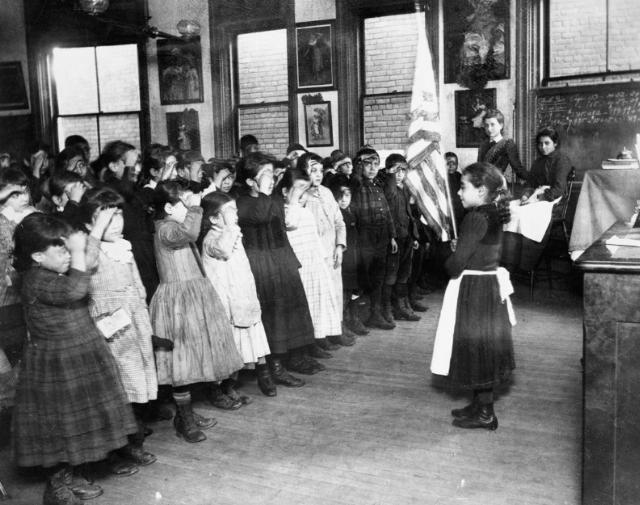
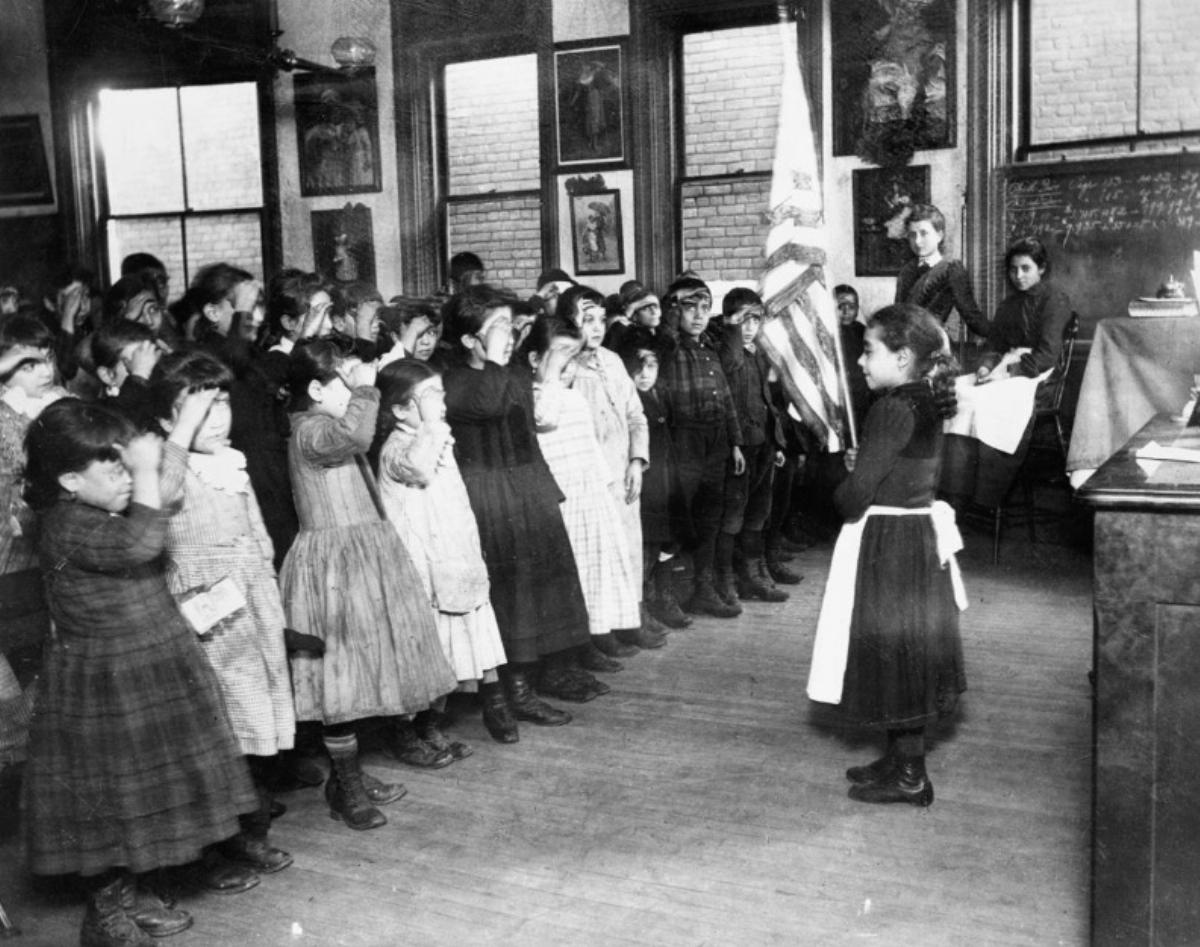
Immigrant children in New York City saluting the flag, circa 1890.
Cyr’s Fourth Reader (© 1898, 1899)
In addition to passages from famed writers such as Nathaniel Hawthorne, Charles Dickens, Alfred Tennyson, George Eliot, Thackeray (writing about Pocahontas), etc., the reader has A Welcome to Lafayette, The National Flag (ours, of course), Lincoln’s Gettysburg Address, and Washington’s Address to His Troops.
McGuffey’s Fifth Eclectic Reader (Revised) (© 1879, 1896, 1907, 1920)
This book establishes that American public schools firmly sought to mold children’s character: love of God, country, and family was intertwined with a manifest duty to convert that love into service.
Read more Tucker, you’re no Jesse Ventura
The contents included such historical, moral, and patriotic essays as Respect for the Sabbath Rewarded, The Battle of Blenheim, King Charles II and William Penn, The Righteous Never Forsaken, The Relief of Lucknow, The Goodness of God, The Hour of Prayer, The Blue and the Gray, Make Way for Liberty, How Sleep the Brave, Supposed Speech of John Adams, No Excellence Without Labor, The Boston Massacre, Sowing and Reaping, Religion the only Basis of Society, The Character of a Happy Life, and The Bible the Best of Classics.
The Elson Readers: Book Five (© 1920)
This reader has an entire section dedicated to “Our Country and Its Flag.” The essays are The Land of Liberty, The Flag of Our Country, The Name of Old Glory, The Star-Spangled Banner, The Boyhood of Lincoln, and Washington with Braddock. In another part of the reader, students are exposed to Benjamin Franklin’s writings,
One whole section emphasizes service to others rather than our modern obsession with self-fulfillment and self-esteem. In those days, service to others was seen as a pathway to truly virtuous self-fulfillment and self-esteem.
The Elson Readers: Book Six (© 1920)
The preface to this one explains that, among other things, a good reader must include “patriotic literature, rich in ideals of home and country, loyalty and service, thrift, cooperation and citizenship—ideals of which American children gained a new conception during the World War, and which the school reading should perpetuate…”
In pursuit of these ideals, students would read One County, America, The Boston Tea Party, Hail, Columbia, The Flag, Washington and the American Army, as well as Stanzas on Freedom, Our Noble Defenders, True Citizens, and Go Forth to Serve.
The Elson Readers: Book Seven (© 1921-1925)
By this level, students read an entire section titled “Our Inheritance of Freedom.” In “Stories and Songs of Liberty,” they read about Leonidas, the Spartan (“come and take it”), Robert the Bruce, England and America in 1782, The Stamp Act, Warren’s Address at Bunker Hill, Liberty or Death, Washington’s Letters to His Wife and to Governor Clinton, Song of Marion’s Men, and Times that Try Men’s Souls.
They also learned about Early America, American Scenes and Legends, amusing American stories (e.g., Mark Twain), American Workers, and “Love of Country.” That last included essays that every American once knew: Old Ironsides, The American Flag, The Flag Goes By, The Flower of Liberty, Citizenship, The Character of Washington, The Twenty-Second of February, Abraham Lincoln, O Captain! My Captain!, and America’s Answer.
Long lists get tedious, so I’ll stop here. Suffice to say that, if you take a stroll down the memory lane of your great-grandparents, you will discover that their education tackled mass immigration by inculcating all children, whether American-born or not, with love for America and the Biblical tradition that underpins America’s approach to liberty and morality.
Today’s mass immigration would be less of a problem if our schools were still teaching that our country is a unique testament to individual liberty, faith, hard work, and service. If that were the case, we wouldn’t tolerate people like Zohran Mamdani, a recent immigrant who hates this country and who sits at Washington’s desk while he spouts that hatred, all while surrounded by glum new citizens (at least 20% of whom are Muslims) who are clearly just longing to tear it all down:
NYC Mayor Mamdani on American exceptionalism: “We are told that America is exceptional because we are richer, stronger, more powerful than everyone else… The truth, my friends is that America is exceptional because here, nothing is fixed into place.” pic.twitter.com/FAiPfcPvB3
Read more In praise of Old Glory
— CSPAN (@cspan) July 3, 2026