
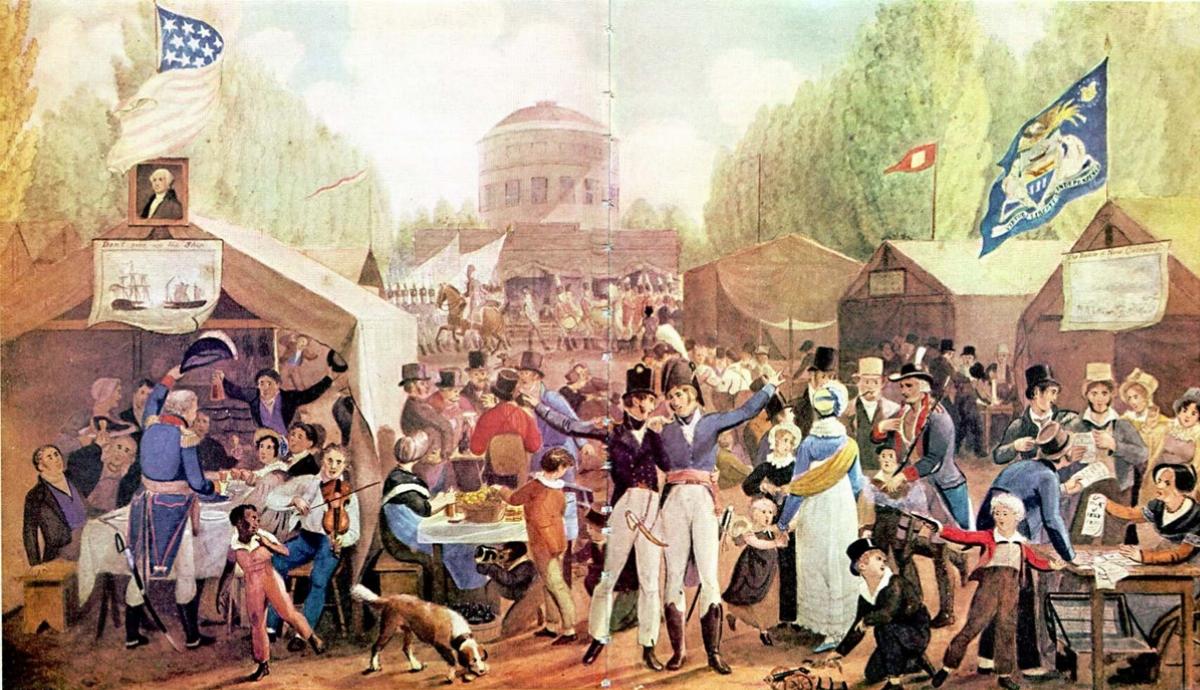
This July 4th will be the biggest celebration since the bicentennial. The stars and stripes will be raised, patriotic music will fill the airways, grills will ignite all over America, and endless fireworks will block out the stars till late at night.
Read more America at 250: Will our Founding Ideals Survive?
Were Independence Day celebrations always so bright and noisy? Pretty much.
The 1787 Constitutional Convention formed a new system of government in the same room where the Declaration of Independence was signed. On July 4th, the delegates took a break from their deliberations to celebrate the 11th anniversary of the historic signing. If you were there, this is what you would have seen.
Philadelphia, as the birthplace of the Declaration of Independence, took pride in holding the rowdiest Fourth of July gala in the nation. Festivities went on from dawn until deep into the night. The city echoed with public celebrations, ringing bells, and martial music. Every church would conduct special devotionals, and all 117 taverns would compete for revelers with loud entertainment.
Formal celebrations started at daybreak, centered in the city Commons in front of the State House. One after another, city officials, aspiring orators, and preachers made the customary thirteen toasts. The city had distributed kegs of free grog at each corner of the Commons, and, despite the early hour, toasts had already made the crowd boisterous. Those experienced enough to bring their own tankards threw down swallow after swallow of the watered-down rum.
Cannon fire hurt partyers’ ears and teared their eyes as concussions pounded the air. Sulfur and a rotten egg odor scratched their throats. After the thirteen reports ended, the audience could finally draw a grateful and tranquil breath. But for only a moment. The artillery brigade soon started another round. Three consecutive resounding salutes of thirteen cannon shots. It felt exhausting, with the only relief being another swallow of grog.
The Society of the Cincinnati, the City Cavalry, the Light Infantry, and a battalion of militia vied for attention in the center of the Commons while a huge, boisterous crowd churned the periphery. Each military formation, spruced up in its finest regalia, stood eager to demonstrate its parade skills as soon as the artillery finished its noisy salutes.
As the Commons throbbed with excitement, the delegates to the Constitutional Convention crowded around the second-floor windows of Independence Hall to watch the festivities. (Except at the time, people called it the Federal Convention at the State House.)
On June 28, Ben Franklin moved for a special sermon on the Fourth of July. A simple sermon had exploded into an orchestrated procession from the State House to the Sassafras Street Church to hear James Campbell. The delegation was led in grand martial style by the marching Society of the Cincinnati, with Washington in the lead. The Society formed ramrod straight columns, while the delegates meandered awkwardly behind their escort of retired military officers.
The Sassafras Street Church reserved the front pews for the delegates. The meetinghouse was beyond capacity with every seat taken and many standing in the aisles and along the back. James Campbell was a very young man. As he climbed the circular steps to the elevated pulpit, the reverend-in-training looked relaxed and at ease. When he spoke, his surprisingly robust voice easily carried his words to the far corners of the meetinghouse.
Read more A Verdict on the American Experiment
“Gentlemen of the Federal Convention, welcome. I’m gratified that you’ve come to seek God’s guidance in your unprecedented and formidable commission. We all need a little help now and then. Shall we pray?”
After a brief, eloquent prayer, Campbell looked over his congregation and spoke in a commanding voice.
“Gentlemen, your country looks to you with anxious expectations on your decisions. She rests confident that the men who cut the cords of foreign tyranny are also capable of framing a government that will embrace all of our interests. This is our chance for a new beginning. A plan acceptable to the people must remain faithful to the principles of our present government and the American character.
“Any proposition to add kingly power to our federal system should be regarded as treason. Is the science of government so difficult that we don’t have men among us capable of unfolding its mysteries and binding the states together by mutual interests and obligations? No! God will not abandon us after shepherding us to freedom. I already see the fabric of a free and vigorous government rising out of the wisdom of the Federal Convention.”
The reverend showed no preference for a particular form of government. His intent was to inspire the delegates to rise to the occasion and hold fast to their principles. His confidence was shared by James Madison, who believed a good government design could be deciphered by analyzing ancient and modern systems. Unknown to him at the time, Madison would become known as the Father of the Constitution.
Our Constitutional Convention finished the work of the Declaration of Independence and the Revolution. We did not go the way of most revolutions that collapse from good intentions without adequate thought about the aftermath. The most illustrious minds of the period sequestered themselves in a hot, stuffy room until a consensus was reached that they had as good a design as possible. When the debate got heated and failure seemed certain, they took a break, celebrated Independence Day, and asked for God’s assistance.
As James Campbell said, “We all need a little help now and then.”
Among other works, James D. Best is the author of Tempest at Dawn, a novelization of the Constitutional Convention. Maelstrom, A Civil War Novel, is his second book in his American Exceptionalism Series.
Read more MAGAs Can Agree to Disagree