
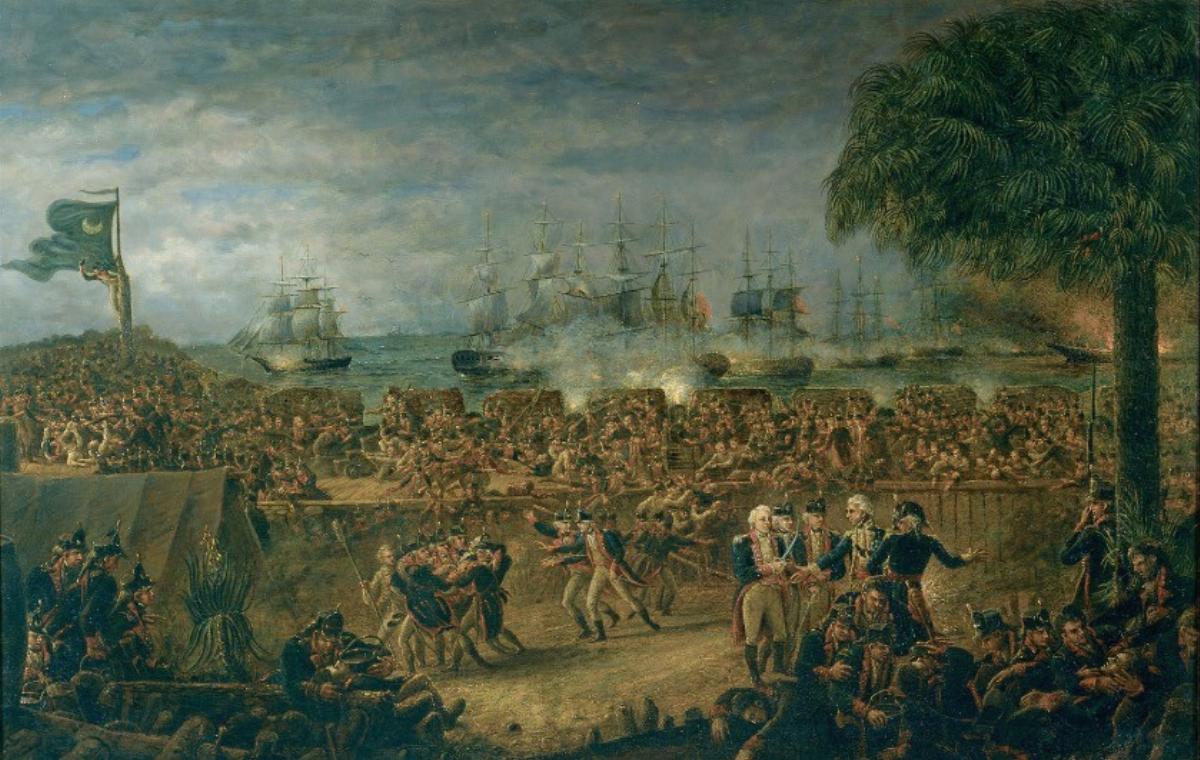
Today marks the 250th anniversary of one of the most stunning military victories in the American Revolution, but few have heard of it. That’s because it took place when communication was incredibly slow, the battle was far from Philadelphia, where the Continental Congress was meeting, and that same Congress, just six days later, officially announced that the thirteen colonies were now independent from Britain thanks to a history-making Declaration on July 4. It’s never too late to learn, though, about the Battle of Sullivan’s Island.
Read more A fiasco for education in…Texas?
The first shots in the American Revolution were fired in April 1775 at the Battles of Lexington and Concord. Two months later, although the British technically won the Battle of Bunker Hill, the raw American troops still managed to stand strong. Indeed, by March 1776, when Washington had firmly placed artillery on Dorchester Heights, overshadowing the British fleet, the world’s greatest army withdrew to Halifax.
In the fourteen months since the Battles of Lexington and Concord, the active rebellion—guns, not just talk—had gradually spread throughout large swaths of the colonies. There was now a formal Continental Army, with George Washington as its official commander-in-chief.
Still, that didn’t mean things were going well. The Americans had not stopped the British in Canada. Their attack on Quebec failed, General Richard Montgomery was killed, and, starting a chain reaction that almost led to the Americans losing West Point, Benedict Arnold had been badly wounded.
Meanwhile, the British were planning the New York campaign. Throughout June, they assembled a large land and sea fleet to attack New York City. Controlling the Hudson would allow them to sever New England from the other colonies.
And then there was the Carolina colony, with Charleston as its crown jewel. When the war began, Charleston, with its broad, beautiful harbor, was the heart of the world’s major rice- and indigo-producing region, and the richest city in the entire thirteen colonies. Had the British seized it, that would have been a devastating, perhaps fatal, blow to the nascent American Revolution. The British, therefore, were determined to quash the Charleston rebels.
The planned British attack was focused on an as-yet unfinished sand and palmetto log fort on Sullivan’s Island. In a harbor ringed by shoals and channels, the fort’s location guarded the main path for deep-draft ships such as British warships. If the Patriots completed the fort, the British navy would pay a heavy price in any attempt to enter the harbor. The fort needed to go.
Moreover, the patriots had a problem: They’d managed to complete only those two sides of the fort that faced the water. The remainder was completely open. They also had only 31 cannon and about seven tons of iron shot. They were exceptionally vulnerable.
Read more Will Paramount object to Abdul El-Sayed’s apparent Blue’s Clues copyright violation?
And the British had a plan: General Henry Clinton would come by land to attack from the rear, and Commodore Sir Peter Parker’s nine warships would bombard the fort from the water.
The naval bombardment began early on June 28, 1776. While the fort’s commander, Colonel William Moutrie, ordered his men to husband their small supply of ammunition by firing slowly and carefully, the British simply let loose, with one of the largest, sustained naval bombardments in history before WWI. Their approximately 300 cannons fired continuously on the fort for around 10 hours, using 17 tons of gunpowder and over 50 tons of iron shot.
However, the British hadn’t counted on a few things: The first was an unusually high tide that made it impossible for the army to ford what they thought would be a low channel to reach the fort’s open sides. The second was that the spongy palmetto wood, when combined with sand, completely absorbed the British shells. Moreover, thanks to the Patriots’ carefully aimed firing, they managed to cause serious damage to several ships, among which was Parker’s own flagship—including (and this is true) the seat of Parker’s trousers.
The British were able to knock down the fort’s flagstaff, which Sergeant William Jasper bravely replaced under fire. At the end of the day, despite the extraordinary bombardment, only 12 Patriots were lost, and 25 were wounded.
The British, meanwhile, tucked their tails between their legs and slunk away. They would not return until 1780, when they successfully conquered Charleston. By then, however, the Patriots, under George Washington, had become so militarily competent that Charleston’s loss could not stop the Revolutionary War’s momentum.
But, as I said, on July 4th, the Continental Congress signed the Declaration of Independence, and history books had little time or space for the Battle of Sullivan’s Island. Here in Charleston, though, we still remember and honor Carolina Day.
The Battle of Fort Moultrie (the name later given to the fort on Sullivan’s Island) by John Blake White, 1826. U.S. Senate Collection.
Read more Becerra for governor? The disqualifier you didn’t know about