
During Operation Epic Fury, Iran used Chinese space assets and satellite imagery to track and target American military bases and operations in the Middle East. The Financial Times reported that Iran had secretly purchased a satellite from Earth Eye and ground-based signal-processing services from Emposat, both Chinese companies. Together, these purchases gave Iran an advantage it was not previously known to possess.
Read more Two polls show the left hates America
Naturally, Beijing denies allowing the use of commercial space systems for military purposes. But these developments raise a serious concern: given the ambitious pace of China’s space program, it may soon be able to wage war from space.
Consider China’s space goals:
- A long-term lunar presence with a permanent base in cislunar space (the orbital region between Earth and the Moon);
- A return mission to Mars, following its successful 2021 robotic mission;
- Launches to Jupiter (2029), Uranus (2040), and Saturn, as well as to near-Earth asteroids and comets;
- Space tourism is already being offered over the next five years, with seats priced at $210,000 in 2027;
- A lunar mission with three astronauts by 2030;
- And by 2035, an ambitious International Lunar Research Station, a multinational scientific research base on the Moon.
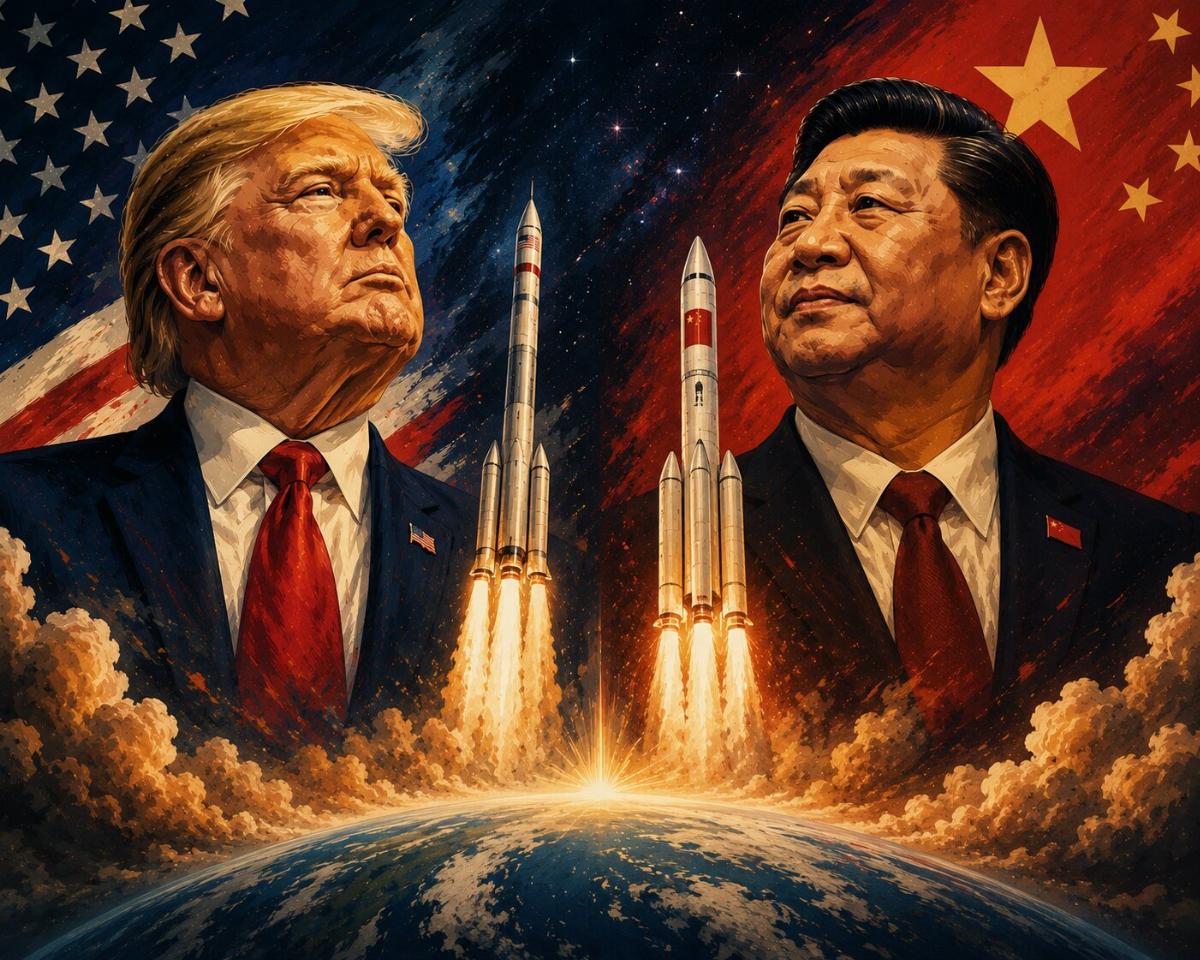
China is determined to become the world’s preeminent space power by 2045, surpassing America’s capabilities in near- and low-Earth orbits, on the lunar surface, and in deep space. It also plans to establish a dominant Earth-Moon economic zone. China has never hesitated to gain power by any means. Therefore, America faces an imminent battle to control the high frontier, from which any place and thing on Earth is easy to observe, attack, or destroy.
The U.S., of course, has had a head start in space since the Cold War era. It launched its first unmanned spacecraft in 1958, four months after the Soviet Union launched Sputnik. Three years later, Alan Shepard became the first American in space, just a month after Russia’s Yuri Gagarin, who completed an orbit of the Earth. The following year, John Glenn became the first American to orbit the Earth, and by 1969, America had put a man on the Moon.
The six Apollo missions, the mapping of Mars by the Mariner spacecraft, the mapping of Jupiter and Saturn by the Voyager spacecraft, and America’s first space station, Skylab, marked American dominance in space through the 1970s. In the 1980s, America made 24 successful shuttle launches, bringing the total to 113 by 2011. The same year, the International Space Station (ISS), now serving as a microgravity lab, was launched into orbit 261 miles above Earth.
But 2011 also saw the Obama administration end the 30-year space shuttle program, cancel the Constellation program for crewed journeys to the Moon and Mars, and usher in commercial companies into space exploration and travel. From 2011 to 2020, NASA—which once competed neck-and-neck with the Soviet Union—purchased seats on Russia’s Soyuz spacecraft to transport astronauts to and from the ISS.
By 2020, private players, bringing immense capital and rapid innovation, had become integral to America’s space program. SpaceX’s Crew Dragon became the first commercial spacecraft to launch humans (three NASA astronauts) into orbit, departing from Florida’s Kennedy Space Center. In 2021, NASA awarded contracts to Blue Origin, Northrop Grumman, and Nanoracks to develop private space stations.
In 2017, President Donald Trump launched the Artemis program to return astronauts to the Moon and, eventually, establish a sustained lunar presence. Complementing the program, NASA announced plans this March for multiple lunar launches that will culminate in a permanent human presence at the lunar south pole by 2036.
While China can boast of the world’s first rockets—or ‘fire arrows,’ a Song dynasty innovation from the 9th to 13th centuries—the roots of its space program trace to the 1950s. Although it put a satellite into orbit in 1970, its tentative steps were overshadowed by the advances of the Soviet Union and the United States.
Only in 2004, when China announced the four-phase Chang’e Project, did the U.S. recognize the urgency of reclaiming its leadership in space exploration. Eventually, a return to the Moon through the Artemis project was prioritized as a stepping stone toward crewed missions to Mars.
Read more Joy Reid quits Democrats over Israel stance
The Chang’e Project is a large-scale, accelerated effort: a series of robotic and crewed missions to the Moon, with plans for lunar orbit, soft landings, automated sample collection, and the construction of a lunar station. By 2019, Chang’e achieved a soft landing on the Moon’s far side, making China the first country to do so. In 2020, samples were collected from the near side, and in 2024, rock and soil samples were collected from the far side, again marking a first.
China plans a lunar mission with three astronauts by 2030, with two descending to the lunar surface for scientific exploration and a third remaining in lunar orbit. It is already developing the Long March 10, a superheavy-lift rocket; the Mengzhong, a next-generation partially reusable spacecraft; and Lanyue, a heavy lunar lander designed to carry two astronauts to the Moon’s surface. By 2035, it aims to establish an International Lunar Research Base on the Moon.
China’s long-term strategy is to take control of the Moon, secure the resources needed to sustain life there, and further assert control over space. It has its eye on the Shackleton crater, located at the lunar South Pole and considered the most favorable for human habitation and future space exploration. The crater is the Moon’s largest, oldest, and deepest basin, a radiation-shielded, permanently shadowed region. It contains billions of years’ worth of ice, usable to produce oxygen, water, and hydrogen for rocket propulsion.
Another advantage of the lunar poles is that the mountain ridges there are perpetually sunny, making them well-suited for operating solar farms to power human habitation, deep-space missions, and even manufacturing. Power from the solar farms could be used, for example, to extract the Helium-3 isotope found in lunar soil, which has great potential as a nuclear fusion fuel for the future.
Currently, both the U.S. and China have “parking spots” for permanent stations or satellites at key Lagrange points between the Earth and Moon and between the Sun and Earth—gravitational equilibrium points where spacecraft can be positioned with minimal fuel use. Because such spacecraft can serve as crucial outposts for observation and further exploration, free from thermal or magnetospheric interference, there is intense competition for this prime real estate.
The U.S. made the securitization of space a priority with the establishment of the Space Force and Space Command in 2019, the newest branch and command center, respectively, of the U.S. Armed Forces. They will train and equip specialized troops, develop technology, and build the capability for space defense.
The Pentagon has already recognized space as a “contested war-fighting domain” and deemed it necessary to protect our space assets and guard against disruptions to our communication, navigation, and intelligence-gathering capabilities. It has also identified China as the primary, long-term threat.
China’s advantage, as it rapidly expands its commercial space sector, is that funding is not subject to political battles, as in the U.S. It also has a stable space station, a lunar landing plan, and anti-satellite weapons, and it never hesitates to take disruptive action, whether through cyberattacks or other means. America, on the other hand, has the advantage of the world’s largest commercial space ecosystem, with stalwart global leaders in innovation who are enmeshed in the national security infrastructure.
This intense space race for geopolitical influence, resource extraction, and the establishment of standards for future exploration is not about proving what is possible but about securing a foothold. The winner will shape the next generation of human activity in space.
Read more BLM finds another victim for Peak Rioting Season
Image generated by ChatGPT.