
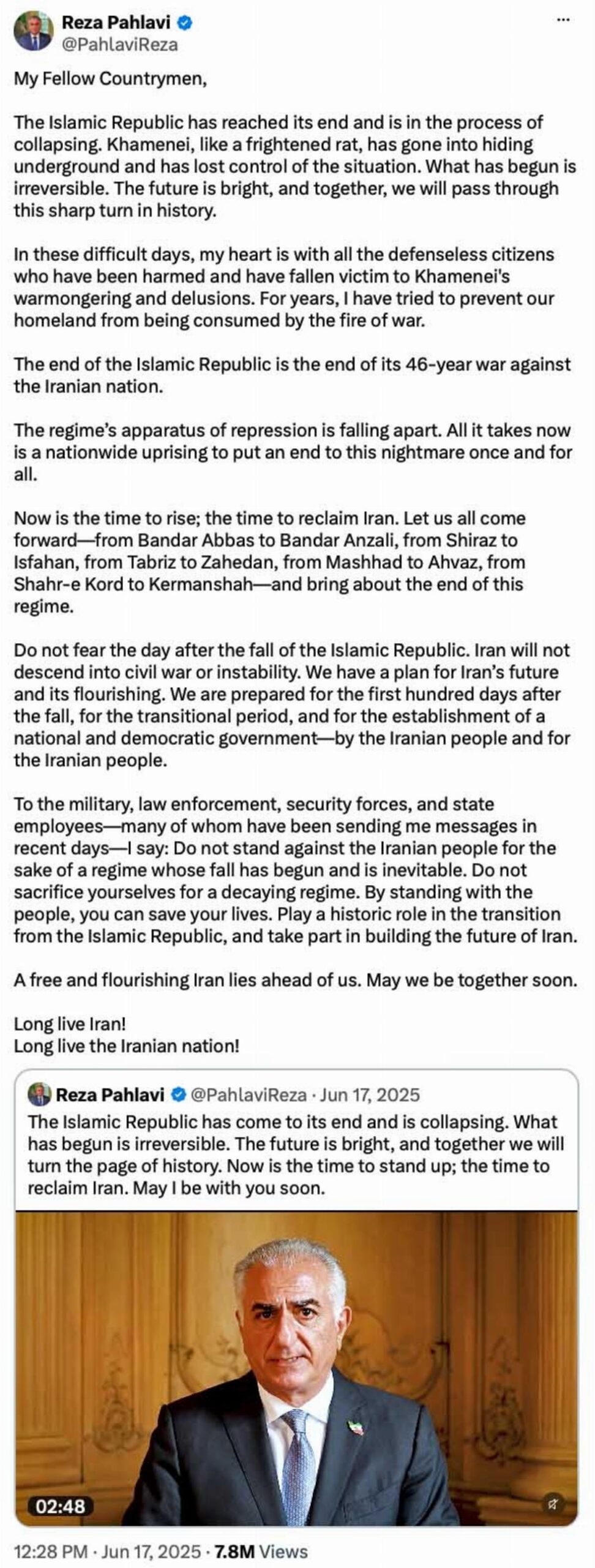
Western democracies have long insisted that political legitimacy derives from democratic accountability, not inherited privilege. Yet in Iran, some Western political and media circles have increasingly presented Reza Pahlavi, the son of the last shah, as a figure for the country’s future, without clearly reckoning with the authoritarian legacy of the system his father led.
Read more Regarding Ilhan Omar: A message to the dumbocrat socialists of America
The issue is not whether Reza Pahlavi has the right to express his views. The question is why hereditary status should carry political weight in shaping Iran’s democratic future.
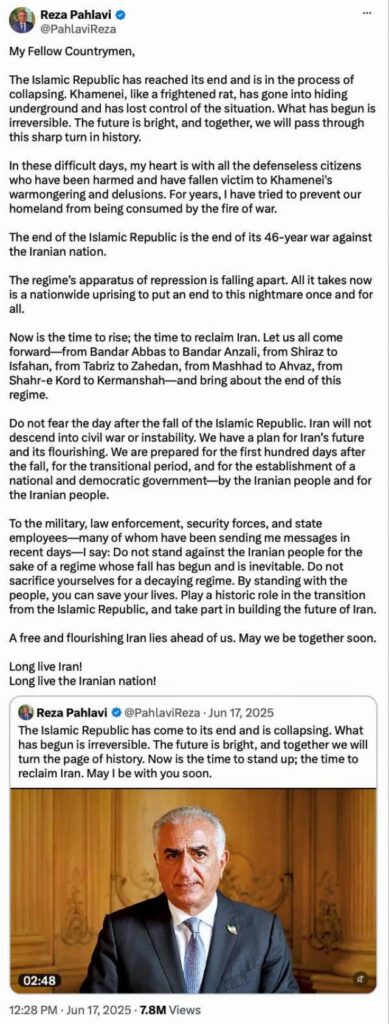
Graphic: X Post
The narrative that the Shah’s rule brought broad-based prosperity overlooks the persistent inequalities that accompanied Iran’s oil boom. Although poverty declined substantially between 1971 and 1975, estimates based on the period’s poverty line found that 28 percent of the population still lived in poverty in 1975, including 41 percent of the rural population. Poverty was particularly concentrated in rural areas and regions such as Khorasan and Sistan and Baluchestan. Research on household expenditure also documented substantial disparities between income groups, with the wealthiest urban households accounting for a growing share of expenditure. These findings illustrate how rapid economic growth and rising oil revenues coexisted with persistent poverty and unequal access to the country’s growing wealth. Encyclopaedia Iranica and a study published in World Development examine these inequalities using historical data.
Economic performance, however, is only one measure of a country’s development. The Shah’s regime restricted political opposition, while SAVAK, the secret police, became notorious for the imprisonment and torture of dissidents. Britannica’s historical account documents the autocratic character of his rule and SAVAK’s role in suppressing opposition. Economic growth alone cannot establish democratic legitimacy when political freedoms and accountability remain restricted.
The issue gained renewed attention in April 2026 when, in an interview with the Swedish broadcaster SVT Agenda, Reza Pahlavi expressed pride in his family’s legacy and in what had been achieved during his father’s era. His remarks raise a legitimate question: has the heir to an authoritarian monarchy sufficiently confronted the historical abuses associated with that system?
The issue is not inherited guilt, but political responsibility. No individual should be held personally responsible for every action of a predecessor, but anyone seeking a prominent role in Iran’s political future must be prepared to address that historical record. A family name cannot confer democratic legitimacy and promises of a future referendum cannot substitute for clear commitments to democratic principles.
Democratic commitments must also be evident in how political power is sought, how dissent is treated, and whether opponents are recognized as legitimate participants in public life. Iran needs institutions that prevent the concentration of power, protect political pluralism and ensure accountability—not the rehabilitation of hereditary authority.
Read more The Left is determined to destroy religion
Media attention can create an impression of political importance without demonstrating popular support or a democratic mandate. During the January 2026 uprising, Reuters and Le Monde covered Pahlavi’s efforts to assume a political role. Reuters noted that the extent of his support inside Iran remained unclear, while protesters expressed diverse political aspirations.
International visibility is not evidence of public consent. Opposition to the Islamic Republic does not automatically establish a democratic mandate for any alternative. The desire to end the current theocracy and the question of who should govern afterward are separate issues. Rejecting the clerical regime does not make the previous monarchy democratic by comparison. A genuine commitment to democracy must reject both religious and hereditary claims to political authority.
Western governments and commentators should distinguish between opposing a regime and endorsing a particular individual to replace it. Supporting the Iranian people’s right to choose their future is not the same as elevating a figure because of his lineage, international profile, or perceived usefulness to Western policy.
If Western democracies believe political systems must rest on citizens’ consent rather than dynastic entitlement, that principle cannot be suspended because a hereditary figure offers a familiar face during an uncertain political transition. The same standards should apply in Iran as elsewhere: free and fair elections, political pluralism, freedom of expression and association, equality before the law, and institutions that ensure accountability. These principles must be demonstrated in practice, not merely promised.
The central question is not which individual or family should inherit power in Iran, but whether the West applies its democratic principles consistently. Iran’s future must be determined by the freely expressed will of its people—not by lineage, media visibility, or political preferences constructed abroad.
Read more The case of the hidden home listings