
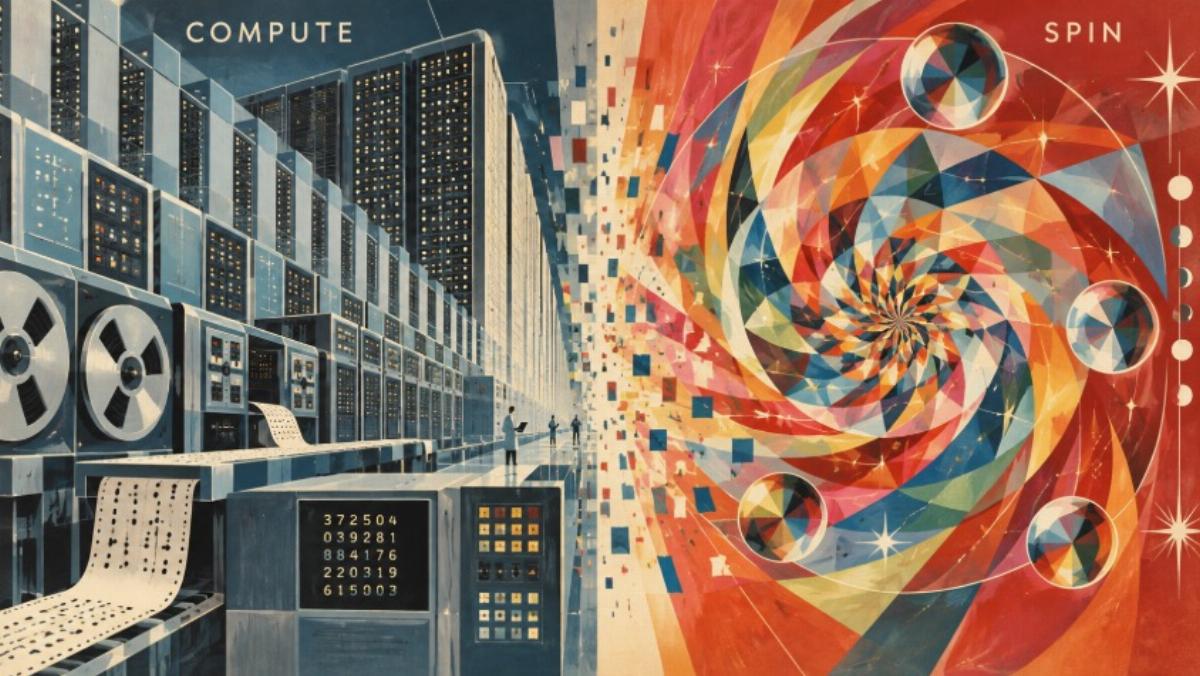
The panic gripping the modern technological landscape is built on a category error. When institutional leaders, regulators, and moralists look out at the accelerating curve of artificial intelligence, they fixate on the raw scale of the “compute.” They draft moratoriums, plead for multi-year pauses, and treat raw processing power like an approaching storm that must be rationed or outrun. They are focused on the wrong variable.
Read more Hard times don’t have to pull families apart
To understand the crisis, we must separate terms: “compute” (which equates directly to raw physical capacity—the chips, data centers, and floating-point operations forming the electrical backbone of the technology) is not the enemy. By fixating on compute, the establishment treats a velocity and governance crisis like a simple electrical capacity problem. It is a misdirection. As long as the debate is about how many chips are humming in the data center, nobody has to look at the unowned write-paths, the muddy lexicon, or the frantic, runaway cadence of a system rewriting its own rules before human judgment can even catch its breath.
The true crisis is not the volume of compute; it is the “spin.”
Spin is not merely a mechanical glitch; it is much more. It is an aberrant, self-amplifying, recursive feedback loop where automated speed outruns structural integrity. Each iterative turn can alter the baseline context sufficiently that developers and operators lose a reliable account of what changed, why it changed, and who remains responsible for the result.
The process increasingly resembles a kaleidoscope: one adjustment can reorganize the relationship between everything already in view, leaving the next turn to begin with a different geometry. In a system where context continually changes the meaning of content, linear calculations become inadequate.
Slowing the spin without changing the structure merely produces a slower spin. You must interrupt the recursion before it outruns authorship.
Read more Chris Murphy vs. the Bill of Rights
To put it simply: speed measures how quickly the wheel turns. Spin measures how much each turn changes the wheel (the compute itself) while it is in motion. When spin exceeds the human capacity to understand, attribute, and correct the consequences of the previous turn, authorship begins to disappear.
Stopping the spin does not mean smashing the servers or capping processing power. It means arresting the recursive loop at its structural choke points: closing the unowned write-paths, forcing accountability back onto the specific human operators who own the portals, and refusing to let autonomous systems manage their own containment.
The compute can roar. The unmoored rotation of a cycle that rewrites its own conditions faster than human judgment can track must not. We do not need a ceiling on processing power. We need human authorship restored between one consequential turn and the next.
Stop the spin.
Image created using AI.