
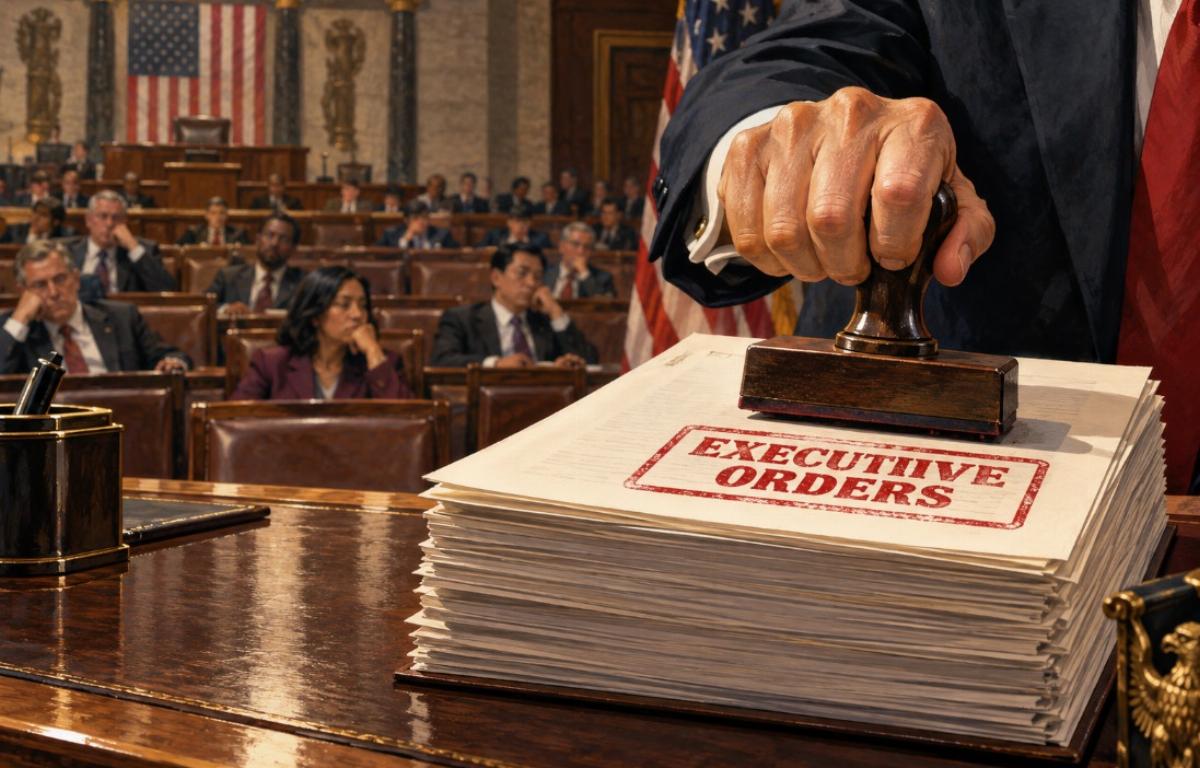
Congress on a Knife’s Edge
Congress’s responsibilities include making laws, settling national questions, and holding the executive branch accountable. Increasingly, however, legislators find obstruction more rewarding than governing, particularly when control of Congress is balanced on a knife’s edge. The November 3 election may change which party holds the advantage, but it won’t resolve the deeper problem: a Congress increasingly unable to produce durable laws. When lawmakers fail to act, presidents fill the vacuum with reversible executive orders.
Read more Why Leftists Won’t Let Us Live
Our adversaries understand the weakness this creates. Two senior Iranian officials told Reuters last week that Iran is changing its tactics in the Strait of Hormuz to keep oil prices high, attempting to influence the American midterms. One said Tehran would not let Trump bring prices down before the vote. Iran can weaken Trump’s congressional support by betting that American policy won’t last. The 2015 nuclear agreement was never submitted to the Senate as a treaty, and three years later a new president walked away from it. The lesson is clear: when policy rests on executive action rather than durable legislation, adversaries are incentivized to wait us out.
A Congress That Cannot Finish Anything
A Democrat House would control subpoenas, investigations, impeachments, and more. It won’t control the Senate filibuster, which requires 60 votes to end debate on most legislation, so Democrats could obstruct, block, or tie Trump in knots without replacing his agenda with their own. Republicans, even with a Senate majority, face the same obstacle.
When Congress doesn’t legislate on issues of national or international importance, administrations turn to executive action, often ending up in court. Barack Obama announced sweeping immigration actions in 2014 after Congress declined to act, with courts blocking key parts of his initiatives. The Supreme Court struck down Joe Biden’s student-loan cancellation plan in 2023 because the administration lacked congressional authorization for such a sweeping program. Trump has used the same executive toolkit. Courts ultimately decide whether such actions are lawful, setting national policy without electoral accountability. Many recent rulings appear to reflect progressive ideological aims rather than judicial restraint or precedent.
Why Nobody Fixes It
Political incentives explain the stalemate. A legislator who compromises risks a primary challenge, annoyed donors, and an opponent who promises magical solutions to an electorate too often fed pablum instead of facts. One who blocks the other side can claim credit for stopping its excesses without demonstrating that his own plan would work. Investigations make headlines, and fundraising appeals thrive on whatever the other party might do next. Obstruction pays in attention and donations, while governing mostly earns blame. Are we really surprised where we’re at?
Oversight is one thing; the danger is a Democrat House majority that spends two years opposing Trump without offering a viable alternative beyond ever-higher deficit spending by adopting Europe’s failed social-spending model. Meanwhile, the United States is fighting a consequential war against Iran. Tehran’s leaders have every reason to welcome a Washington consumed by partisan warfare rather than a determined, unified, motivated, and out-for-blood U.S.
Democrats may overreach once again, focusing on impeaching Trump and pursuing endless investigations, scaring the beejesus out of a lot of middle-of-the-road voters. But the possibility that Democrats might overreach is no substitute for governing, regardless of who is in power.
What Conservatives Are Really Holding
For conservatives, the stakes are concrete. Much of what this administration has done since January 2025 on the border, energy, and federal workforce reductions rests on executive action. When Joe Biden took office in 2021, he rescinded Trump’s executive orders, and Trump rescinded dozens of Biden’s within hours of returning in 2025.
The arithmetic is unforgiving. Power accumulates because each President inherits what the last one used and finds reasons to keep it, but the policies they produce keep flipping. The country ends up with an ever stronger presidency and less stable policy. Republicans who see a Democrat president as a threat should be uneasy about governing in a way that puts the same tools in that President’s hands.
The Window That Closes January 3
The best way to make policy outlast the President who made it is to write it into law. Republicans hold both chambers until January 3, and the lame-duck session is their last practical chance to legislate with unified control. Most measures will face the Senate filibuster. Reconciliation offers a route around it for qualifying budget legislation, requiring only a simple majority, provided the measure complies with the Senate’s budget rules, especially the Byrd Rule.
Read more In Vietnam, A Story Of Political Betrayal
Reconciliation could strengthen border enforcement, curb waste and fraud, and deliver additional tax relief, provided the provisions meet the applicable budget rules. It is no panacea, but Republicans should try hard to turn executive priorities into law while they still can. Whatever they leave to executive order is on borrowed time.
Given recent history, I’ll be surprised if Republicans seize the opportunity. Hope is eternal: I still hope they try, regardless of next month’s results.
Over the longer run, Congress could reclaim authority by requiring votes on major agency rules before they take effect and limiting open-ended delegations of power. That would return more hard decisions to officials voters can remove at the next election. Unfortunately, legislators, regardless of party, don’t seem to want to do what they were elected to do. Congress last completed all regular appropriations bills on time for fiscal year 1997, on September 30, 1996. The only honest conclusion is to declare, “A pox on both your houses.”
What November Won’t Change
November 3 will determine which party holds the advantage in Congress. It will not, by itself, change the incentives that reward obstruction over legislation.
That failure has consequences beyond Washington’s partisan battles. It leaves domestic policy vulnerable to reversal, weakens America’s ability to sustain commitments, and gives foreign adversaries too much room to exploit our divisions. Iran’s attempt to influence American voters is one example of how our opponents can turn political instability into a strategic victory.
The answer is not simply to elect the right party. It is to restore Congress to its constitutional purpose: making laws, accepting responsibility for difficult choices, and producing policies that can survive a change of administration.
A victory meant to restrain presidential power may instead reinforce the conditions that expand it. The real test of this election will not be which party celebrates on November 3. It will be whether the people elected can do what Congress was created to do—and leave behind something more durable than the next executive order.
God Bless America.
Image created using AI.
Author, Businessman, Thinker, and Strategist. Read more about Allan, his background, and his ideas to create a better tomorrow at 1Plus1Equals2.com.