
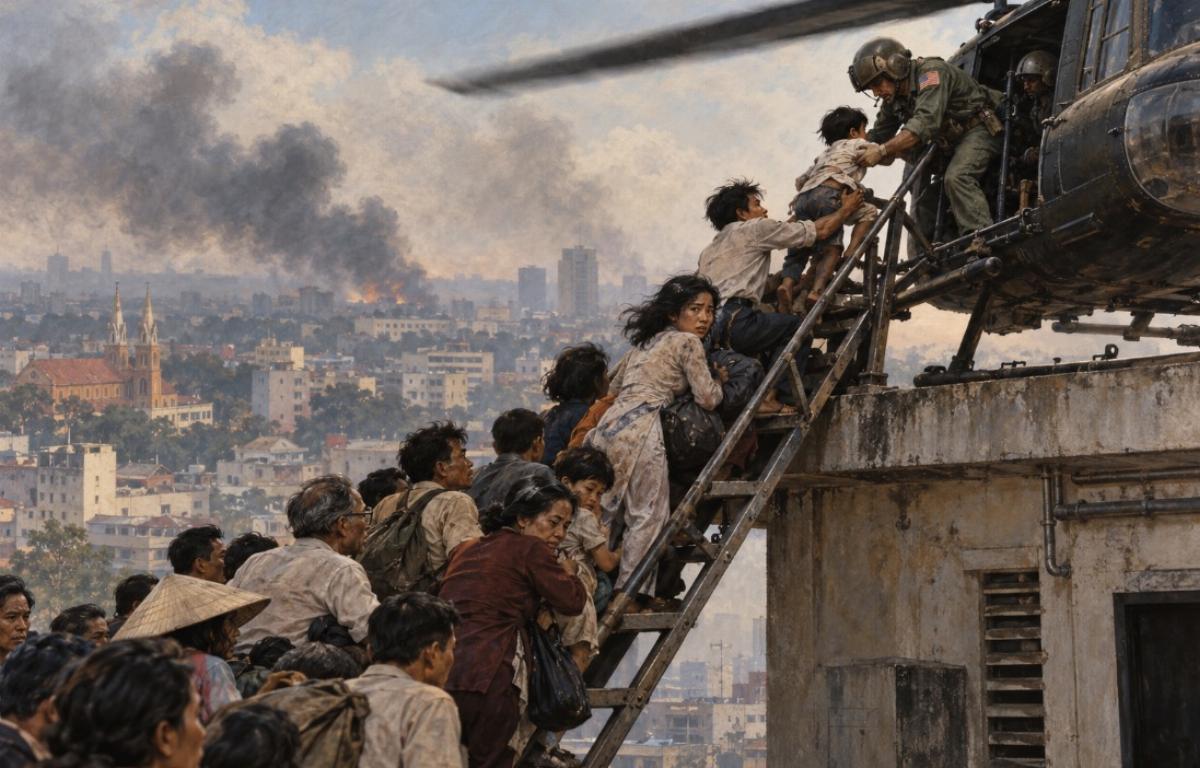
I recently saw a doctor with a Vietnamese last name and asked whether his parents were “boat people.” They were. His father, a physician in the South Vietnamese Army (ARVN), was imprisoned for years after Saigon fell. When he was released, he put his family, including my doctor, then five, on a boat and brought them to the United States.
Read more Marching Orders For Christians On Election Day
Both my doctor and his father worked multiple jobs so my doctor could get through medical school and become a surgeon. When I told my doctor I had been an advisor embedded with the ARVN, we struck up a friendship. His father is still alive in California, and our conversation brought this memory back.
It reminds us that wartime political decisions carry enormous consequences: lives lost, families destroyed, destruction, domestic politics, and America’s reputation and credibility.
The Easter Offensive
My story begins in 1972, when I was an advisor on Team 22 in II Corps, Vietnam. By then, U.S. ground combat forces had left; only advisors remained, and their numbers had been drastically reduced.
For years the North Vietnamese Army (NVA) had waited for the Americans to leave. On 30 March 1972, about 120,000 NVA regulars invaded the South on three axes: I Corps, II Corps, and toward Saigon. This Spring, or Easter, Offensive employed tanks, heavy artillery, rockets, and many thousands of Viet Cong.
The plan was to panic the ARVN into retreating toward the coast, and it worked to a large degree. Within weeks, ARVN forces in II Corps had been overrun in places. Team 22 supported the ARVN 22d Infantry Division.
Fortunately, with no American ground units competing for air strikes, U.S. airpower from carriers and land bases was abundant. Weather permitting, we had beaucoup air support, directed through Air Force Forward Air Controllers (FACs).
Once the advance was stemmed, the ARVN and advisors launched a months-long counteroffensive that stopped the assault and pushed most NVA forces back or fixed them in place. Success depended largely on U.S. air strikes directed by advisors and enabled by FACs flying countless missions.
Life with the ARVN
A typical advisory team in my area had three men: a lieutenant colonel, a major, and me, a first lieutenant. We slept, ate, maneuvered, and fought beside our ARVN counterparts, developing close relationships with them.
We moved among fire bases as enemy activity dictated. Typically, the ARVN engaged and fixed the enemy, then advisors directed air strikes. Battles sometimes lasted four or five days, after which the ARVN cleared the battlefield.
In fall 1972, the ARVN began hearing that advisors would soon leave under the Paris peace negotiations. Our counterparts asked whether we would leave them to fight alone.
It was a very difficult question to have to answer. We confirmed the plan but said the United States would leave equipment and continue supplies. They seemed to suspect—and fear—how that would turn out.
During my last two months, I was Assistant District Senior Advisor to a District Chief controlling local Regional Forces and Popular Forces militia. The Senior Advisor, a major, and I were the only advisors; earlier, such a team might have had fifteen. I returned home in January 1973.
Captain Tai
In 1975, while attending an Army Advanced Course, I was assigned to sponsor Captain Nguyen Tan Tai, one of three ARVN officers in the class. We became friends and had social interactions. Tai was married with several children in South Vietnam.
Read more Trump Demands Two Loyalties
In 1974 and 1975, Congress cut funding for the South Vietnamese military, knocking the legs out from under it. Saigon fell on 30 April 1975.
Overnight, there was no South Vietnam and no ARVN. The State Department gave ARVN officers bleak options: remain in America without families, go to a Philippine refugee camp, relocate to a third country, or return to South Vietnam to most certainly face a reeducation camp or death. It was a Hobson’s choice.
Tai wanted to return to his family. I do not know which option he chose; time was short. Within 24 hours, he had no country, no army, and no uniform. He removed his insignia and ribbons, gave them to me, and shook my hand in a brief, emotional farewell. I feared he would be dead within months.
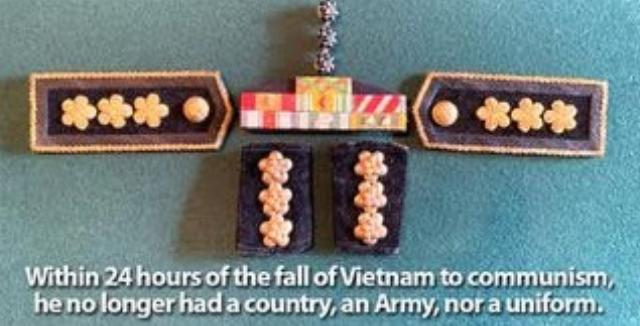
Image from the author.
In 1981, I received a letter from him. Over many months, by a serendipitous route, he had returned to Vietnam and found his family. Somehow, he got them out. Writing from Paris, where he worked in an automobile factory, he asked for help bringing his family to America.
That began a months-long saga. The State Department said that without relatives in the U.S. as sponsors, he could not enter. Church groups could not help. I offered to sponsor him, but that was not permitted because I was not family. Eventually, I had to tell him I could not make it happen. We lost touch, and I have not heard from him since.
Afghanistan
Fast forward 46 years. After nearly twenty years of war in Afghanistan, a conditions-based withdrawal plan was established in 2020 that would have retained roughly 2,500 troops and control of Bagram Air Base. The next administration set it aside and withdrew all U.S. troops by 30 August 2021. It was the greatest military debacle of our lifetimes, and its repercussions still resonate.
Thirteen U.S. service members died. An unknown number of Afghans who supported us were left behind, with some subsequently tortured and killed, and military equipment worth billions remained. Over 79,000 Afghans were brought out and admitted to the U.S., most without proper vetting.
The Common Thread
The fall of Saigon in 1975 and the 2021 defeat in Afghanistan share one political denominator: Joe Biden.
Betrayal 1. As a junior senator, Biden opposed the Vietnam Contingency Act of 1975, which would have provided emergency funds for relief and evacuation. On : “I do not believe the United States has an obligation, moral or otherwise, to evacuate foreign nationals. … The United States has no obligation to evacuate one, or 100,001, South Vietnamese.”
Betrayal 2. As president, he chose a date for leaving Afghanistan rather than allowing conditions on the ground to decide, and the result was a debacle.
These decisions had strategic consequences that still shape the world. In both wars, our military performed magnificently. We won Vietnam militarily and lost it politically; Afghanistan ended the same way. This is a story of political betrayal.
Image created using AI.
Major General Joe Arbuckle, U.S.A. (Ret.) served in Vietnam on Advisory Team 22, with the South Vietnamese Army. He has commanded at every rank from Lieutenant to Major General, specializing in the missile field, and was inducted into the Army OCS, Engineer, Ordnance, and AMC Halls of Fame. General Arbuckle retired after 32 years of commissioned and enlisted service. He now serves on the Board of Directors for STARRS.US.
Read more Rep. Ilhan Omar says “Not to my knowledge’ when asked if she married her brother