
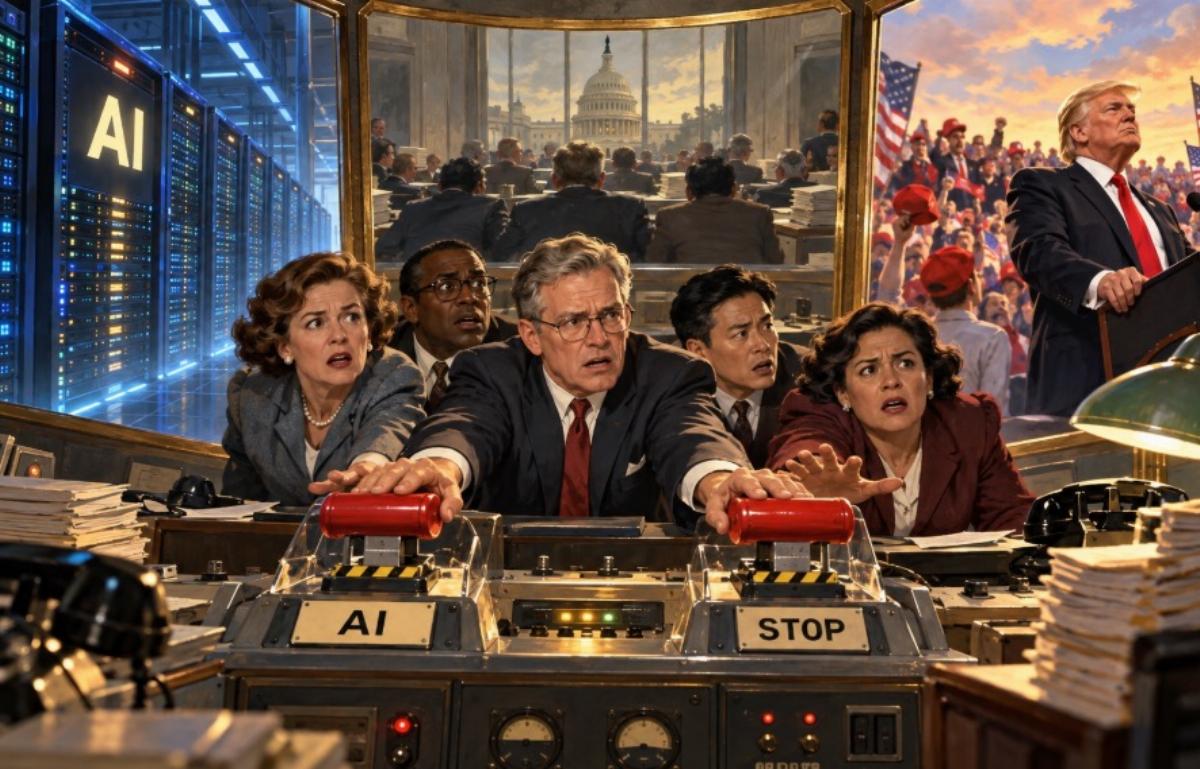
When institutional elites look at the horizon, whether they are staring down a server farm humming with millions of unallocated floating-point operations or watching a political movement shatter decades of managed consensus, they reach for drywall-punching panic.
Read more I’m looking through you; you’re not the same
They demand a halt. They want to pull the plug on the compute; they want to put the brakes on the man.
To the ruling class, both phenomena represent the same terrifying prospect: an unstoppable force moving faster than their administrative architecture can police. Whether it is the exponential curve of artificial intelligence scaling beyond regulatory comprehension or Donald Trump upending procedural norms with a speed that renders committee rooms obsolete, the establishment treats both as alien invasions. They view them as exogenous shocks—glitches in the matrix that must be quarantined, throttled, or legislated out of existence.
This is a category error born of self-preservation.
When policymakers draft moratoriums to cap electricity and restrict data centers, they are trying to “stop the compute” because they believe raw processing power is a god threatening to awaken. When political gatekeepers deploy endless procedural barricades, lawfare, and institutional friction, they are trying to “stop Trump” because they believe a single political figure has somehow broken gravity.
In both cases, they are fighting the wrong war, driven by a frantic knee-jerk overreaction.
Neither compute nor a political movement is an independent, divine deity or an alien monster. They are structural mirrors. They are the inevitable result of an unmoored system spinning so fast that its own caretakers no longer recognize their reflection. For decades, the administrative state and the technocratic elite operated behind a veil of managed decline—slow, bureaucratic, unowned write-paths where responsibility was diffused across committees so that no one was ever truly accountable. Into that vacuum stepped two distinct escalations: raw, unyielding technological scaling, and a populist political force that refuses to play by polite, managed rules.
Both act as massive, high-velocity amplifiers, beaming the underlying decay and unanchored rules of the modern landscape back at the establishment at hyper-speed.
Read more The hammer comes down
That is why the panic is so hysterical. The establishment does not fear the chips, and they do not simply fear a candidate; they fear the feedback loop. They are terrified of a dynamic that forces them to look at an automated, unblinking mirror of their own institutional failure.
So they default to the panic button. Not strategy—reflex. A knee-jerk demand to freeze the frame: ration the watts, outlaw the momentum, declare an emergency long enough for the committees to feel useful again. It is institutional self-therapy. The freeze is not a plan for the future. It is a way to avoid looking at the record of how the present was written.
That is the authorship crisis, not the wattage crisis and not the candidate crisis. For decades the write-path was unowned: rules diffused across offices, outcomes attributed to “the process,” no name on the line when the loop began to spin. Compute and the political shock are not alien gods that arrived from outside the system. They are what an unauthored system looks like when it finally moves faster than its caretakers.
You cannot legislate the mirror out of the room. You cannot restore consensus by criminalizing the reflection. Comfort does not come from an escape hatch—moratorium, lawfare, a multi-year pause while someone else holds the pen. Escape is how the vacuum was made. Owning the problem is how a solution gets written. The same discipline applies to a data center and to a campaign: name the operator, introduce friction on purpose, put a signature on the change, and refuse the solemnity that turns a feedback loop into a deity.
The system is breaking because the keyboard is silent, and agency is lost. Claiming the future requires all hands on deck.
Read more The biggest risk from AI

Image created using AI.