
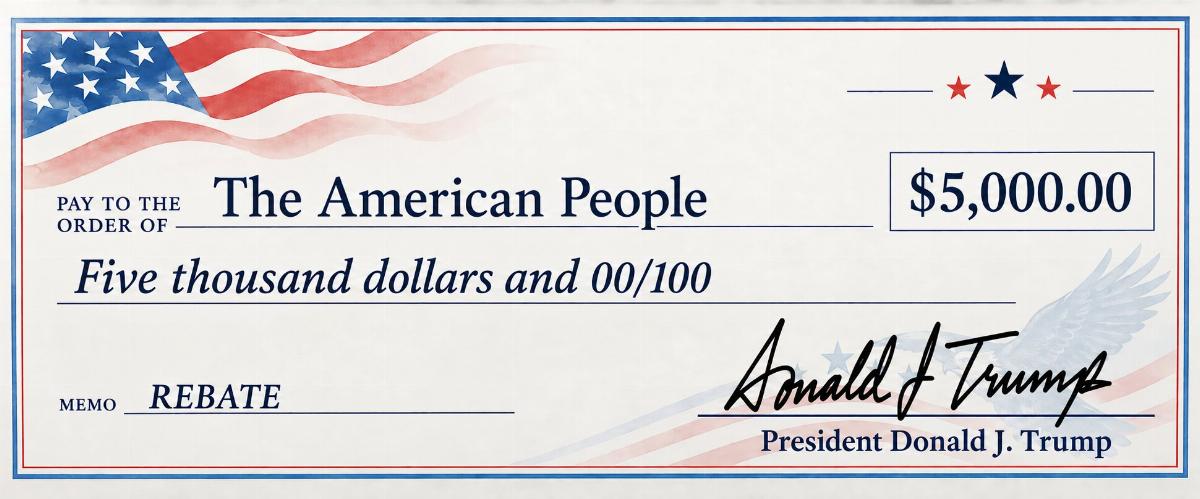
When President Trump promised a $5,000 “dividend” to every adult citizen if Republicans keep control of Congress, the reflexive response from economists was arithmetic: roughly 245 million adults, an estimated $1.2 trillion price tag, added to a national debt already approaching $40 trillion and now costing more than a trillion dollars a year in interest. That arithmetic is correct. It is also incomplete, because it measures the cost of the proposal without measuring the cost of the imbalance the proposal is trying to answer.
Read more French president Macron shows his ‘Sunny’ side
A quarter-century of one-sided gains
For twenty-five years, the American economy has quietly split into two systems running side by side. One, built on real estate and equity markets, has compounded wealth for households that already owned assets. The other, built on wages, has barely moved: real worker compensation rose about 26% between 1978 and 2024, while productivity, the thing wages are supposed to track, rose 80%. The difference did not vanish. It went mostly into executive pay, which rose from roughly sixty times the typical worker’s pay in 1989 to 281 times by 2024. The old ladder into that wealth, the employer pension, was phased out over the same period in favor of 401(k) accounts, which shifted market risk onto workers who never asked for it. None of this happened because ordinary Americans stopped working hard. It happened because tax policy, retirement policy, and monetary policy quietly rewarded capital over labor for a generation.
Why “extraordinary” is not just a rhetorical flourish
Critics are right that a blanket cash transfer is not how a healthy fiscal system ordinarily behaves. But normal is the wrong benchmark for an economy that has run an asymmetric bargain for a generation: gains privatized when markets rise, losses socialized when they fall, and a tax code that still taxes a dollar of capital gains at a meaningfully lower rate than a dollar of wages. An economy this one-sided for this long is not corrected by unusually cautious remedies. The asymmetry shows up inside the market itself, too. For the 20 years from December 31, 2004, through December 31, 2024, DALBAR reported annualized returns of 9.2% for its “average equity investor” measure and 10.4% for the S&P 500, a gap driven mostly by fear-driven selling during the downturns that reactive Fed policy tends to produce. Ordinary households are not short on the desire to build wealth. They are short on the cushion needed to survive the volatility a lopsided system keeps generating.
What pragmatic actually requires
None of this means the dividend should become law exactly as floated. Pragmatic support comes with three conditions the administration has not yet met. Funding is the first: a payment this size should not simply be layered onto debt already costing over a trillion dollars a year to service; tariff revenue, which the administration itself has cited as a funding source, is a more defensible option than new borrowing, though it does not fully cover $1.2 trillion, and Congress, not a presidential announcement, has to appropriate whatever the real number turns out to be. Targeting is the second: a flat payment to every adult, including households already sitting on years of untaxed equity and real estate gains, blunts the very correction it claims to make; a phase-out above a reasonable income threshold, similar to the structure used in the pandemic-era stimulus checks, would concentrate the benefit where twenty-five years of asymmetric gains have not reached. Framing is the third: a payment timed to a specific election and contingent on a partisan outcome hands critics a legitimate opening to call it vote-buying, and a policy this defensible on the economics does not need that particular vulnerability attached to it.
Read more Why every pastor needs to bring the AI conversation to church
A rebate, not a gift
Structured as an unconditional universal payout, timed to an election, and financed by more borrowing, the dividend deserves the skepticism it has drawn. Structured as a one-time, income-targeted rebate, funded substantially from tariff revenue and passed through ordinary congressional appropriation rather than presidential decree, it becomes something closer to a partial, overdue correction for a quarter-century in which risk and reward stopped traveling together. The economics do not require believing capitalism failed. It requires believing that a system where productivity rose 80% while wages rose 26% cannot keep asking the same households to wait for the next generation of gains. Sometimes the pragmatic answer to an unusual economy is a payment. It is not, however, a blank check.
Meda Parameswara Reddy, Ph.D., is the Director of the Reddy Center for Critical and Integrated Thinking. A former R&D executive holding 30 U.S. patents, he specializes in interdisciplinary research and public policy analysis. His writing has appeared in Proc. Natl. Acad. Sci. (PNAS), multiple RealClear platforms, American Thinker, The Fulcrum, The Humanist, AFRO American, The Friday Times, and South Asia Monitor, where he serves on the editorial board. He also hosts the interview show “SAM Dialogues with Dr. M. P. Reddy.” Website: mpreddyinsights.com | Contact: [email protected].
Read more Trump quietly slashes nearly $1 billion in federal cash for illegals and wokester foreign aid grants
Image generated by ChatGPT.