
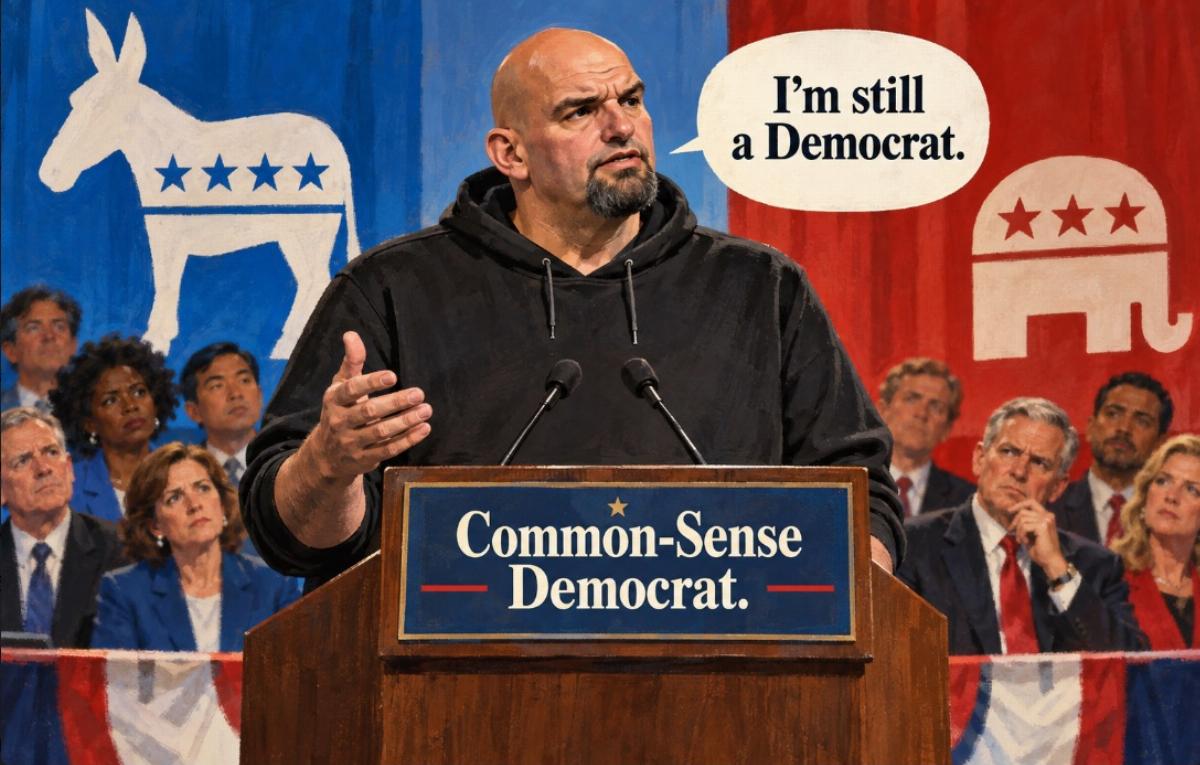
Politics has its Hail Mary passes, thrown when time is running out, conventional plays have failed, and the only option left is to put the ball in the air and hope someone unexpected is waiting in the end zone.
Read more The Way To Defeat The West: Turn Us Against Ourselves
Something about the closing weeks of the 2026 midterm election has that feel. And one of the most interesting figures on the field may be Pennsylvania Democrat Senator John Fetterman.
On September 9, Fetterman did something extraordinary for a sitting Democrat senator: He appeared by video at the Republican midterm convention in Dallas.
“Yes, I’m a Democrat,” he reminded the Republican audience. He called himself a “common-sense Democrat,” praised Republican Pennsylvania Senator Dave McCormick, promised to cooperate with President Trump to protect Pennsylvania steel, and declared that he would reject “the extremes and socialism.”
That last point matters. Republicans can attack socialism all day. Fetterman can attack socialism and then say, “Yes, I’m a Democrat.”
Those are very different political instruments.
Fetterman continues to insist that he is a Democrat, and speculation that he is about to become a Republican remains just that—speculation. Asked recently about his political future, however, he supplied an intriguing answer: “Let’s revisit after the midterm.” He has also talked about remaining Democrats’ 51st vote if the Senate flips.
Perhaps there is nothing more to it. But we have seen a version of this political play before.
During the closing months of the 2024 presidential campaign, Robert F. Kennedy Jr. and Tulsi Gabbard crossed one of the deepest boundaries in American politics.
Kennedy, who had initially sought the Democrat presidential nomination before running as an independent, suspended his campaign and endorsed Donald Trump in August. Days later, former Democrat congresswoman Gabbard also endorsed Trump. Both subsequently joined Trump’s transition team.
Their significance wasn’t simply that two people endorsed a Republican. It was who they had been.
Kennedy carried one of the most recognizable names in Democrat political history. Gabbard had served four terms in Congress as a Democrat and sought the Democrat presidential nomination in 2020. Their presence allowed Trump to make an argument that carried more weight coming from former Democrats: We did not suddenly become conventional Republicans. We left because the Democrat party changed.
The messengers became part of the message.
Fetterman presents an even more intriguing variation because he hasn’t left. He remains a Democrat senator.
When Republicans accuse Democrats of moving too far left, Democrats can dismiss the charge as partisan campaigning. That becomes harder when a Democrat senator appears at a Republican convention and denounces “the extremes and socialism.”
And socialism is no longer an issue confined to Fetterman. Republicans have made socialism and communism prominent themes of their midterm campaign, while Democrats in competitive races are pushing back, some emphasizing that they are capitalists rather than socialists.
The ideological fault line is there. Fetterman happens to be standing almost directly on top of it.
Read more Welcome to California! The ultimate sanctuary state …
That raises the more interesting possibility: What if Fetterman is not an anomaly but a preview?
Imagine—not as prediction, but as political possibility—a closing argument built around several Democrats, former Democrats, independents, or culturally recognizable liberals publicly rejecting the socialist wing of the Democrat coalition.
They would not have to become Republicans. In fact, their usefulness might depend upon not becoming Republicans. Their message could be remarkably simple: I haven’t abandoned my principles. My party abandoned them.
That would reproduce the most interesting feature of the Kennedy-Gabbard moment without reproducing Kennedy or Gabbard themselves. Fetterman can make the argument while still carrying the Democrat label.
The distinction matters especially because Republicans are trying to associate democratic socialism with communism. The two are distinct political traditions, and Democratic Socialists constitute only part of the Democrat coalition. But political campaigns operate through associations as well as precise definitions.
The word communism carries historical baggage that progressive and even socialist do not. Republicans clearly believe that association has electoral value, while Democrats in competitive races consider it important enough to rebut.
That creates an unusual political weapon: not another Republican warning about socialism, but Democrats themselves drawing a boundary against it.
Fetterman has begun doing exactly that.
Politics tends to focus attention on candidates, polls, and advertisements when sometimes the more important development is a change in coalition.
Kennedy and Gabbard did not simply endorse Trump in 2024. Their presence allowed Republicans to show former members of the opposing coalition standing inside their own.
Now Fetterman has appeared at a Republican convention, denounced socialist extremes, and continued to identify himself as a Democrat.
If he remains the lone Democrat figure making this argument across party lines, the episode may simply become another chapter in Fetterman’s unusual relationship with his party.
But if another recognizable Democrat appears—and then another—the meaning changes. It stops looking like a John Fetterman eccentricity and starts looking like a broader political realignment.
In 2024, few would have predicted early in the campaign that Robert F. Kennedy Jr. and Tulsi Gabbard would eventually be standing with Donald Trump. In 2026, John Fetterman occupies an equally peculiar position: still inside the Democrat party while publicly attacking an ideological current Republicans most want voters to associate with it.
Perhaps he stands alone. Perhaps others are waiting—because a Hail Mary works only if someone is waiting in the end zone.
Read more Labour minister in UK says traditional England was a ‘far-right fantasy’ that ‘never really existed’
Image created using AI.