
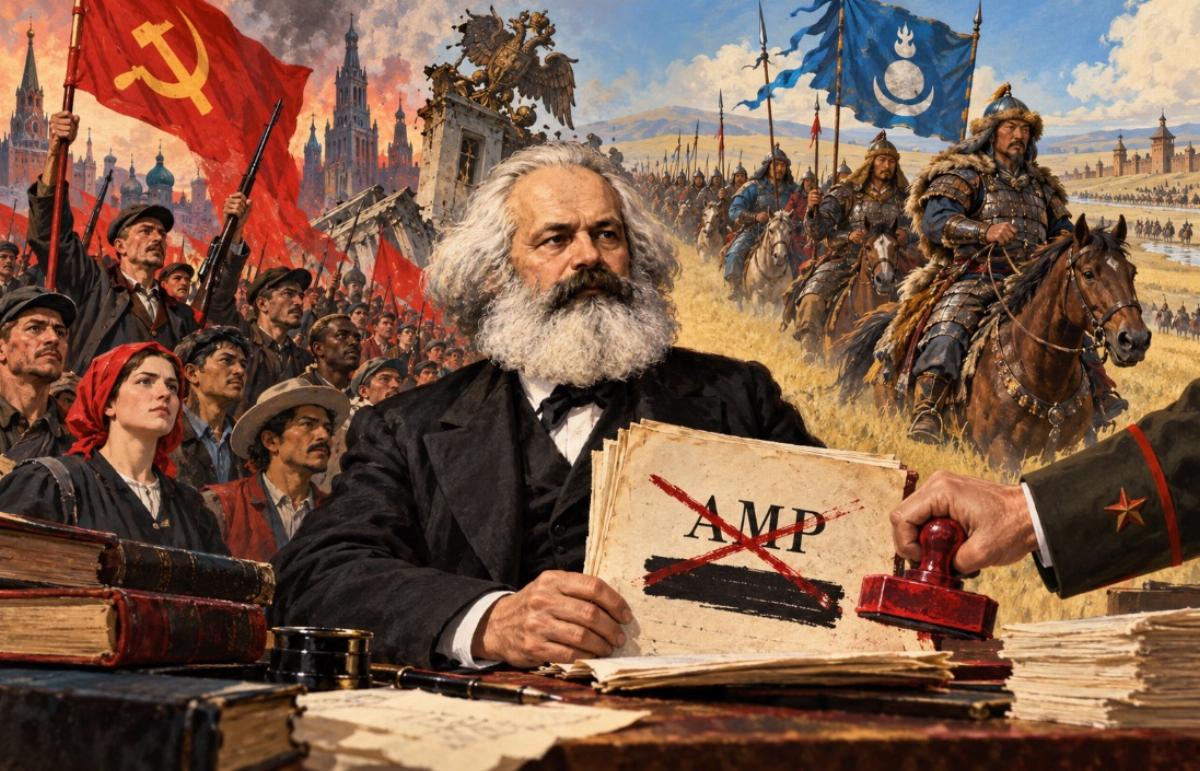
Marxism is in vogue in popular culture in the United States these days. A growing number of young people are turning against capitalism. But I am not sure the new crop of socialists, the ones who cherish the warm embrace of collectivism—the ones belonging to the Democratic Socialists of America—understand the writings of good old Karl Marx. This is especially true for their “inspirational” leader, Bernie Sanders, who honeymooned in the Soviet Union.
Read more When Is A Color Revolution Not A Color Revolution?
Marx and Friedrich Engels published the Communist Manifesto in 1848, and it’s been in vogue ever since. However, there is a little history lesson in Marxism that resulted in an early and particularly vicious example of true cancel culture. Marx developed a theory that ultimately proved so embarrassing to the Soviets, who claimed to follow his teachings, that the government suppressed it and persecuted scholars who studied it.
Marx modestly claimed to have discovered, scientifically, the meaning of history. And history, so he said, would inexorably proceed from ancient societies through feudalism and capitalism to socialism and finally communism. Five years later, he’d complicated his theory after he “discovered” a societal structure that didn’t fit neatly into that progression. He called it the Asiatic Mode of Production (“AMP”).
Marx discussed AMP in his 1853 article “The British Rule in India” and his 1859 A Contribution to the Critique of Political Economy. Those modern “intellectuals” enamored with socialism should acquaint themselves with this part of Marxism and the sad history that goes with it.
Marx identified the great river valley civilizations of China and India as examples of AMP. Harnessing rivers for irrigation required great armies of workers, producing centralized bureaucratic despotisms with enormous governmental power, limited private property, and communities firmly under central authority. Marx said these societies were stagnant, unable to emulate Western Europe’s predicted development.
According to Marx, the government had three departments: public works, which controlled irrigation; external plunder, or the military; and internal plunder, or the tax authorities. Marx also associated this system with “oriental despotism.”
Although Russia was not a river-valley civilization and had extensive contact with the West, Marx saw similarities between Russian autocracy and oriental despotism. He attributed much of Russia’s political development to the 13th-century Mongol conquest.
After conquering China, the Mongols adopted elements of Chinese administration. Mongol emperors ruled China for generations, including Kublai Khan, whom Marco Polo made famous. ((Marco Polo used to be part of public-school education.)
The Mongols also dominated Russia for more than 200 years, profoundly influencing its institutions. Russian princes served Mongol rulers, collecting tribute and administering territories. When Mongol domination ended, Russian rulers maintained centralized authority.
For example, the Russian hero Alexander Nevsky, who defeated the Teutonic Knights, was also a loyal Mongol subordinate who enforced their will against his own people. A hero against Western enemies, he was far less heroic toward the Mongols.
Marx viewed Russian autocracy as a reactionary military force threatening Western European revolutions and wanted the Tsarist regime destroyed. However, his narrow view did not preclude Russia from eventually developing a market economy.
By the early 20th century, reforms and industrialization suggested that Russia might be doing just that. (For more, see Jacob Walkin’s The Rise of Democracy in Pre-Revolutionary Russia, if you can find a copy.) Russian Marxists hoped their country was finally following Marx’s predicted historical development.
In 1905, widespread unrest led to a bloody but unsuccessful revolution involving peasants and increasingly influential industrial workers.
In 1906, Russian Marxists debated that revolution. Vladimir Lenin, leader of the Bolsheviks, believed workers and peasants could overthrow the regime. The Mensheviks thought it premature: Russia first needed capitalist and democratic development to create the conditions for socialism.
Read more Four Soldiers Died Because The Military Knew The Risks And Continued Anyway
An impatient Lenin couldn’t wait. He believed overthrowing the Tsar could encourage socialist revolution in industrialized Western Europe, which would then help Russia advance toward socialism without lengthy capitalist development.
But what would prevent the revolutionary government itself from becoming another centralized despotism?
Lenin later supplied an answer in his 1917 work The State and Revolution. The old state machinery would be smashed. An armed population would replace the standing army and police, while officials would be elected and subject to recall. Western socialist revolutions would help prevent renewed despotism.
How did that work out?
In 1917, two revolutions occurred. February’s overthrew the Tsarist regime; October’s brought Lenin and the Bolsheviks to power. However, socialist revolutions in Western Europe failed.
Meanwhile, the notion that post-revolutionary Russia would have no police, standing army, or secret police should cause anyone evaluating Lenin’s promises to fall on the floor laughing. Then fall into deep depression at the monstrosity Lenin ushered in.
The Bolsheviks established the Cheka, their political secret police, in December 1917. The Red Army followed in 1918. Political opposition was suppressed, and a centralized dictatorship emerged. Under Stalin, the system became vastly more murderous and oppressive.
The Soviet Union so closely resembled Marx’s oriental despotism that it was obvious to anyone with an IQ above vegetable what the Soviet system would be: a centralized government controlling all aspects of life, secret police terrorizing citizens, and the end of political independence.
Given Marx’s theory about the liberty that would flow from socialism, this presented a problem for the regime. During the 1920s, Soviet scholars debated AMP. If centralized state power could create stagnant societies under oppressive bureaucracies, what did that suggest about the Soviet Union?
By 1931, the debate had become politically dangerous. At a major Leningrad conference, the theory came under ideological attack. Under Stalin, AMP increasingly became unacceptable as an independent historical category. By the late 1930s, Stalin’s official account of historical development excluded it.
Think about that: Karl Marx’s own theory was effectively banned in the Soviet Union. The very notion that it was possible to “outlaw a theory” demonstrated the nature of the despotism. Never mind what Marx actually wrote. The Party would decide what Marxism meant.
But what happened to the fervent Marxists who specialized in AMP theory? Those unfortunate scholars faced ideological denunciation and pressure to abandon their work. Academic careers and freedom to publish were threatened. We’ve seen the same thing happen here in the last decade.
Stalin had the power to be more brutal than today’s cancel culture warriors. During the purges, scholars were dismissed, imprisoned, and, in some cases, executed. An incorrect interpretation of history could be treated as evidence of political disloyalty. This was Stalin’s version of cancel culture, backed by the machinery of a totalitarian state.
The lesson is unambiguous: When reality and ideology collide in a despotism, blood flows, and the same will surely happen here if the DSA ever takes power.
Read more Maybe France Deserves to Burn
Image created using AI.