
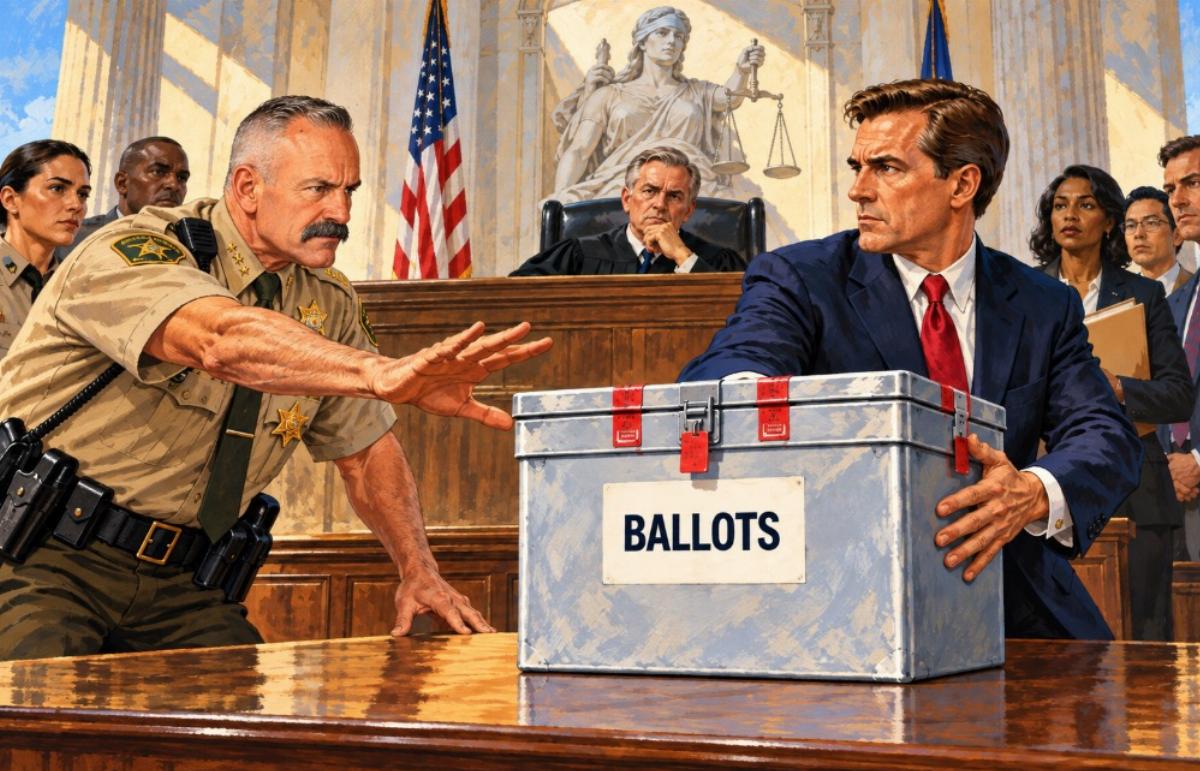
The California Supreme Court did not try the Riverside count. On September 24, it decided who holds the paper.
Read more The Death of Neutrality When a Free Society Demands That Everyone Take a Side
In Cervantes v. Bianco, , Chief Justice Guerrero, for a unanimous court, held that Sheriff Chad Bianco’s seizure of the voted ballots from the November 2025 special election was unlawful under Elections Code section 15551. The court applied the pre-amendment version of the statute, while noting that SB 1418, effective September 19, 2026, made the provision “at least as protective of ballots as preexisting law was” [emphasis added]. The packages go back to Registrar Art Tinoco “forthwith.”
The writ supersedes the search warrants to the extent they conflict. In Bonta v. Bianco, , the same court held that the Attorney General may give a sheriff binding directions on a particular investigation. The look stops while Rob Bonta conducts his “review.”
That is a custody holding and a chain-of-command holding. It is not a verdict that the citizen audit was a fantasy, and it is not a finding that no crime occurred. The court said it was not resolving the 45,896-versus-103 fight.
Most of the press did not write that. Democracy Docket called it a shutdown of “rogue” law enforcement and a roadmap stopped before the midterms. AP, Politico, the Times, and the rest ran the same verbs. Just the News/Center Square was the rare shop that reported the practical rule: the sheriff cannot continue the investigation while the Attorney General’s directive remains in force.
Read the statute the way the court did. Section 15551(a) makes voted ballots subject to a court’s order in an election contest or a “criminal prosecution.” The justices said a search warrant is not a prosecution. Then 15551(d): “in no event” shall the packages be taken from the elections official. Even if a prosecutor had filed, the paper stays with the office that was searched. In a detective’s world, that is backwards. The court said unrestricted law-enforcement handling itself creates an election-integrity risk. The people who ran the count keep the evidence.
Five days before those opinions—while the case was still pending—Governor Newsom signed Senate Bill 1418, carried by Sen. Sabrina Cervantes and sponsored by Attorney General Bonta. Urgency. It expands the same section to election records, certified voting technology, electronic data, and source code.
It sits alongside SB 73, AB 1664, and SB 884, part of a broader election-law package imposing new restrictions on law-enforcement access, requiring state notification when election materials become targets of warrants or investigations, and regulating activity around election sites. The statute was widened before the court spoke. Then the court applied the wall.
Pay no attention to the man behind the curtain. That is the instruction.
The same move is running in Washington, D.C., on a different caption. The company that sued Patrick Byrne in 2021 was Dominion. In October 2025, two of those plaintiffs filed Delaware name changes: US Dominion, Inc. became Liberty Vote Holdings Inc.; Dominion Voting Systems, Inc. became Liberty Vote USA Inc. Same Delaware file numbers. They asked the district court to (ECF 169). Dominion had also been acquired under new ownership. New owner. New name. Same deployed voting systems.
On September 10, 2026, Byrne filed a corrected opposition to a default-judgment motion. On September 11, the U.S. District Court for the District of Columbia sealed that filing. It is ECF 204. The next papers are public. Byrne asked the court to explain the seal and unseal the opposition ECF 207. The company said no ECF 208. The open docket is process—default, sealing, who wrote chambers—not a public test of the machines. I am not reciting what is inside 204. I am reciting what happened to it.
Read more Middle class wages rise faster when Trump is president
That courthouse has a habit of treating the country as one district. Judge Boasberg’s fights over lane are the example readers already know. He is not the judge on the Byrne file. To my eye, the institutional reflex is the point: process first, the merits later, if ever.
The sequence is not unique to Sacramento. Governor and attorney general, statute while the case is hot, local investigator last. Washington and Minnesota have been running versions of the same fight over who commands the look. Georgia already taught the country how a county stalls.
The same unusual sequence in more than one blue state—governor and AG, a statute while the case is live, the local investigator told to stand down—is, in my opinion, evidence of a playbook. Repeated patterns of actors, methods, timing, and objectives can support an inference of coordinated conduct. You do not necessarily need their memo. You need enough matching pieces.
Marc Elias’s Democracy Docket reports the writ and calls it a win for voters. What its framing does not emphasize is what the court did not decide: it did not try the underlying discrepancy; it decided who holds the paper and who commands the investigation. A search warrant, the justices said, is not a “criminal prosecution” under section 15551. Senate Bill 1418, sponsored by the Attorney General who brought the case, was signed five days earlier.
That is misleading by omission—the same habit as treating thirty-four New York felony counts on President Trump as the last word and never mentioning what the charges were built on. The facts they print are not the whole file. I do not have Elias’s signature on the California bills. I have the same ending in more than one state.
Assemblymember Mia Bonta, the Attorney General’s wife, carried a separate bill in the same session, AB 2624, extending confidentiality and anti-doxxing protections to immigration-support-service workers. Critics argued that some of its publication restrictions could inhibit investigations of publicly funded providers. I will leave the family commentary to the reader. The official fact remains the sponsorship of 1418: the petitioner who stopped the sheriff also widened the statute before the court spoke.
If the equipment can take an independent red team, it does not need a vault, a new name, and a custody statute that outranks a warrant. The scoreboard talks. The paper and the source code stay with the official. November is still on that architecture.
In my opinion, this is not a one-off custody fight. It is the same enterprise I described in “There’s Strong Evidence That Deep Staters Were Engaged In a RICO Criminal Conspiracy”: process to protect the count, and the count as the instrumentality. A state Elections Code does not repeal 18 U.S.C. §§ 241 and 242. That is why I wrote that “the President should treat election integrity as a national-security emergency.” The casino is still open.
Image created using AI.
Ron Wright is a retired detective who served 35 years with Riverside P.D., Calif. Ron earned a B.A. in political science from Cal State University, Fullerton, and a Master of Administration from the University of California, Riverside. X @RonTcop
Read more In time for Halloween–A two-faced Palestinian mask