
In 1978, I left Iran for Britain to pursue my studies. Like countless young Iranians at the time, I believed that the movement then sweeping across Iran would open the way to freedom, political pluralism, and accountable government. Nearly half a century later, Iran once again finds itself confronting a question many believed the 1979 revolution was meant to settle forever: can political legitimacy be inherited?
Read more A Boston Prof Links Hayek to the ‘Far Right’
Recent reports indicating that Mojtaba Khamenei has been selected to succeed his father as Supreme Leader have brought one of the Islamic Republic’s deepest contradictions into sharp focus. For nearly five decades, the regime has justified its existence as a rejection of hereditary rule. Yet power now appears to have passed from father to son under a system that was founded on the promise of ending dynastic politics.
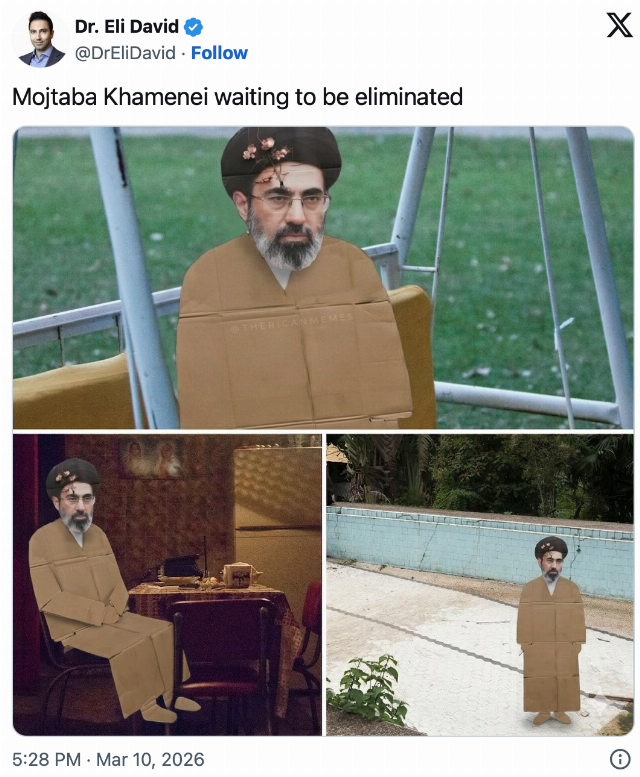
Graphic: X Post
The circumstances surrounding Mojtaba Khamenei’s emergence only deepen the uncertainty. He has not appeared publicly, nor has he issued a video or audio message since reports of his selection emerged earlier this year. Various reports have suggested that he may have been injured during recent attacks, although the extent of any injuries remains unclear. Whatever the reality of his condition, the larger issue remains unchanged: after decades of repression, corruption, economic decline, and international isolation, are Iranians prepared to accept another form of inherited rule?
When millions of Iranians took to the streets in 1979, they rejected more than a particular ruler. They rejected the notion that political legitimacy could be inherited. Whatever one’s view of the revolution’s legacy, few would dispute that opposition to hereditary power was among its defining themes.
For years, much of the discussion in Western policy circles has framed Iran’s future as a choice between the ruling theocracy and a return to monarchy. Yet this narrative overlooks a political reality that has become increasingly difficult to dismiss. A growing number of Iranians reject both alternatives.
They do not want the son of the Supreme Leader to inherit power. Nor do they want the future of their country to revolve around the son of a former Shah. What has emerged through successive waves of protests is a demand for something fundamentally different: a democratic republic in which political authority derives from the consent of the governed, not from family lineage.
This sentiment has become increasingly visible in nationwide protests. Demonstrators have challenged not only the current regime but also the idea of returning to past forms of governance. Their message is clear: Iran does not need another heir. It needs a new political system.
What makes this shift particularly significant is that it cuts across generations. Older Iranians who experienced both the monarchy and the Islamic Republic have seen firsthand the shortcomings of systems built around concentrated and unaccountable power. Younger generations, meanwhile, have grown up under clerical rule and are increasingly connected to democratic values and institutions beyond Iran’s borders. While their experiences differ, many have reached a similar conclusion: political legitimacy cannot rest on family lineage, ideological privilege, or religious authority. It must be earned through the consent of the governed and renewed through free elections.
That reality is often overlooked in international discussions about Iran. Foreign governments tend to focus on nuclear negotiations, sanctions, regional tensions, military confrontations, or succession battles within the regime. Important as these issues may be, they risk obscuring a deeper political transformation: the growing determination of ordinary Iranians to shape their own future.
Read more The World Cup Will Expose Los Angeles’ Liberal Illusion
That aspiration is reflected in the activities of organized democratic opposition movements that advocate democratic governance, political pluralism, gender equality, and the separation of religion and state. Among the most organized is the National Council of Resistance of Iran (NCRI), which has advanced a vision of a secular and democratic republic founded on popular sovereignty and fundamental human rights. Whether one agrees with every aspect of its platform or not, its existence challenges the assumption that Iran’s only alternatives are clerical rule or monarchy.
That challenge is expected to be visible on June 20, when hundreds of thousands of Iranians from across Europe and beyond gather in Paris alongside lawmakers, former officials, and supporters of democratic change. The significance of the gathering extends beyond any single organization. It reflects a broader current within Iranian society that seeks a future beyond both theocracy and monarchy and demonstrates that an organized democratic alternative exists. For many participants, the gathering represents not merely opposition to the current regime but support for a democratic alternative to both clerical rule and hereditary politics.
This explains why discussions about succession inside the regime often generate far less public enthusiasm than some outside observers assume. For many Iranians, the central issue is not who occupies the office of Supreme Leader, but whether any unelected individual should possess such sweeping powers in the first place. The debate is therefore larger than Mojtaba Khamenei. It concerns the future structure of the Iranian state itself.
This is the reality many policymakers have yet to fully recognize. The defining political divide in Iran is no longer between rival elites or competing claimants to power. It is between those who believe authority should remain concentrated in the hands of unelected rulers and those who believe it should rest with the people.
The question confronting Iran, therefore, is not whether power will pass from father to son. It is whether hereditary rule itself still has any claim to legitimacy.
Nearly half a century after a revolution that promised to end dynastic politics, Iran once again faces a historic choice. The real alternative is not one dynasty versus another. It is between authoritarian continuity and democratic change.
Iranians rejected hereditary rule once before. There is every reason to believe they will reject it again.
Read more Colorado’s Empty Classrooms Are a Warning for America