
Colorado colleges are bracing for what education experts call an “enrollment cliff.” Fewer high school graduates mean fewer college applicants, shrinking tuition revenue, budget cuts, mergers, and even campus closures.
Read more Republicans Won the Redistricting War. Will They Secure its Legacy?
The same phenomenon is unfolding nationwide. After years of warnings, the demographic reckoning has arrived.
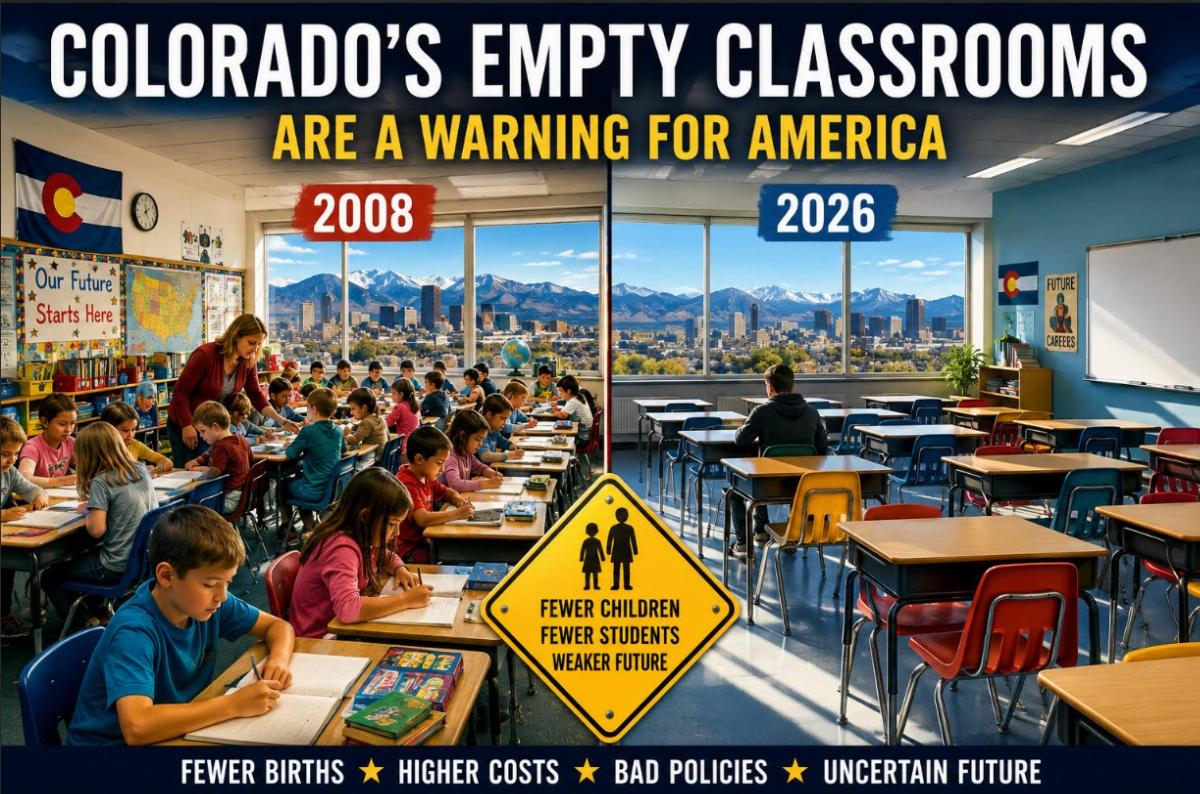
According to recent Colorado education data, public school enrollment fell by more than 10,000 students this year, the state’s largest decline since the pandemic.
Image generated by ChatGPT
State officials point to a simple explanation: there are fewer children. Birth rates have been declining for years, and those missing children are now becoming missing students.
Many analysts trace the problem to the 2008 financial crisis. As economic uncertainty grew, Americans postponed marriage, delayed having children, or chose to have fewer children altogether. Eighteen years later, right on schedule, colleges are seeing the predictable consequences.
That explanation is correct, but incomplete.
The enrollment cliff itself was largely set in motion nearly two decades ago.
But instead of addressing the underlying causes of declining family formation, policymakers have spent the last twenty years making them worse.
Colorado provides a revealing case study.
In 2008, the median Denver-area home price was about a third of what it is today, $225,000 then and $610,000 today.
Colorado was once a magnet for young families. Affordable housing, good schools, abundant jobs, and a high quality of life attracted newcomers from across the country.
Today, many of those same advantages are eroding. The state remains desirable, but increasingly expensive, particularly for young adults contemplating marriage, homeownership, and children.
Housing costs have dramatically outpaced wage growth. Young adults face not only higher mortgage payments but soaring rents, childcare expenses, insurance premiums, property taxes, fees, and utility costs.
Starting a family increasingly feels like a luxury good or a vacation home.
How are Coloradans responding? They are leaving for greener pastures. “For the first time in 20 years, more people left Colorado to go to other states than moved here from elsewhere in the country, 12,100 more.”
Politicians frequently express concern about declining birth rates while simultaneously supporting policies that increase the cost of living. Every new tax, fee, regulatory mandate, or housing restriction ultimately lands somewhere. Increasingly, it lands on young families.
Denver Public Schools officials themselves cite housing affordability as a significant factor in the decline in enrollment. Families with children are increasingly priced out of many neighborhoods.
Then came COVID.
The educational damage from prolonged school closures is still being measured. While graduation rates have recovered and even improved statistically, many students disengaged from traditional education during the lockdown years.
Some shifted to homeschooling. Others moved to online alternatives. Some never fully reconnected with the educational system at all. Colorado continues to see growth in alternative education pathways while traditional enrollment declines.
Parents learned an important lesson during COVID: school systems need families more than families need school systems.
The result is fewer students in traditional classrooms and growing financial stress on institutions built around perpetual enrollment growth.
Higher education faces a similar challenge.
Clemson is $1.5 billion in debt. Syracuse is closing or pausing 93 programs, UNC-Chapel Hill plans to cut spending by $89M over 3 years. Duke recently let 600 employees go in a $350M budget cut. Indiana public colleges announced a plan to eliminate or merge 580 programs statewide.
These institutions did not suddenly become less capable. They built budgets, staffing levels, and facilities around demographic assumptions that are no longer true.
Read more Trump’s beautification of Washington, D.C. infuriates Democrats
For decades, colleges believed that more students would always arrive. New administrators were hired. Diversity bureaucracies expanded. Campus amenities multiplied. Tuition rose relentlessly.
Now the supply of students is shrinking. The business model is under pressure.
At the same time, confidence in higher education has declined as tuition rises faster than inflation, while many graduates leave campus burdened with debt and degrees offering uncertain economic returns.
Many universities face growing financial challenges as the number of traditional college-age students declines nationwide. Experts project significant decreases in high school graduates over the next decade, especially in western states such as Colorado.
The response from many policymakers has been predictable: import more people.
Immigration can increase population numbers. It cannot automatically create social cohesion, economic productivity, or cultural stability. And as is evident in many Western countries, unfettered immigration produces the opposite.
Milton Friedman famously observed that a welfare state and open borders are incompatible. The reason is straightforward. Immigration can be enormously beneficial when newcomers assimilate, work, and contribute more than they consume. Problems arise when large numbers of arrivals become net recipients of public benefits.
Across America and Europe, political leaders increasingly appear to view immigration as a substitute for declining native birth rates. It is not.
A nation cannot sustainably replace its future workforce by importing non-assimilating and culturally disruptive populations while simultaneously discouraging its own citizens from forming families.
The demographic crisis extends beyond economics.
For years, young Americans have been bombarded with apocalyptic messaging. They aretold the planet is on the verge of climate catastrophe. They hear predictions that future generations will inherit an unlivable world. Some activists openly argue that having children is environmentally irresponsible.
When people are repeatedly told that the future is bleak, some begin acting accordingly.
Fewer marriages. Fewer children. More social isolation.
Then society wonders why fertility rates collapse.
The irony is striking.
The same political and cultural institutions that express alarm about declining school enrollment, labor shortages, and demographic decline often support the very policies and narratives that contribute to those outcomes.
Colorado’s shrinking classrooms are not merely an educational story.
They are a warning sign.
Empty desks today become unfilled jobs tomorrow. Fewer workers mean slower economic growth. Fewer taxpayers mean an increasing strain on entitlement programs. Fewer families mean weaker communities.
No civilization prospers by producing fewer children generation after generation.
Importing students or cheap labor may temporarily fill the gap, but the cost is the loss of social cohesion and shared purpose with eventual Balkanization.
The enrollment cliff is not the disease.
It is the symptom.
The deeper problem is a society that has steadily made family formation more difficult, more expensive, and less culturally valued.
Eighteen years ago, Americans had fewer children.
Today, colleges are discovering what that means.
Demographic decline is unlike most policy failures. What took a generation to create cannot be fixed by the next election cycle.
The real question is whether policymakers are willing to learn the lesson before the next demographic cliff arrives.
Brian C. Joondeph, M.D., is a Colorado-based ophthalmologist who writes frequently about medicine, science, and public policy.
Read more Germany’s National Socialist policies seem strangely familiar
Follow Brian:
Twitter @retinaldoctor
Substack Dr. Brian’s Substack
Truth Social @BrianJoondeph
LinkedIn @Brian Joondeph
Email [email protected]