
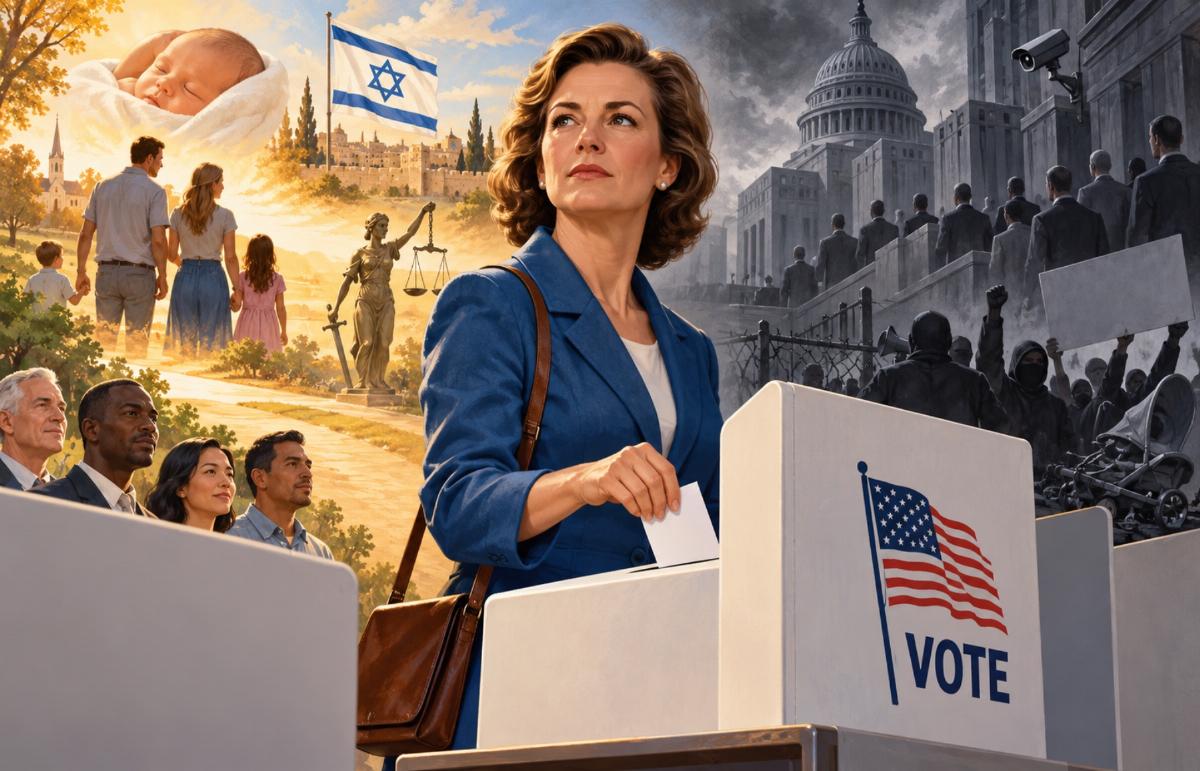
For most of my life, I lived in overwhelmingly Democrat communities. I grew up in San Francisco and then raised my children in Marin County. And one thing I always said about my neighbors was that, whatever their politics, they were lovely people who lived remarkably conservative lives.
Read more Mountains Or Molehills?
They were educated. They married before having children. They worked. They created stable homes. They raised their children with structure, discipline, and manners. They were good friends, and I miss many of them now that I no longer live there.
Politically, though, virtually every woman I knew was a single-issue voter. That issue was abortion.
My friends might deplore crime, but they would still vote for politicians whose policies encouraged it. They might be uncomfortable with open borders, but they would vote for the party opening them. They weren’t necessarily enthusiastic about racializing every aspect of American life. Many were still old-fashioned Martin Luther King liberals who believed people should be judged by the content of their character rather than the color of their skin.
But when push came to shove, none of that mattered. Abortion trumped everything.
Since the Dobbs decision returned abortion policy to the states, I’ve sometimes wondered how those women vote now. And thinking about them made me realize something about myself: I’ve become a single-issue voter, too.
My issue is antisemitism.
More broadly, that includes the obsessive demonization of Israel, the world’s sole tiny Jewish state—a country of fewer than 10 million people surrounded by hundreds of millions of Muslims—now routinely portrayed as uniquely evil, genocidal, and responsible for seemingly every misery in the Middle East.
Of course, I’m Jewish, so antisemitism has a personal resonance for me. But that’s not why it has become my political dividing line.
For me, antisemitism has become a proxy for something much larger: whether a political movement ultimately reveres life and individual human worth or is comfortable subordinating both to ideology and the state.
The Bible, whatever one’s personal religious beliefs, gave Western civilization something revolutionary. The ancient pagan gods were arbitrary, capricious beings whom people attempted to placate. Biblical Judaism introduced an ethical God and a moral order independent of rulers and human convenience.
At the center of that moral order is the value of human life. God created mankind, so human beings have inherent worth that neither kings nor governments confer on them.
That doesn’t mean biblical morality rejects punishing people, including execution. Quite the opposite. The Bible recognizes that justice sometimes requires the ultimate punishment because murder is an attack upon something sacred. The principle is not that life must be preserved under every imaginable circumstance. Instead, innocent life has intrinsic value, and justice matters.
“Choose life” is not merely a random Biblical mandate. It describes an entire moral orientation.
Read more Our Brothers to the south, not the east
Abortion points in the opposite direction. It says that innocent human life can be extinguished because it is inconvenient, unaffordable, badly timed, or emotionally unbearable. I understand those arguments very well. I grew up in completely pro-abortion circles, and it took me years to change my thinking.
But once a society accepts convenience as sufficient justification for ending innocent life, euthanasia follows surprisingly naturally. An elderly person is suffering. His care is expensive. The government is paying the bills. A younger person works, produces, and pays taxes. From a purely utilitarian perspective, keeping the old person alive begins to look inefficient. And once you’ve embraced what you tell yourself is merciful euthanasia (as the Nazis did in the 1930s when they started euthanizing allegedly defective people), the trip to genocide is very short.
That is the danger. Once human worth is no longer inherent, somebody gets to decide whose life is worth the cost—and that somebody inevitably becomes the state.
This is also why the life issue ultimately connects to individual liberty and limited government. If the individual has inherent value, the government exists for him; he does not exist for the government. In a life-oriented system, the state cannot legitimately decide that people are disposable merely because they have become inconvenient.
This is where antisemitism and anti-Israel politics enter my calculation.
The Jewish people gave the world this biblical moral tradition. That certainly doesn’t mean every Jew lives by it; plainly, they don’t. Some of Abdul El-Sayed’s wealthy supporters, for example, are Jewish. Nor does one need to be an Orthodox Jew, keep kosher, or dress in traditional garments to embrace biblical ethics. I certainly don’t.
But I have come to believe that reverence for the Jewish inheritance and respect for Israel tend to travel with a broader respect for life, individualism, and Western moral principles. Conversely, the political movement that is increasingly hostile to Israel is also the movement most committed to abortion, euthanasia, expansive government, and the elevation of the state over the individual.
These things are not disconnected, which brings me to my single issue. At this moment in American politics, the Republican Party is the party that is far more supportive of Israel, far more resistant to antisemitism, and far more aligned with the proposition that innocent human life has value. The Democrat Party is increasingly moving in the opposite direction (and yes, I know there are the antisemites still parading under the Republican banner, but polling shows that, thankfully, they are still a fringe).
That matters to me more than any individual politician. A politician can disappoint me. I can dislike his conduct, object to his policies, or think him personally objectionable. But elections are ultimately about more than personalities. They are about the moral direction in which a political party will take the country.
This is why I’ve become what my Marin neighbors once were: a single-issue voter. Their issue was abortion. Mine is life.
So, if you like death, vote for Democrats. And if you cherish life, vote for Republicans.
Read more Tear down that woke
Image created using AI.