
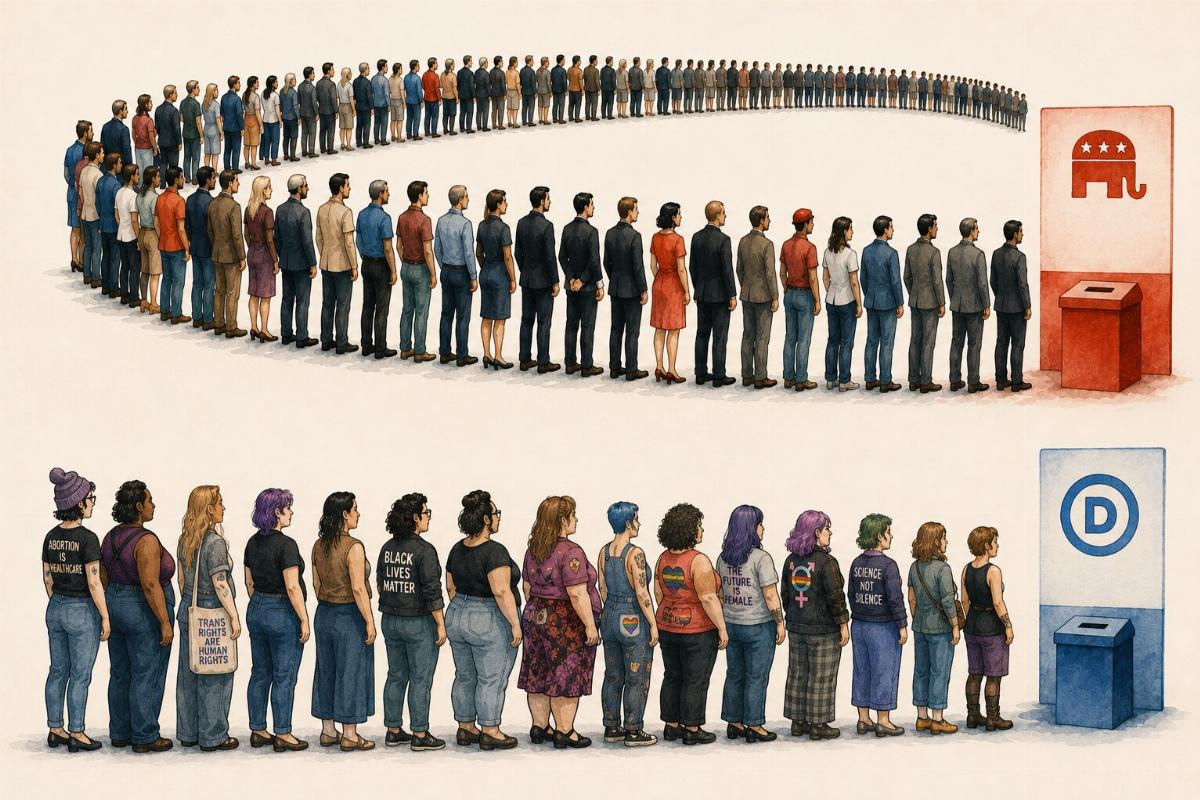
The Democrats are not just at the mercy of their socialist wing. They are in a state of bewilderment as to why all their attacks on men—“toxic” is such an alienating prognosis—has disenfranchised their once-was base of blue-collar, unionized men.
Read more An Islamophobic murder blows up in the media’s face
Nevertheless, a recent opinion piece in that central pillar of leftist thought, The New York Times, titled “America Has a Masculinity Crisis,” has all the answers they cannot see—albeit between the lines.
In it, the Times’s culture editor, Nadja Spiegelman, speaks with Frederick Joseph, whose books include The Black Friend: On Being a Better White Person and Patriarchy Blues: Reflections on Manhood, and Ruth Whippman, a British-American opinion writer and the author BoyMom, to have a “much-needed, nuanced conversation about masculinity and feminism today.”
In the setup, the opinion piece says, “Young men are in crisis. While the left tells men to stay in their lane, members of the manosphere and the far right are welcoming them with open arms.” The opening paragraph then claims these handpicked authors will explain “what a healthier version of manhood could look like—and how we can get there.”
Joseph begins with “I think the reality is that we’ve always had patriarchy at the intersection of capitalism and white supremacy….”
“Yeah, I would agree,” says Whippman. She then uses the phrase “caricatured masculinity” to describe what she calls “this tough guy, bulletproof man,” though doesn’t seem to realize this stereotyped simplicity is her bias on display.
Still, Whippman does then say something honest by noting that the left tells the men who complain about the treatment to “shut up,” which is not helpful to anyone.
After that snort of honesty, however, they continue on aggressively agreeing about the toxicity of the patriarchy. The discussion soon settles into a lot of wondering about how they can formulate a reductionist doctrine that boys and men will willingly ingest so they can be re-indoctrinated as voters for a Democrat party that loathes them.
It is almost a productive endeavor, but the social constructs these three leftist intellectuals have been so dutifully taught in college and by the Times continually obstruct them from the fact that actual manliness—self-reliance, a can-do gumption, a willingness to problem solve out of a natural disaster or home-maintenance issue, a real-world understanding of the need to shake off a skinned knee or bruised ego to get something done (and to tell their sons and daughters to do the same)—are beyond the scope of the academic constructs these leftists are captured by.
And therein lies the chasm they cannot see to cross.
Joseph tries to articulate what the next steps must be for Democrats to win male voters back, but derails himself with the claim that masculine men “don’t teach you how to cry. They don’t teach you how to laugh. They don’t want you laughing. They don’t want you crying because they actually do, in capitalism, want to monetize that rage of yours. That’s how you get the manosphere.”
Read more A captured terrorist has a blunt lesson for us
Uh, what?
Joseph somehow combines a sexist stereotype from the left (yes, against men) with a criticism of private property and earned wealth (capitalism) and then says it adds up to the manosphere.
Okay, if your narrow worldview is that men who run the patriarchy must be defeated—and not just defeated, but belittled, bled dry, and their wealth redistributed—then this will be your cartoonish political analysis to explain why Democrats have lost so many male voters.
Indeed, this analysis from Joseph descends into,
And I think there is so much toxic masculinity, and I hear boys all the time say, ‘I literally do not know what it means to be a good boy or man.’ Because I think, on the one hand, all you see is these terrible role models who aren’t role models at all. On the other hand, you have people saying what isn’t good, but you have to tell people what can be good, right?
Instead of now articulating the left’s manly heroes—granted even Hollywood’s best struggle with this feat—Joseph shifts to argue that being a good white person is different from being a good person of color. It is lost on Joseph that we all have the same rights. With Joseph, equality is not the goal. He wants revenge against a strawman. He has over-simplified the problem, as the left’s reductionist theory has taught him to do, into a power struggle between the oppressed and oppressors.
As with Whippman, who derailed her beginning of a point upon feminist theory, he derailed his on race.
The thing is, Joseph is right that young men, and men in general, need role models or heroes. This is why I wrote Cool Heroes for Boys—20 True Tales of Adventure to tell the truth about men who did and stood for big things that boys and men today can learn a lot from—but, tellingly, that the left has cancelled.
If only these leftist thinkers for the Times, and for the rest of the Democrat party, could break away from their self-empowering academic theories on men, they might come to a real reformation in the Democrat party. That could be beneficial for all of us.
Frank Miniter is, ironically, a New York Times best-selling author. His latest book is Cool Heroes for Boys—20 True Tales of Adventure.
Read more Scott Pelley kicks himself out at 60 Minutes
Image generated by ChatGPT.