
“If you build it, he will come,” says the voice whispering to Iowa farmer Ray Kinsella, played by Kevin Costner in Field of Dreams, a good movie from an earlier time. A contemporary, but far less entertaining and noble, parallel might be: “If you fund them, they will come,” which describes what’s happened to California, and particularly Los Angeles, with the “homeless.”
Read more Facts the critics of Israel should know
The California Globe says:
Gov. Gavin Newsom has spent $37 billion on homelessness since 2019, yet undercounts the homeless, according to the California Legislative Analyst’s Office 2025-2026 budget overview.
The state has also spent $900 million on “encampment resolution funding” – encampment removal and cleanup. Yet, homelessness is growing.
Undercounts? Like this:
So, California is counting 181,000 homeless but serving 316,000? That doesn’t add up.
Like pretty much everything else in California, homelessness is big business, and none of the numbers add up. Also, it’s an employment boom for bureaucrats administering homeless programs without any accountability, as Stephen Green at PJ Media reports:
Before we take a look into just how profitable and luxurious it is not to solve the Los Angeles homelessness crisis, let me first advise you to delay that next cup of coffee and make sure that you’ve taken any and all prescription blood pressure medication.
A California-based independent journalist going by InnerRhythmMedia — think of him as Nick Shirley 2.0 — recently looked into the headquarters of the Los Angeles Homeless Services Authority, and what he found looked more like a multibillion-dollar Silicon Valley firm than a joint city-county government project.
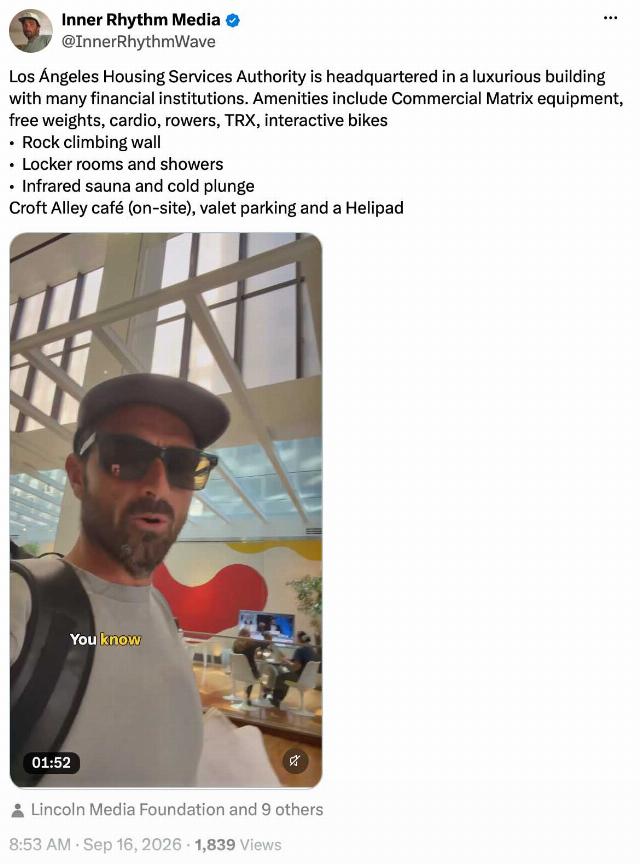
Graphic: X Post
That’s a nice gig if you can get it. Apparently, no threadbare, underpaid clerks labor away in dimly lit, wretched, Dickensian cubicles. Not helping or decreasing the number of the homeless obviously requires very high salaries and benefits and lavish working conditions. How high are the salaries?
- Chief Executive Officer, Va Lecia Adams Kellum, $491,908
- Chief Financial Officer, Janine Trejo, $299,912
- Deputy Chief, Systems, Nathaniel VerGow, $257,196
- Chief of Staff, Rachel Johnson, $252,079
- Chief Operating Officer, Tifara Monroe, $248,367
As I said, a nice gig if you can get it. One suspects none of these folks are ensuring lower-paid employees are putting in a solid eight hours per day when they’re not in the sauna or pumping iron, or on the rock climbing wall. And how are these pampered princes and princesses spending all that taxpayer money? Like this:
Read more English is and should be America’s official language
It seems like just earlier this week [It was just earlier this week, Steve —Editor] that I looked into the city’s “mansion tax” that was supposed to help the homeless and build low-cost housing, but after three years, has raised less than half the expected revenue, destroyed an estimated 16,650 construction jobs, cost the city about $450 million in lost tax revenue, and actually disincentivized the construction of 9,100 housing units (in a city with a permanent housing shortage), including about 1,000 low-income units.
But the weirdest part of that story is how little money the city has spent so far — and where it’s gone. So far, Los Angeles has spent just $114 million over three years, or a little less than 10% of the $1.2 billion raised so far.
- Emergency rental assistance: $32.49 million
- Eviction defense and prevention: $24.15 million
- Multifamily affordable housing: $15.87 million
- Income support for at-risk seniors/disabled: $9.88 million
- Tenant harassment protections: $6.93 million
- Tenant outreach and education: $4.05 million
- Homeownership assistance: $3.62 million
- Administration & oversight: $17.20 million
That’s a lot of money, but it’s not being spent as you’d think, or maybe you would:
Emergency rental assistance? Sure, let’s help people who lost their jobs or whatever pay the bills. Build some low-income apartments (“multifamily affordable housing”), fine. And nobody wants to see seniors or disabled people kicked out on the streets, and maybe helping people with the down payment on a house wouldn’t be so bad. Add it all up, and that’s $61.86 million.
The rest — that’s $52.34 million, or nearly half of the $114.2 million for the various programs — goes to lawyers, consultants, administrators, and overseers. And that’s assuming, as stipulated above, that every single cent of the other half goes where it’s meant to.
That wouldn’t be a very bright assumption. And so it goes in California, the state with the most illegal aliens and the highest poverty rate, where everyone who can flee has or is, where the homeless magnet is still fully powered, and where the income gap between the middle class and the selfless servants of the homeless is ever-expanding. True, the homeless don’t get all that much money, but they get enough: free needles, no one is really trying to remove or help them, and the climate is great.
Kind of gives a new meaning to “the golden state,” doesn’t it?
Become a subscriber and get our weekly Friday newsletter with unique content from our editors. These essays alone are worth the cost of the subscription.
Mike McDaniel is a USAF veteran, classically trained musician, Japanese and European fencer, lifelong athlete, firearm instructor, retired police officer, and high school and college English teacher. He is a published author and blogger. His home blog is Stately McDaniel Manor.
Read more A plague, a lack of accountability, and the nations we deserve