
I watched Abdul El-Sayed’s interview with Martha MacCallum and initially thought I was watching a politician who simply talked very fast. The longer I watched, however, the less I thought speed was the important part. There was a method underneath it.
Read more Amazon took 20 years, but AI will take less
I started noticing the same thing happening over and over. MacCallum would ask about something fairly specific, and El-Sayed would take one of the words in her question, redefine it, and then proceed as though his definition were the one everyone had agreed to use. Suddenly, MacCallum wasn’t asking the question anymore. She was defending herself against his version of it.
Once I saw it, I couldn’t stop seeing it.
Take capitalism. MacCallum challenged El-Sayed on how his policies fit with capitalism. He answered by defining capitalism around supply and demand, saying he believes we should leave it to supply and demand to determine where capital goes and what goods are produced. That sounds perfectly reasonable. Then he started building the rest of his definition.
He talked about government providing what he called the “basic foundations” of society: good schools, clean air, clean water, health care, and childcare. Those things, in his formulation, can coexist comfortably with capitalism.
Fine. But notice what just happened.
He took a word everybody already understands and expanded it to accommodate his own political program. Once that definition is accepted, the argument changes. If you object to the government’s role in providing those things, you aren’t merely disagreeing with El-Sayed anymore. You can be portrayed as somebody who doesn’t understand capitalism.
He defines the playing field, then tells you you’re playing the game wrong.
That same maneuver appeared when MacCallum asked about the amount Americans pay for government services. El-Sayed didn’t spend much time explaining the cost of those services, why they cost what they do, or whether government delivers them efficiently. Instead, he talked about wars America shouldn’t be fighting and wealthy Americans who don’t pay enough in taxes.
Maybe those are legitimate arguments. But they are answers to different questions.
That is what kept catching my attention throughout the interview. When a question became inconvenient, the subject seemed to move just enough to make the question easier to answer.
Then they got to terrorism.
MacCallum asked about specific organizations that had already been designated as terrorist organizations. El-Sayed responded by defining terrorism as “the act of political violence.” He then effectively put the burden back on her: Show me that the organization engages in political violence, and he would support the designation.
The Iran discussion was even more revealing. MacCallum was asking about Iran, the threat it represents, and American military action. El-Sayed turned the discussion toward American responsibility, asking whether war itself creates more violence and whether the United States should examine the consequences of its own actions.
Again, those are questions worth debating, but they aren’t an answer to the question of what America should do when a hostile regime presents a threat.
Read more Canada approved woman for MAID euthanasia because she could no longer make Sunday dinners
The health care discussion followed the same path. “Medicare for All” sounds wonderful. Who doesn’t want everybody to have health care? But a slogan is not a health care system. At some point, somebody has to explain who will pay for it, how much they pay, who runs the system, how doctors and hospitals get reimbursed, what happens to private insurance, what happens to employer coverage, and how the government keeps the whole thing from becoming another enormously expensive bureaucracy.
El-Sayed instead went back to how much Americans already spend on health care and how much money flows to insurance companies, pharmaceutical companies, hospitals, and corporate executives. But telling us what’s wrong with the current system doesn’t tell us how the replacement system works.
That same problem surfaced in his discussion of socialism. El-Sayed used garbage collection as an example of something government provides without Americans necessarily thinking of it as socialism. But garbage pickup isn’t some mystical government service that appears because we have collectively decided it belongs on the socialism shelf.
Someone provides the trucks. Someone employs the workers. Someone writes the contract. Someone pays the bill. In many communities, the government contracts with a private company to do the work. There are decisions about cost, competition, service, and accountability.
Calling something a “basic foundation” doesn’t answer those questions. It simply makes the government’s involvement sound obvious and inevitable.
The common thread among all the above topics isn’t any particular policy. It’s control of the vocabulary. Once you control the definition, you control the argument. And El-Sayed is fast enough that you can miss the handoff.
That’s what makes him effective on television.
He doesn’t look as though he’s dodging a question. He looks as though he’s giving you a sophisticated answer. He’s confident. He’s articulate. He has another point ready before you’ve finished processing the first one.
But eventually you have to stop listening to the speed and start listening to the substance.
I don’t know whether Abdul El-Sayed has no ideas. Maybe he has plenty of them. What I saw in this interview was something more interesting: a politician who is extraordinarily good at avoiding the obligation to explain them.
But governing isn’t defining words until your policies fit inside them. Governing is taking responsibility for what happens after the words become reality.
Read more Stupidity: Is It The New Political Power?
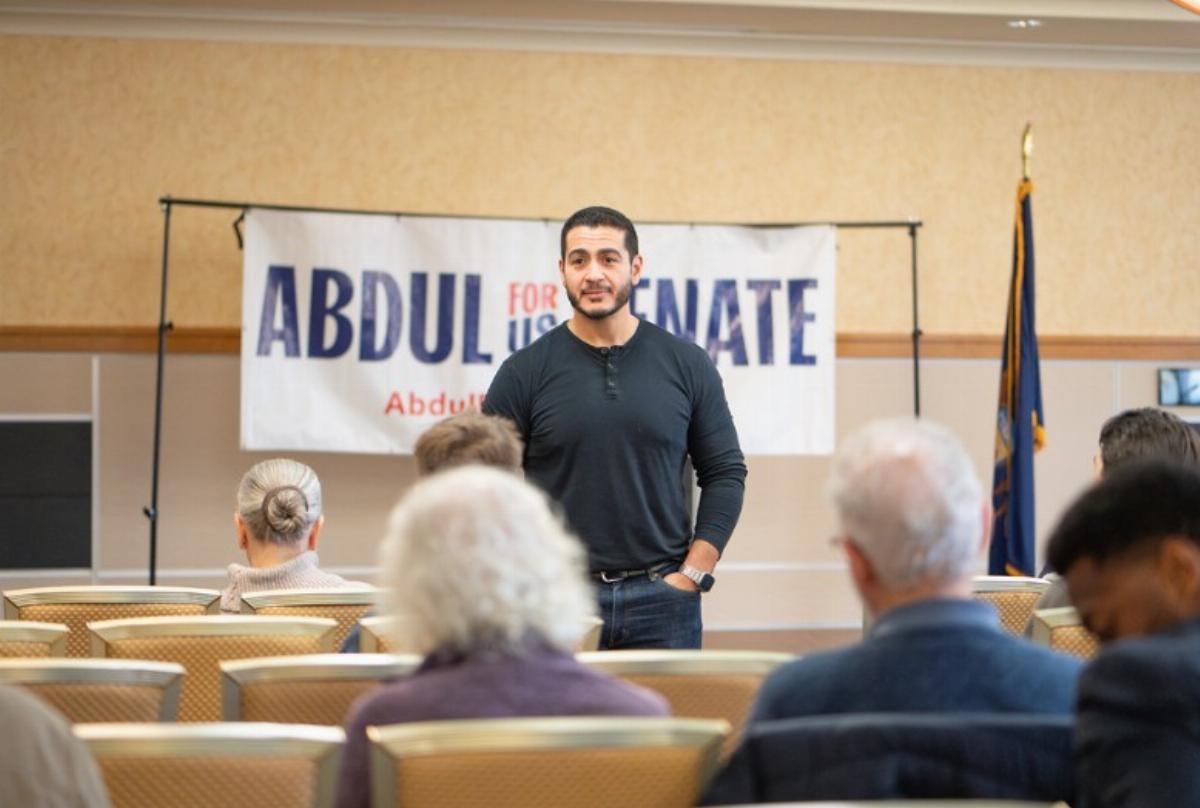
Image: Abdul El-Sayed. Credit: Conlan Houston via Flickr, CC BY-SA 4.0.