
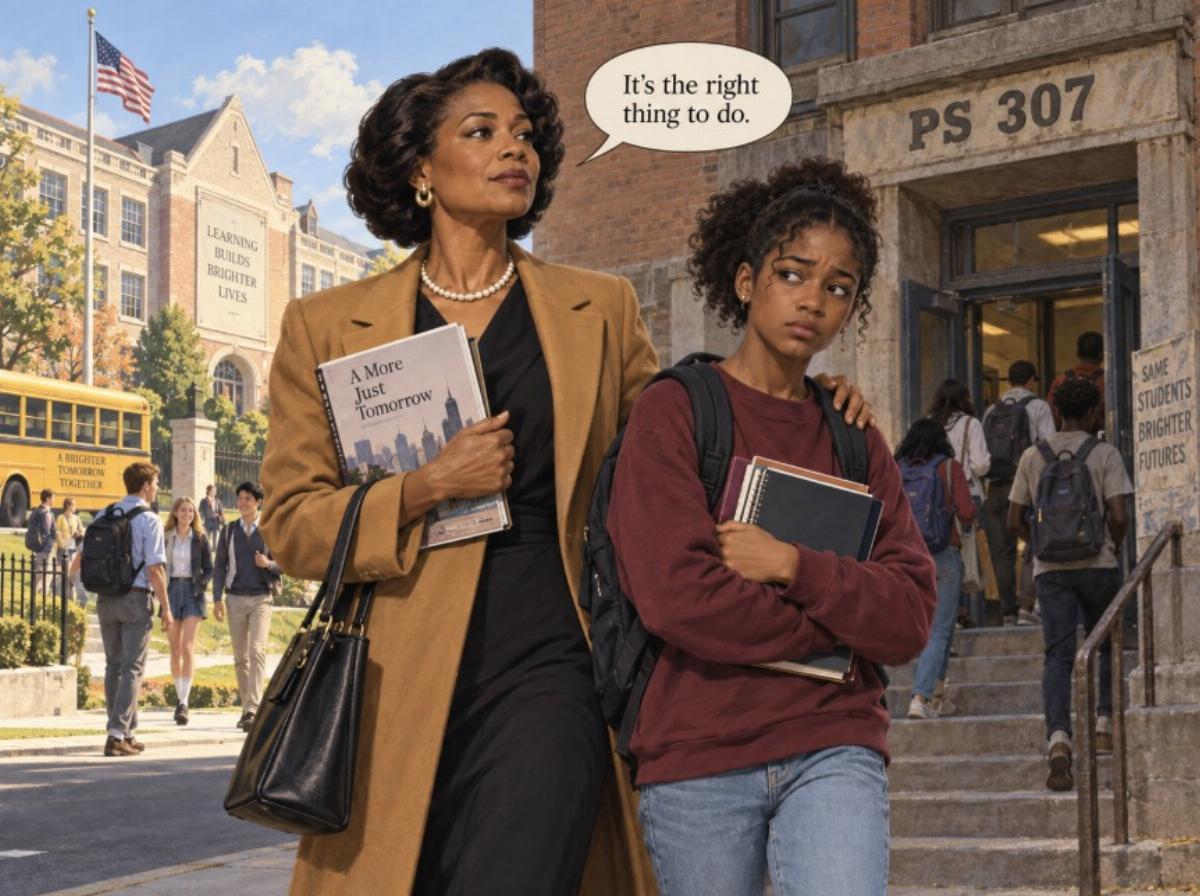
It’s not easy being the child of an ideologue, especially when your parent is famous for those ideas. The past centuries have revealed many children treated abominably as their parents pursued their beliefs. Now, Najya Hannah-Jones, the 16-year-old daughter of Nikole Hannah-Jones, the woman behind the error-filled 1619 Project, can be added to the list.
Read more Hennepin County, MN: we’re number one–in fraud
For centuries, ideologues, whether anxious to live by their own theories regardless of their children’s needs or to prove those theories using their children as guinea pigs, did terrible things to their children.
Jean-Jacques Rousseau, who said, “Man is born free, and everywhere he is in chains,” never intended to be chained to children. Despite being famous for his wholesome child-rearing theories, he consigned all five of his children to a foundling hospital. It’s unknown whether any survived.
Mahatma Gandhi refused to give his son Harilal the same quality English legal education he’d received. When a scholarship opportunity arose that would have benefited Harilal, Gandhi nominated other young men.
Doris Lessing, a hardcore communist in southern Rhodesia, abandoned her two children to ally herself with a communist who rejected the entire notion of family. She later came to regret that decision.
Bronson Alcott, one of the early transcendentalists, kept his family in grinding poverty so that he could live out his ideals, most of which involved him not working. I guess we should be thankful, though, for Louisa May Alcott might never have written her transcendent girls’ books were it not for financial necessity.
Leo Tolstoy became a radical Christian worshipper, eschewing worldly goods and plunging his family into poverty. Ultimately, he transferred his remaining property to his wife and children.
And now there’s Hannah-Jones. In an essay in The New York Times Magazine, Hannah-Jones explains that, in service to her radical racial ideas, she and her husband deliberately put their daughter into one of New York City’s all-black schools. “Our decision had been informed by values shaped by my years of reporting on the enduring and too often seemingly hopeless battle for school integration.” In other words, if the city’s poor black children weren’t going to a good school, neither would her daughter.
According to Hannah-Jones, the problem of poor black education lies entirely with systemic failures, especially the absence of cold, hard, capitalist cash:
Nationally, a Black student is less likely to have teachers who are qualified and experienced, and to be offered rigorous and college-prep curriculum, to have up-to-date technology and attend school in modernized facilities.
In New York, a combination of housing segregation and “academic” sorting, called school choice, that begins as early as pre-K means most Black students — even middle-class ones — are forced to attend racially segregated schools with high rates of poverty. And nationally, schools in predominantly nonwhite districts receive $23 billion less in annual funding than their heavily white counterparts, according to a 2019 analysis by EdBuild. In everything that we measure, these schools have less, even though the economically struggling student bodies they serve need more.
Read more A college student’s manifest mental instability should worry us all
What Hannah-Jones ignores, of course, is culture. During my youth in San Francisco, the public schools were flooded with Asian students. Their families had escaped Mao’s Chinese communism, Cambodia’s killing fields, and Vietnam’s wars. They lived in abysmal poverty in and near Chinatown. Few had English-speaking parents. They wore used clothes, smelled unwashed, and had no money for educational frills such as better books, tutors, and extracurricular activities.
Nevertheless, most thrived academically. So many got into San Francisco’s academic high school, Lowell, that leftists on the school board put a quota on them, and when the quota was finally knocked down in court, the school board destroyed Lowell’s academic standing.
The Asian kids I knew were not unique. The same story has been repeated with other cultures obsessed with education, from turn-of-the-last-century Jews to modern Indian immigrants. They figured out that, in America, education is the key to wealth.
Meanwhile, as John McWhorter described powerfully in Losing the Race: Self-Sabotage in Black America, since the 1960s, the black approach to education has been that doing well in school is a white thing. You are denying your racial heritage if you study.
The grand court-ordered experiment in Kansas City, Missouri, showed that no matter how much money you throw at a school, if the culture is anti-education, nothing changes. Federal district judge Russell Clark ordered roughly $2 billion spent on Kansas City’s predominantly black school district, yet academic performance failed to improve as hoped.
But for an ideologue like Hannah-Jones, the problem is always systemic, never cultural or personal. Therefore, her child had to be sacrificed. She and her husband were well-educated and affluent, but they were determined to make a point. So their child went to Public School 307, “a segregated, high-poverty school across from the Farragut housing projects in Brooklyn.”
Hannah-Jones’s essay is too long to summarize adequately here, but the bottom line is heartbreaking. Her daughter was plunged into a chaotic, unpleasant environment where she was learning nothing.
But you know what the worst thing about the essay is? How Hannah-Jones ends it:
But for all of our justifications, including mine, an undeniable verity remains. As long as we continue to rescue our own children from the failing schools where we allow other people’s children to languish simply because those children have been born Black and poor in a nation of racism and riches, there is no absolution here. Not for me. Not for you. Not for any of us.
In other words, I feel bad about what I did to my daughter, but it was still the right thing to do. For leftists, it’s a politically correct form of child sacrifice.
Read more Bums of Santa Monica, living their best lives in state-financed luxury
Image created using AI.