
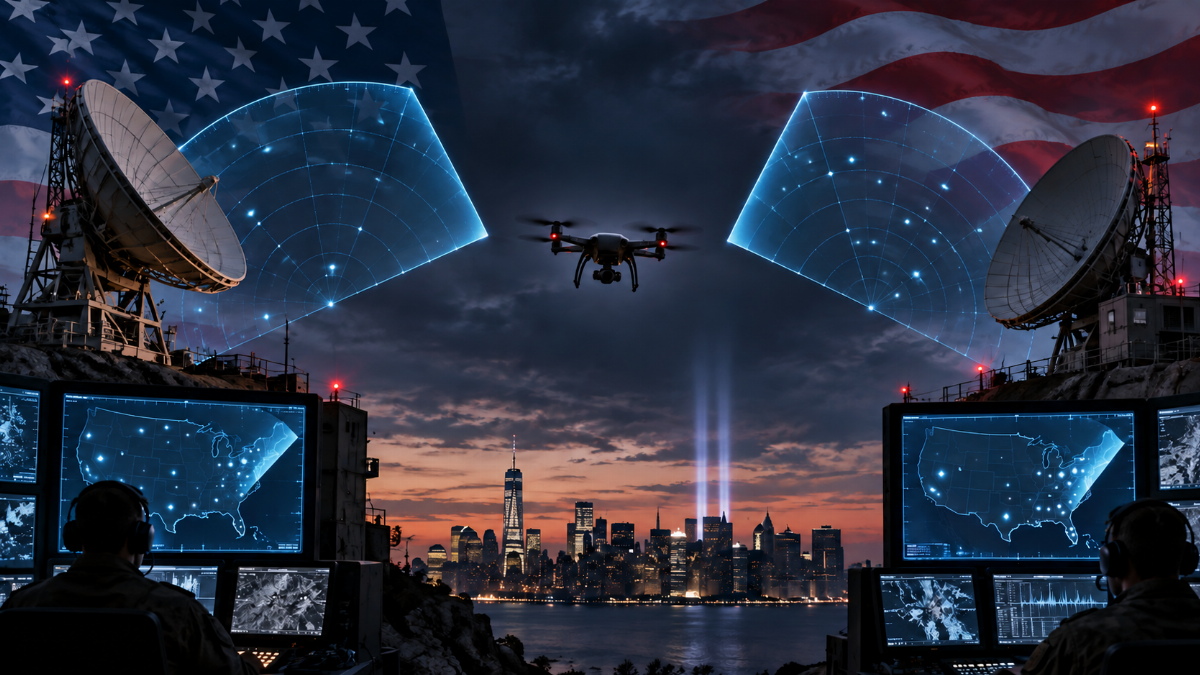
This month America marks 25 years since the September 11th terrorist attack. The lesson of that morning was never about equipment, but agencies that did not share what they knew and people on the front line who had not been trained for what came. The military’s air defense sector learned that United 93 had been hijacked four minutes after it crashed. The 9/11 Commission called it a failure of imagination. The pieces were there, but no one put them together.
Read more Boobwatch: California Sen. Alex Padilla unwittingly highlights company that fled his state
That blind spot is reappearing, only this time the threat is a drone.
Drones are already probing American defenses within the homeland. Within days of the first strikes on Iran earlier this year, one was flying over a strategic U.S. military installation. The commander of U.S. Northern Command told the Senate his forces handled it. However, the defense used is called a ‘flyaway kit,’ a small team with portable gear dispatched to a base after a drone shows up. That is a fire brigade; what the country lacks is the fire code: standing sensors, shared data and trained people at every important site. Northern Command’s deputy commander said in August that, depending on where a swarm struck, the military might have not had sensors to see it or weapons to stop it. “We are ill-equipped right now to handle something like that.”
The World Cup this summer showed what the alternative looks like. The Pentagon’s counter-drone task force counted more than 1,600 unauthorized drones over host cities because, for one tournament, the military, the FBI, Homeland Security, and local police were pulled into a single operation working from a shared picture. That coordination was assembled for a sporting event, and ordinary critical sites do not get it.
The Pentagon’s 2027 budget request includes tens of billions of dollars for drones, counter-drone technology and related systems. The problem is not a lack of money, but what happens after the equipment is delivered.
Rep. Ryan Zinke, a former Navy commander who sits on the House Appropriations Committee, said on the Impact Point podcast: “I can buy the best shotgun in the world, but I’m not going to be very effective unless I train with it.” By his account, many counter-drone systems in the field are being run at about 70% of what they can do.
Two gaps explain why so much paid-for capability goes unused.
The first is training. Teaching a soldier, a guardsman or a sheriff’s deputy to use equipment already in his hands takes weeks, not years. The counter-drone task force has trained about 500 state and local officers under rules that took effect in July. The 2018 federal census of law enforcement counted roughly 788,000 sworn officers.
The second is coordination. When a drone appears over a refinery or a football stadium, the response involves a base commander, a Guard unit, a county sheriff, the FBI and the FAA. Most have never trained together and cannot share what they know when it matters. The task force’s own leaders said that a year ago many of them “were strangers working adjacent problems.”
Read more Leftists’ fan-girling over Lindsay Clancy is the logical end of pro-abortion activism
A member of that task force told me this summer that demand for counter-drone capability is now being shaped almost entirely by the warfighter in the field. That is healthy, but requests from the field tell you which sensor a unit wants next, not that a sheriff in Ohio and a Guard unit in Texas need to train from the same picture. Shared training and a common operating picture are strategic requirements, and they have to be set from the top.
Congress can close both gaps without spending another dollar by attaching three conditions to the counter-drone money it has already approved.
First, make training a condition of the money. Every counter-drone dollar should carry a required share for training the people who will operate the system.
Second, require an independent assessment. An independent evaluator should report to Congress each year on how much of each fielded system’s capability is actually in use, what sits idle, and why.
Third, require one common operating picture. Counter-drone vendors are competitors, and do not make their products work together unless government requires it. Congress should direct the Department of War, Homeland Security, and the FAA to designate a single platform, selected through open competition, that every counter-drone sensor and system the government buys must connect to, and to require that every agency that would respond to a drone train together on that platform before a crisis occurs.
The failure the 9/11 Commission described was agencies that could not see what the others saw. Twenty-five years later we have the sensors, the money, and fresh warnings from our own commanders. What we still do not have is a requirement that these systems and agencies work together before the day comes when we need them.
Read more Democrat loses support for her smiling pose in Nazi death camp
Marsha Slocum is Senior Strategy Advisor at Q2IMPACT.