
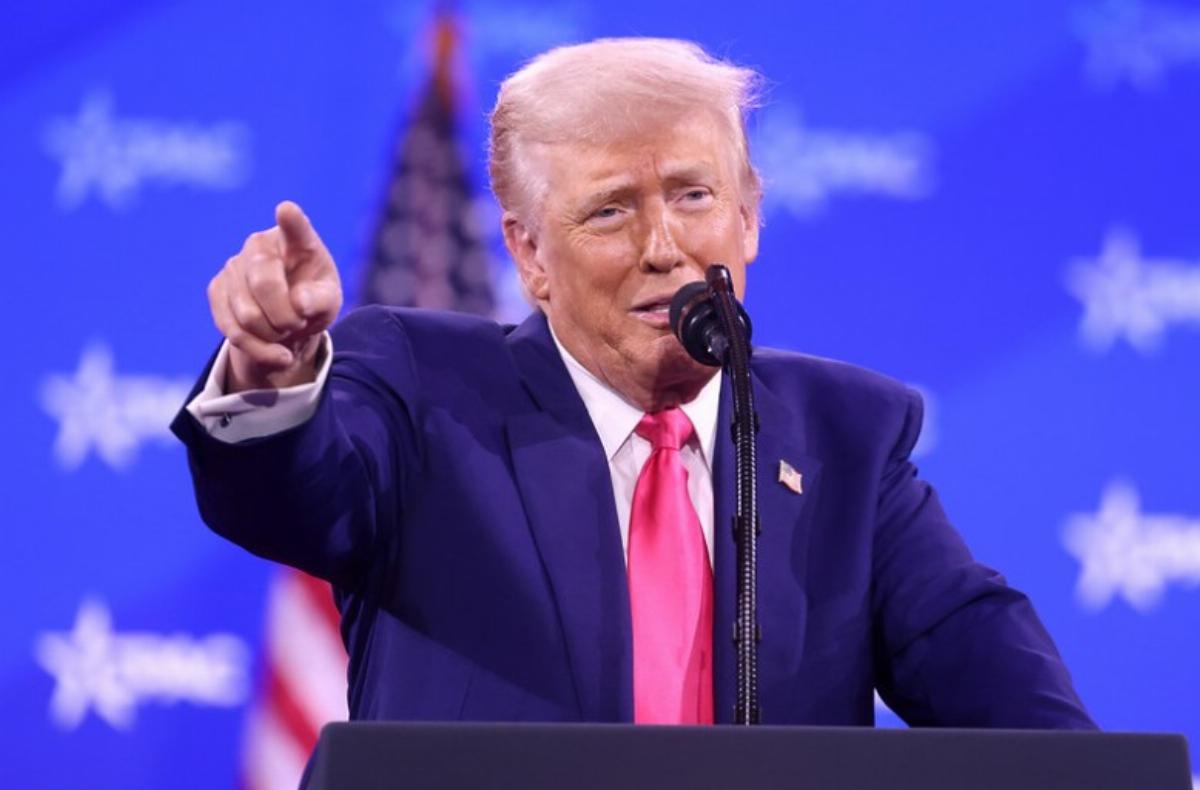
Odysseus endured many diversions and overcame mighty obstacles on his mythical return home. Likewise, Donald Trump’s return from political exile has the makings of myth — except in Donald Trump’s case, the myth is true.
Read more A simple 5-point program for real education reform
In The Counter Revolution: The Fall and Rise of Donald Trump and the MAGA Movement, Victor Davis Hanson, classicist, historian, and farmer, devotes his many gifts to explaining Donald Trump and his efforts to rescue America from the anti-constitutional, counter-productive nostrums of progressivism and the barbarous hand of Marxism.
As with Ronald Reagan, the media saw Trump as a political amateur — or to use a Trumpism, “fake news” portrayed him as such, one writer describing his famous ride down the escalator in Trump Tower as a slow descent into the “abyss of politics.”
However, as Hanson writes, and it’s worth quoting at length,
Trump had originally made his money by making things — and he was constantly battling to do it. In the real estate jungle of Manhattan, that meant fighting year after year, with suspect politicos, self-interested community activists, passive-aggressive tabloid media, radical environmentalists, unyielding union bosses, unpredictable prosecutors and judges, ruthless business rivals, cutthroat regulators, and no-nonsense bankers. …
He was known for having sued more people and companies and in turn being sued by them — 3,500 cases in federal and state courts, with 1,900 as plaintiff and 1,450 as defendant — than any other prominent Manhattan businessman.
Though many see Trump as overbearingly narcissistic, his confidence signals his belief that, to paraphrase Frank Sinatra, “if you can make it in New York, you can make it anywhere.”
“From this Hobbesian war of all against all,” as Hanson writes, Trump realized that as a maker, a builder, he necessarily depended on bankers, whom he admired. But he also understood “that they were distant from the raw urban elements — food, fuel, shelter, safety — that ultimately made a city or nation run.” Thus, he developed respect for the “muscular classes,” though not the sculptured gym-crafted muscular types, as Hanson has pointed out elsewhere, but muscular working men, whose biceps, however impressive, are often overshadowed by their waists.
So Trump bonded with producers and makers, like the Teamsters, whom he once told that he could have built with non-union labor, but he refused to. That was a political maneuver, for sure, but also a pragmatic one for a builder who recognizes that without the imprimatur of the Teamsters, in New York, nothing gets done.
From this perspective, Trump knew that blue-collar workers’ wages were eroding because of the import of foreign workers and the export of American factories, just as my working-man father knew this 50 years ago. Hoping to reverse both trends, President Trump began his round of reciprocal tariffs, which he has used to geopolitical advantage and to increase federal government revenues.
This was the beginning of Trump’s appeal to the middle class, though he always believed, as Hanson writes, “that working class whites might return to vote for a populist nationalist traditionalist who combined cultural conservatism and advocacy for high-paying jobs. So was born the MAGA base.” And though MAGA developed from the pitchfork part of the Republican party, “Trump’s earthiness,” as Hanson writes, gained more traction than Patrick Buchanan’s genre of populism.
Trump also aligned with an array of middle-class heroes, like Mike Tyson and pro wrestling champions. Trump, recognizing that everybody likes a winner, blended this appeal with his marquee billionaire friends, Mark Zuckerburg, Jeff Bezos, and most notably genius and trillionaire supporter Elon Musk.
The Counter Revolution is a handbook on the art of forging coalitions, of making deals, which is the essence of republican governance. Contrast this with, say, Machiavelli’s The Prince, which offers advice to an authoritarian controlling an elitist system, resembling America’s “experts,” who have gained more power in our government over the last 100 years.
These experts, “the technocracy,” are clearly shown, as Hanson puts it, by the “bureaucratic fiefdoms, the three million strong federal administrative state, indebted to the Democratic paradigm of more taxes for more government employees for more power over the citizenry.”
Read more Perhaps, perhaps, perhaps
Though Trump has shown himself to be brilliant and even a political genius, “MAGA did not operate in a vacuum. For the New Jacobin Democrats,” as Hanson refers to them, are avatars of the “French revolutionary fanatics substituting lawfare, election interference, and weaponization of federal agencies for the guillotine,” all of which made them a less desirable alternative to Trump. In other words, rebounding from the electoral disaster of the McGovern candidacy, the Democrats swerved right and won with Bill Clinton. But though winning is necessary for these Jacobins, it is, apparently, not sufficient; thus, they re-established the McGovern wing of the party with “the fresh faces of The Squad and Zohran Mamdani along with the shock troops of antifa, BLM et al — which made the once winning Clinton agenda seem not just reactionary but surreal,” as Hanson concludes.
Perhaps electing zombie Joe Biden president and then running cackling Kamala as the Democrat nominee in 2024 made the loony left think they could destroy the border, the penal system, and the buying power of Americans by spending $7 trillion and christening such spending with Orwellian names like “The Inflation Reduction Act.”
Even Larry Sommers, who sometimes stumbles onto inconvenient truths, wrote that Bidenomics caused “the massive inflation which, more than anything, helped cripple Biden’s presidency and fuel the Trump recovery.” After all, America “has a $37 trillion debt with $3 billion a day in interest payments,” as Hanson reminds readers. Nonetheless, government spending continues at a destructive pace, even under the Trump administration!
The left branded “minorities” who voted for Trump in 2024 as victims of the Marxist construct of “false consciousness.” But Trump appealed to the continuing upward economic mobility of Americans of African and Hispanic descent; thus, he saw that class has more voter appeal than ethnic solidarity has, that e pluribus unum trumped the Democrat party’s tribal appeal to “race” with slogans like “Black Lives Matter” and Sí se puede, “Yes, we can.” Minorities’ economic advancement is nothing new, as Thomas Sowell has established and I witnessed growing up in a mixed ethnic neighborhood.
“Four hostile newspapers are more to be feared than a thousand bayonets,” Napoleon warned. Likewise, Hanson points to the “legacy media” as “Armies of Anti-Trumpers who were the most vitriolic of all the various ant-Trump entities.” And though this herd of independent thinkers has always been uncritically left-wing, its younger reporters are even more untrained in “traditional journalistic methods,” though they have certainly “absorbed a woke zeal.”
All of this was topped by the Russia Hoax, an attempt at a multiyear and multiagency unprecedented frame-up of Trump. Meanwhile, his frothing opponents like Bill Kristol, along with the late-night court jesters, have been vanquished. Hanson calls NeverTrumps “clueless,” “increasingly irrelevant.”
The endless attacks on Trump, from the lawfare to the two impeachments, the assassination attempts, and the invasion of his Mar-a-Lago estate, gave rise to a “Nietzschean Trump.” Hanson concludes that “much of Trump’s phoenixlike rebirth was due to his enemies’ pathological obsessions.”
Hanson refers to Trump’s foreign policy as “deterrent engagement,” which just as easily could be called “deterrent disengagement,” since he is leaving other nations to defend themselves instead of mooching off the American taxpayers for their national defense needs. As Hanson said several years ago, “though Trump is blamed for ending the post war order, all he did was bury its corpse.”
Hanson calls this policy a return to 19th-century balance of power geopolitics, buttressed by bilateral alliances and backed up by a strong military, as opposed to the way American power dissipates when funneled through bureaucratic organizations like NATO and the U.N.
Hanson charts the many victories Trump has made with this policy, including the monumental Abraham Accords and the re-establishment of the Monroe Doctrine, which has begun to cleanse the South American stable of the ruin caused by Marxism.
In The Case for Trump, Hanson’s 2019 book, he casts Trump in the role of a tragic hero who slashes evil from the body politic but is then exiled for having blood on his hands. By contrast, Hanson now writes, “all the eccentricities and rudeness that they insisted would doom Trump — they now admit only made him more formidable.”
Hanson concludes the book on a hopeful note for the restoration of America: “By enraging, warping and thereby emasculating the Democratic Party, Trump made it possible for Trumpism to outlast him.”
Read more The woman behind Qatar’s influence in America
 Flickr, CC BY-SA 2.0.” class=”wp-image-3288″ width=”640″ height=”421″ />
Image: Gage Skidmore via Flickr, CC BY-SA 2.0.