
It doesn’t matter what side of the aisle you’re on when it comes to cancer, and cancer doesn’t care about politics. Perhaps that’s why for decades, fighting back against cancer has transcended partisan divides between Democrats and Republicans. Despite this bipartisan alignment, the federal government’s progress in this effort has never quite matched its ambitious rhetoric.
Read more Canada just told the world food is a weapon
For all of the government’s noise about cancer moonshots, though, the latest milestone in cancer research actually came from tried-and-true American entrepreneurship. Recently, American ingenuity delivered a remarkable breakthrough: positive late-stage trial results for a personalized mRNA treatment for melanoma – the deadliest form of skin cancer, which accounts for over five percent of all new cancer cases.
The thousands of Americans every year who survive melanoma still carry a high risk of recurrence, and many live with the fear of their cancer returning. But this new mRNA medicine, combined with immunotherapy, kept cancer survivors in remission for longer and helped prevent the cancer from spreading to other organs. Researchers are actively studying this same promising approach against other types of cancer beyond melanoma.
The vaccine was developed by two American companies who invested money, resources, and manpower to achieve an oncology miracle.
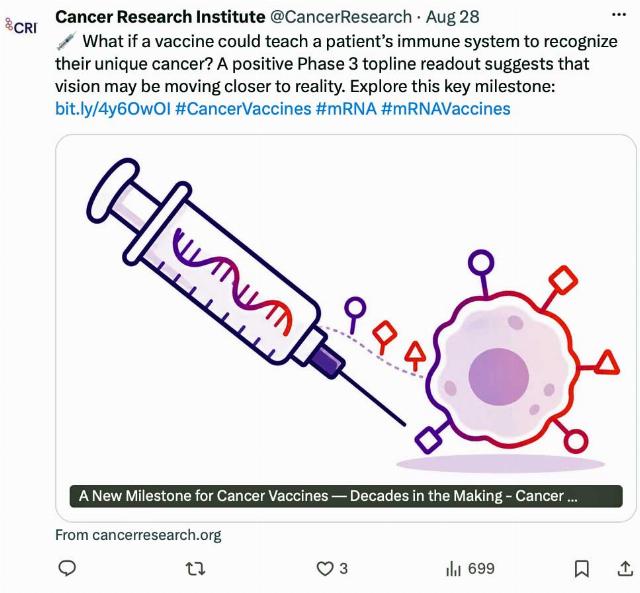
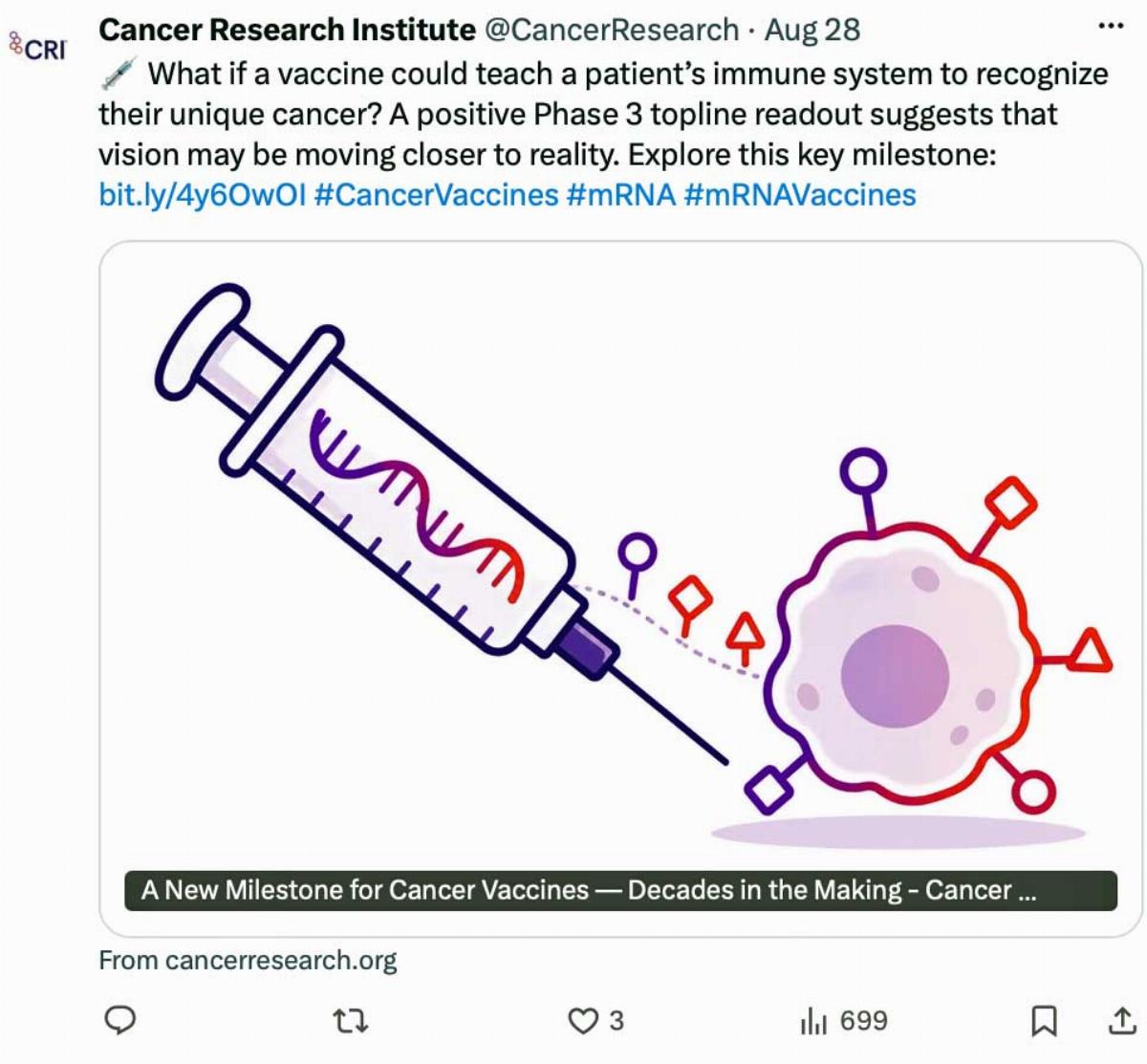
Graphic: X Post
Only in an economy that rewards entrepreneurship and empowers companies to take risks would the giant leap of faith that these biotech companies took be possible. Unlike the bureaucratic red tape and political theater that often hinders government agencies from greenlighting innovative research, the gap in the market for new, innovative approaches to cancer treatment paved the way for a decade of research and billions of dollars in investment toward this novel technology. Experts and analysts project that this melanoma treatment could mark just the beginning of mRNA solutions to other types of cancer, with other pharmaceutical companies already launching other mRNA trials for lung, breast, and pancreatic cancer.
The potential of new cancer clinical trials is far-reaching beyond the immediate health benefits it provides survivors. Industry-sponsored clinical trials bring states $60 billion annually in economic activity, ensuring manufacturing remains in America where it belongs and generating skilled jobs for American workers. In fact, the U.S. biotech sector supports almost 5 million good-paying jobs and contributes over $1.65 trillion to the American economy.
Read more The rhetoric of September 10 and September 11
Meanwhile, America is also locked in a global race for biotech leadership, a race we’re losing by a large margin. Other nations are hosting more clinical trials, conducting more research, and scaling manufacturing faster than we are. That includes America’s economic adversaries, who are eager to replicate the results of this personalized mRNA approach.
Whichever country develops the next generation of cancer treatments will likely define global health for generations to come and reap the economic rewards that come with it. This new cancer breakthrough gives America an edge, providing a once-in-a-lifetime opportunity to be the global superpower that plants our flag in the ground and cures cancer, exporting our cures and treatments around the world. We certainly don’t want to be dependent on another country for life-saving drugs, especially when it’s at our fingertips.
While curing cancer may have been an empty campaign promise from politicians for decades, American business is putting its money where its mouth is. That underscores why it would be senseless for legislators to advance the state-level bans and restrictions on mRNA technology we’ve seen in recent years, outlawing the very tools that make these breakthroughs possible and slowing down American dominance.
Rather, lawmakers should embrace cutting-edge technology like mRNA and adopt policies that facilitate the work of private companies advancing cancer research. We’re simply too close to making the impossible happen to self-sabotage.
Read more OMG! Several Lindsay Clancy jurors spoke and unwittingly indicted themselves