
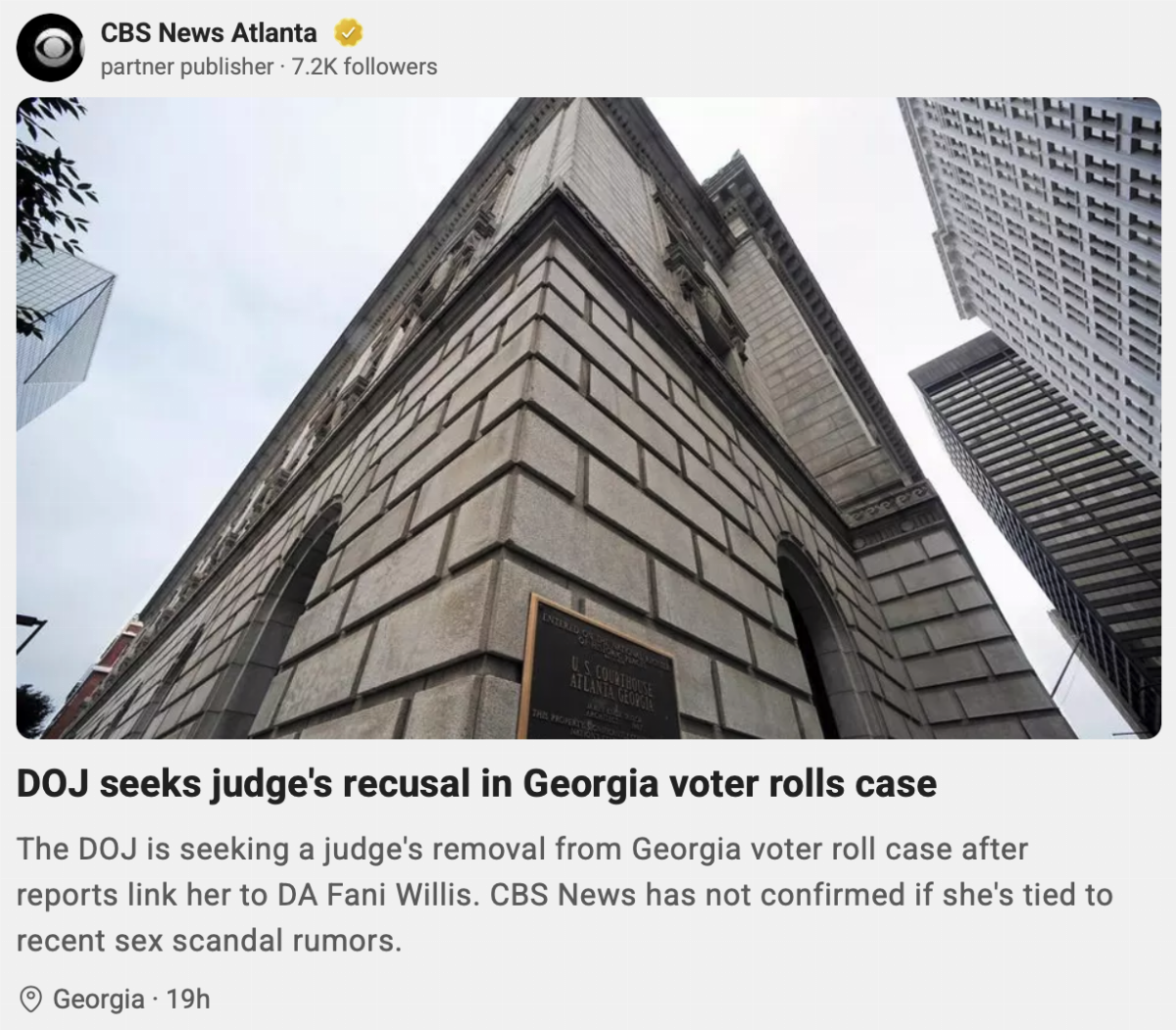
Fani Willis unaccountably remains the DA of Fulton County, Georgia (Atlanta). It’s pronounced “Fah-knee,” which is rather like demanding “Outhouse” be pronounced “O’Twozee.” She’s the black prosecutor—not the prosecutor who happens to be black—who tried to build a RICO case against Donald Trump during the heady days of “get Trump at all costs” national lawfare. Trump’s crime? Daring to question 2020 Georgia election results.
Read more Fukuyama’s Follies
Willis indicted Trump and 18 of his supporters and hired local, lackluster lawyer Nathan Wade, who had no experience in complex RICO law. She paid him around $750,000. He made at least two stealthy trips to the White House but was eventually thrown off the case for gross professional and personal misconduct: they were publicly flagrant lovers. Willis appeared at black church services, crying racism and whining that justified criticism of her conduct was due to fear and hatred of a strong black woman. The Georgia courts eventually disagreed, and she and her office were thrown off the case, and a state-appointed prosecutor dismissed the whole thing. An appeal of her ejection from the case was denied in 2025:
The Georgia Court of Appeals in December ruled that Willis and her office could not continue to prosecute the case, citing an “appearance of impropriety” stemming from her romantic relationship with special prosecutor Nathan Wade. [skip]
Steve Sadow, Trump’s attorney in the Georgia case, welcomed the decision.
“Willis’ misconduct during the investigation and prosecution of President Trump was egregious and she deserved nothing less than disqualification,” Sadow said in a statement. “This proper decision should bring an end to the wrongful political, lawfare persecutions of the president.”
Willis claimed the 2020 election in Georgia was a model of election integrity.
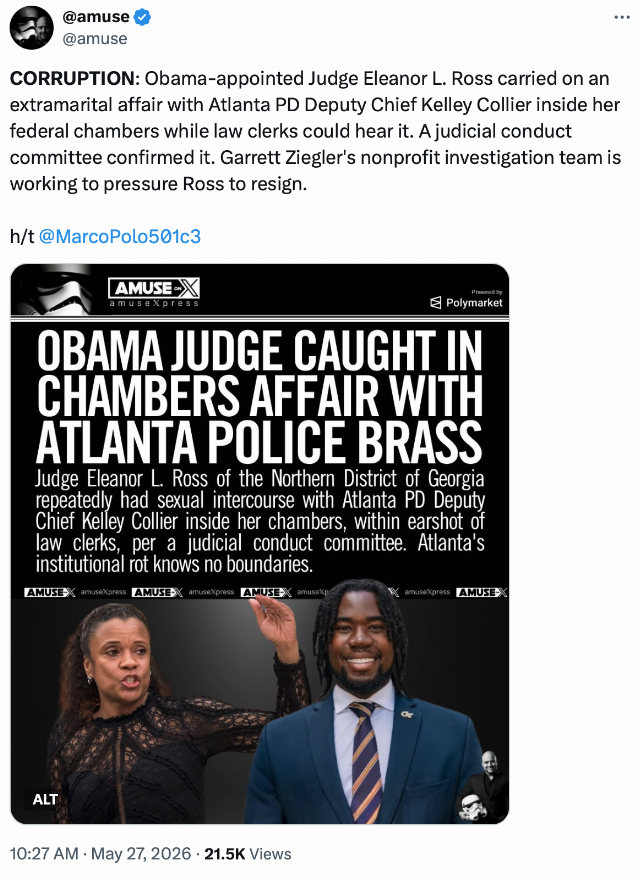
Graphic: X Post
There must be something in the justice system water in Georgia, because the 11th Circuit recently and privately reprimanded an Obama-appointed judge for repeatedly having B- movie, comically loud sex with a police officer in her chambers. The judge was outed as Elanor Ross, coincidentally a black woman, and equally coincidentally, there’s a Fani Willis connection and even more misconduct:
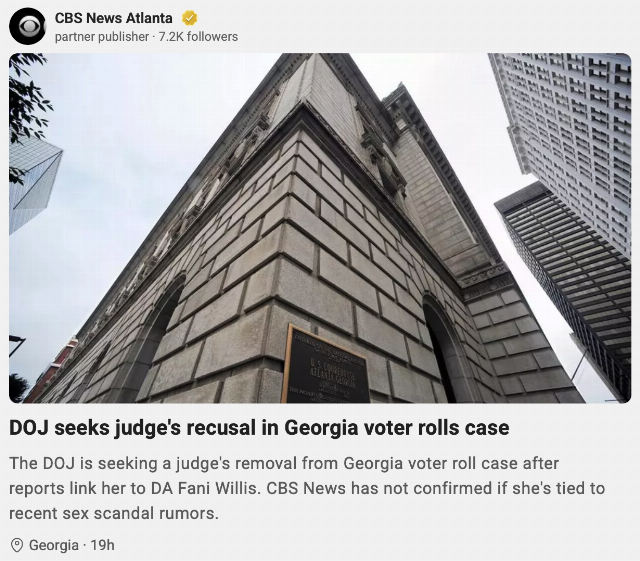
Grapjhic: X Post
Assistant Attorney General [DOJ] Harmeet Dhillon filed a memorandum Friday calling for a federal judge to recuse herself from an election integrity case in Georgia after allegedly attending an event that allegedly honored Democratic Fulton County District Attorney Fani Willis.
Dhillon, in the memorandum, says the Eleventh Circuit Judicial Council, the primary governing and administrative body for the U.S. Court of Appeals for the Eleventh Circuit, operating out of Atlanta, found an unnamed judge “committed judicial misconduct by attending a “partisan and political event.”
Judges aren’t supposed to do that sort of thing but apparently being black and female in Georgia gives one license not available to others, or so Ross—and Willis—thought.
She also says in the memorandum the event “reportedly” honored Willis – who investigated the 2020 presidential election in Georgia that resulted in indictments against President Donald Trump and 18 alleged co-conspirators. Willis was disqualified from the case for professional and personal misconduct, which was followed by a judge in 2025 dismissing all of the charges.
Read more The Calamitous Legacy of the GOP’s Civility Caucus
This is a “well, duh” moment:
She [Dhillon] writes that if Ross is, in fact, the unnamed judge and she indeed attended the Willis event, then she should recuse herself over the “misconduct” and the appearance of bias.
“A judge who attended a party celebrating the election of a Democrat best known for prosecuting a Republican president for alleged election interference cannot then preside over a case concerning that president’s efforts to ensure election integrity,” Dhillion also said.
One would think a federal judge would know that. In Georgia, one would be wrong. There’s another sexual misconduct parallel between Ross and Willis, as George Washington University law professor Jonathan Turley notes via Powerline:
All of this leaves me baffled about the decision to enter a private reprimand. The judge agrees not to serve as Chief Judge or take positions on judicial committees. Yet the judge is allowed to continue to perform that most important function of being a judge. More importantly, counsel and parties are left without confirmation of the judge’s identity. There are myriad cases in which a judge could have a conflict of interest. Parties should be able to raise such conflicts rather than be left wondering if they have “that judge” in random assignments.
The use of court property for sexual liaisons with a police officer and then lying about it should warrant a bit more than an anonymous order, private reprimand, and a waiving of future positions. This judge, who has shown serious ethical concerns, will continue to render judgments on others.
But of course! It’s Georgia. Apparently, the Georgia justice system needs a long visit from the judicial equivalent of Roto Rooter.
Become a subscriber and get our weekly Friday newsletter with unique content from our editors. These essays alone are worth the cost of the subscription.
Mike McDaniel is a USAF veteran, classically trained musician, Japanese and European fencer, life-long athlete, firearm instructor, retired police officer, and high school and college English teacher. He is a published author and blogger. His home blog is Stately McDaniel Manor.
Read more Jefferson and the Declaration