
“It can be lost, and it will be, if the time ever comes when these documents are regarded… merely as curiosities in glass cases.”
Read more Booker’s hesitation may be beginning of end for Platner, and Dem midterm hopes
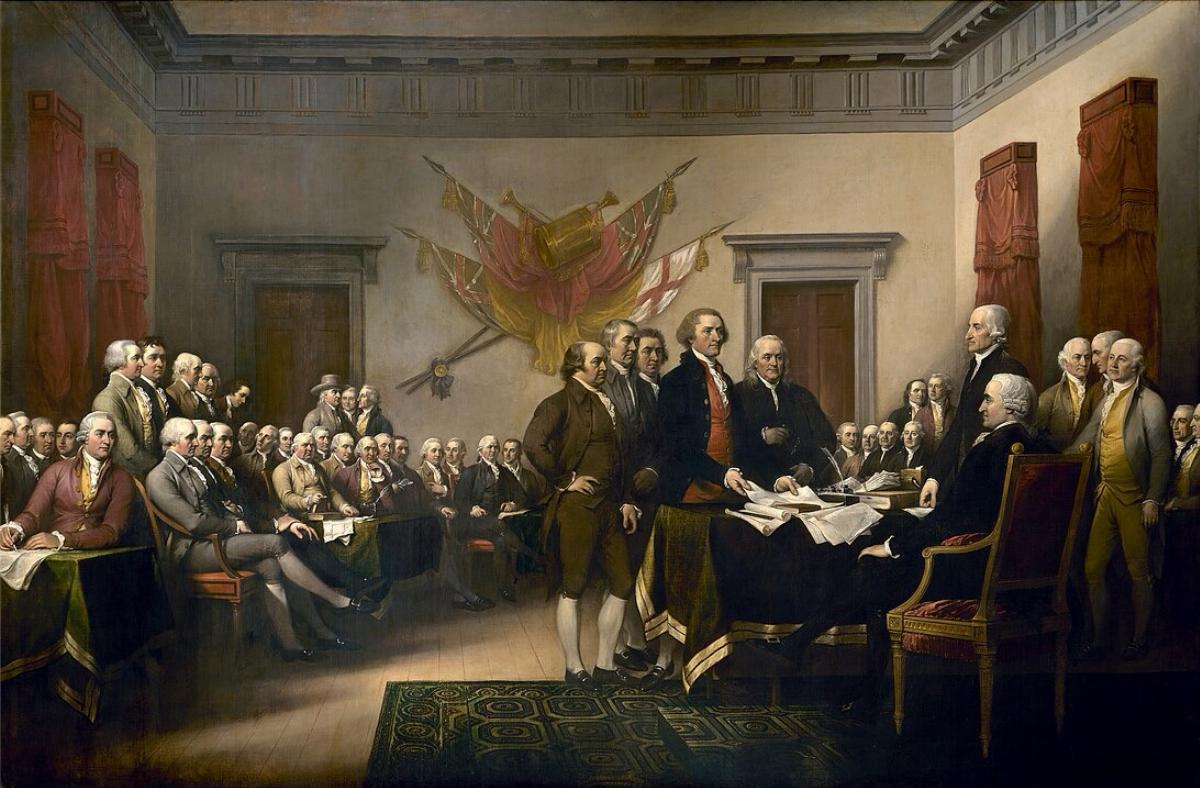
So spoke Harry Truman about the Declaration of Independence. He also called it a “supreme expression of our profound belief.” How did this world-shattering document come about? From the pen of one man, Thomas Jefferson. On June 11, 1776, the second Continental Congress appointed a committee to write a declaration of independence. The committee was composed of John Adams, Benjamin Franklin, Thomas Jefferson, Robert R. Livingston, and Roger Sherman.
One of these five was a renowned writer. That person did not write the Declaration of Independence. Often, we forget that Benjamin Franklin was a bestselling author. For nearly thirty years, only the Bible outsold Poor Richard’s Almanac; his Autobiography has never been out of print, and his articles made the Pennsylvania Gazette the most successful newspaper in the colonies. Franklin, however, declined to draft the declaration, purportedly due to poor health, so the committee asked the thirty-three-year-old Thomas Jefferson to draft it.
In less than three weeks, Jefferson presented the committee with this historic document. For the most part, the committee accepted the Declaration as drafted, except that Franklin made some subtle but important revisions. For example, Jefferson had written “We hold these truths to be sacred and undeniable,” which Franklin revised to “self-evident.” Some have suggested that Franklin was pushing the text toward the analytic empiricism of David Hume, but it’s more likely that the master editor was wordsmithing for a more graceful rhythm to the words.
On June 28th, the Committee of Five reported out the declaration to Congress, and they began arguing over every sentence, making thirty-nine revisions. Thankfully, Congress left the preamble alone, so altering the list of grievances did not dilute the earth-shattering ideas in the first two paragraphs. Although Jefferson never uttered a word of complaint, he fumed at the incessant meddling.
Jefferson reported afterward that Franklin admitted he avoided drafting papers for committee review. You can almost hear the seventy-year-old patriarch chuckling as he gives this advice to the young Virginian. According to Jefferson, Franklin told him the following story.
When I was a journeyman printer, one of my companions, an apprentice hatter, having served out his time, was about to open shop for himself. His first concern was to have a handsome signboard, with a proper inscription. He composed it in these words, ‘John Thompson, Hatter, makes and sells hats for ready money,’ with a figure of a hat subjoined. But thought he would submit it to his friends for their amendments. The first he showed it to thought the word ‘Hatter’ tautologous, because followed by the words ‘makes hats,’ which showed he was a hatter. It was struck out. The next observed that the word ‘makes’ might as well be omitted, because his customers would not care who made the hats. If good and to their mind, they would buy them, by whomsoever made. He struck it out. A third said he thought the words for ready money were useless, as it was not the custom of the place to sell on credit. Everyone who purchased expected to pay. They were parted with, and the inscription now stood, ‘John Thompson sells hats.’ ‘Sells hats!’ says the next friend. ‘Why, nobody will expect you to give them away. What then is the use of that word?’ It was stricken out, and ‘hats’ followed it as there was one painted on the board. So, the inscription was reduced ultimately to ‘John Thompson,’ with the figure of a hat subjoined.
A few have criticized the Declaration for not presenting new concepts. Five centuries after Magna Carta (1215), Englishmen had gradually gained individual rights, and by the late eighteenth century were exercising some self-government. The King and nobility still wielded substantial power, but Parliament — especially the elected House of Commons — had gained authority. Meanwhile, toward the end of the period, Enlightenment thinking began to influence those outside the aristocracy. Enlightenment thinkers challenged religious, governmental, and social norms, arguing that mankind not only possessed the capacity for self-government but had it as a natural right.
Read more Not in My Silver Lake Yard
The Enlightenment turned the world upside down. Instead of the divine right of kings, individuals were endowed with God-given rights. The Founders, thoroughly schooled in this doctrine, knew their words were not breaking new ground but were doing something far more powerful: putting those revolutionary concepts into practice.
This understanding was shared by the committee. In 1822, John Adams answered a query about the Declaration of Independence:
As you justly observe, there is not an idea in it but what had been hackneyed in Congress for two years before. The substance of it is contained in the declaration of rights and the violation of those rights in the Journals of Congress in 1774. Indeed, the essence of it is contained in a pamphlet, voted and printed by the town of Boston, before the first Congress met, composed by James Otis, as I suppose, in one of his lucid intervals, and pruned and polished by Samuel Adams.
Jefferson himself told Henry Lee:
This was the object of the Declaration of Independence. Not to find out new principles, or new arguments, never before thought of, not merely to say things which had never been said before; but to place before mankind the common sense of the subject, in terms so plain and firm as to command their assent, and to justify ourselves in the independent stand we are compelled to take.
The Declaration of Independence never claimed to plow new ground, but it did an exceptional job of articulating the Enlightenment vision. Or, in Jefferson’s words, made the Enlightenment ideas plain and firm. Some claim the best-known sentence in the English language is, “We hold these truths to be self-evident, that all men are created equal, that they are endowed by their Creator with certain unalienable rights, that among these are life, liberty and the pursuit of happiness.”
Thomas Jefferson rightly deserves enormous recognition and praise for writing an eloquent and powerful expression of this revolutionary concept, but it was an idea more universal than one man — or even one generation.
Among other works, James D. Best is the author of Tempest at Dawn, a novelization of the Constitutional Convention. Maelstrom, A Civil War Novel, is coming June 1.
Read more Somali fraudster pulls Superman stunt in leap from justice
Image: John Trumbull