
I have worked in information technology since the 1980s along Boston’s Route 128, the old “Golden Semicircle” that helped invent the American computer industry. I have watched machines shrink, networks explode, and server rooms become windowless campuses that draw as much power as a small city. So, when a member of Congress who mixed drinks for a living starts issuing national rules for data centers, I pay attention—not because bartending is dishonorable, but because servers, substations, and high-voltage feeders are not cocktail recipes.
Read more Communism’s Insidious Change of Priorities
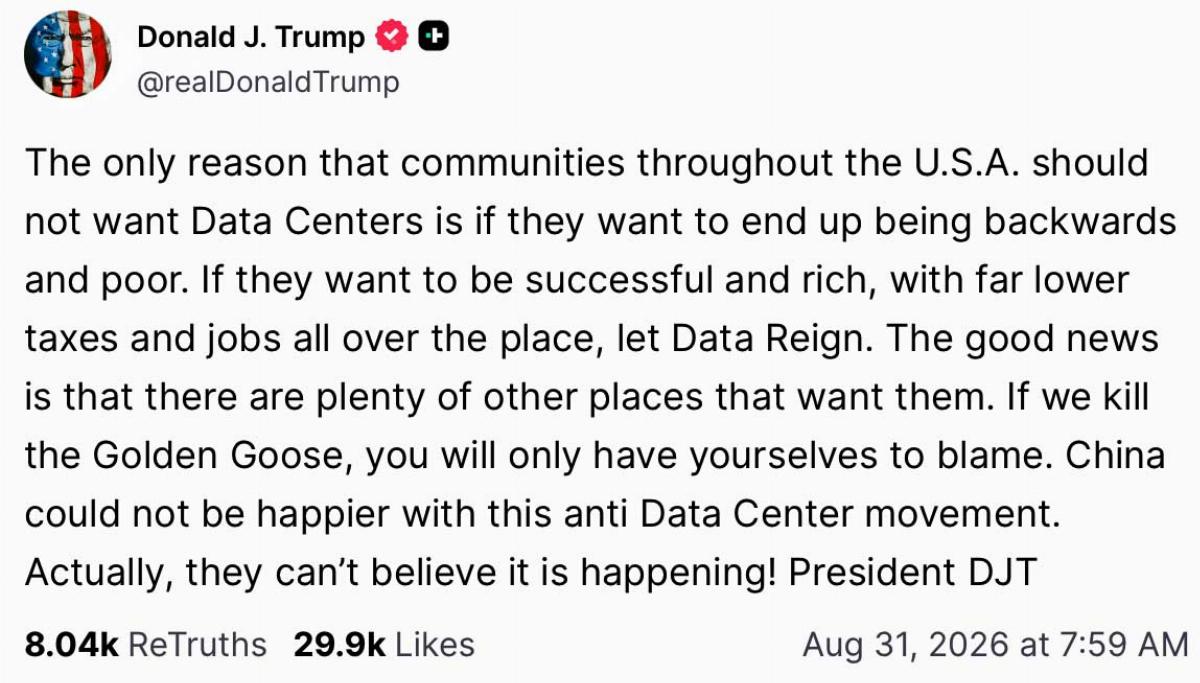
Rep. Alexandria Ocasio-Cortez and Sen. Bernie Sanders have pushed an Artificial Intelligence Data Center Moratorium Act that would freeze new AI-scale centers until Washington writes a thick new rulebook. Sen. John Fetterman called that approach “China First.” President Trump has said Beijing cannot believe Americans are trying to kill their own buildout. Both points are closer to the engineering reality than the slogan that we must “choose humanity over profit” and then stop pouring concrete.
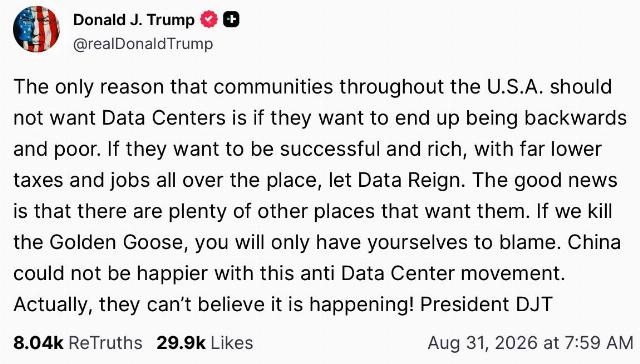
Graphic: Truth Social Post
Data centers are the factories of the future. Like it or not, the country that hosts the computers will host the models, the talent, and a large share of the data. A pause stateside does not stop the CCP. It does not put American data records in a safer cloud. It simply moves the work and the infrastructure offshore. That is the national argument.
The local argument is more powerful, because the people who actually control the dirt are not in a Capitol hearing room. They are on planning boards, in volunteer fire companies, and in houses next to the proposed fence line. They are in a position of strength before the political photo-op gold shovel hits the dirt. After the ribbon-cutting, leverage collapses. Before permits, the center operator needs the town more than the town needs another warehouse full of racks.
Developers know this, which is why so many deals begin in silence. In Virginia, home to the world’s densest cluster of data centers, Public Citizen reports that about 80 percent of localities with proposed or existing centers have nondisclosure agreements in place. Officials sign NDAs that hide the ultimate owner or tenant during the only period when residents can still say no or say yes on hard terms. Campaign cash and the promise of “economic development” do the rest. A town that signs the gag order first has already sold the most valuable thing it owns: time and information.
The first demand should be public ownership of the facts, which means no NDA covering the applicant, the tenant, the load in megawatts, the water draw, or the transmission route. If a company will not name the customer, the town should not rezone the land.
Second, the operator should pay for every transmission line and substation the project requires. The route should be mapped in public: whose property it crosses, what easement is needed, and what the landowner is paid. Eminent domain for a private computing load should be off the table.
Across the country, the fight is already shifting from the slab to the wires. Utilities threaten condemnation to serve a hyperscale customer, and farmers discover a 345-kV line is “public use” because a server farm needs juice. That is a political choice, not a law of physics. Make the data-center owner buy the path, bury what can be buried, and compensate for the rest in cash, not in a lecture about progress.
Third, treat the site as what it is: a heavy industrial plant that looks like a power station with better landscaping. Hyperscale campuses are capital monsters and employment mice. Industry staffing figures put many automated sites at roughly 25 to 40 permanent operators per 100 megawatts. Construction crews come and go. The tax base and the infrastructure bill stay. That is the opening for the town. Pilot payments and abatements are how town officials give the store away.
Read more Grab the Popcorn and Enjoy the Erupting Democrat Civil War
A better model is simple: the project pays for the public plant it forces the town to own. Volunteer fire companies are not trained or equipped for lithium battery rooms, transformer fires, or high-voltage feeder faults. Guess who should buy the foam, the training, the aerial apparatus, and the mutual-aid agreements. The same logic applies to roads, turn lanes, water mains, and emergency generators at the school.
Fourth, do not let the campus lean on the public grid and send the bill to every ratepayer with a porch light. Negotiate dedicated generation up front—on-site gas turbines, behind-the-meter plants, small modular nuclear if it is real, or a contracted islanded supply—and issue building permits only after that power is funded and scheduled. Ocasio-Cortez has said companies should stop “free riding off of the American people.” On that narrow point she is right. The way to enforce it is not a national freeze. It is a local permit that says: you brought the load, you bring the megawatts.
Fifth, protect the neighborhood. Cooling towers, diesel backup, constant fan noise, night lighting, and aquifer or stream withdrawals are not abstractions. They are why projects fail when they are dropped next to subdivisions. Set buffers. Cap wet cooling where water is scarce. Require closed-loop systems. Publish real-time water and noise numbers, not a consultant’s brochure.
Sixth, sell the waste heat and condensed water. A data center is a furnace that happens to compute. Paris used recovered server heat to warm Olympic training pools. Stockholm already pipes data-center heat into thousands of apartments. British leisure centers have put small compute plants under pools to cut heating bills. Architects are now drawing public bathhouses wrapped around server halls. That is not a hippie mural. It is thermodynamics. In the heating season, the town can demand hot-water loops for schools, municipal buildings, and nearby homes. Cooling-tower blowdown and recoverable condensate can be treated for irrigation or other non-potable uses instead of being dumped. Put the operator’s own AI to work on the engineering. And if the campus wants a friendly skyline, make it fund a municipal aqua center—outdoor heated pools and indoor facilities—on its dime.
A few dozen permanent jobs are not a civic plan. Heat, water, fire equipment, training, roads, and a generation plant are.
None of this requires a bartender in Congress to declare a holiday from physics. It requires experts who can read a one-line diagram and residents who understand they are selling location, water, and political peace to one of the richest industries on earth.
Data centers will be built somewhere. The question is whether American towns collect like owners or pose for the shovel like extras. I would rather take advice from people who have kept machines running since the minicomputer era than from a national brand that discovered the power bill in a press release. The town does not have to hate the future. It has to invoice it—before the dirt moves.
Read more What About Clancy’s Diet?