
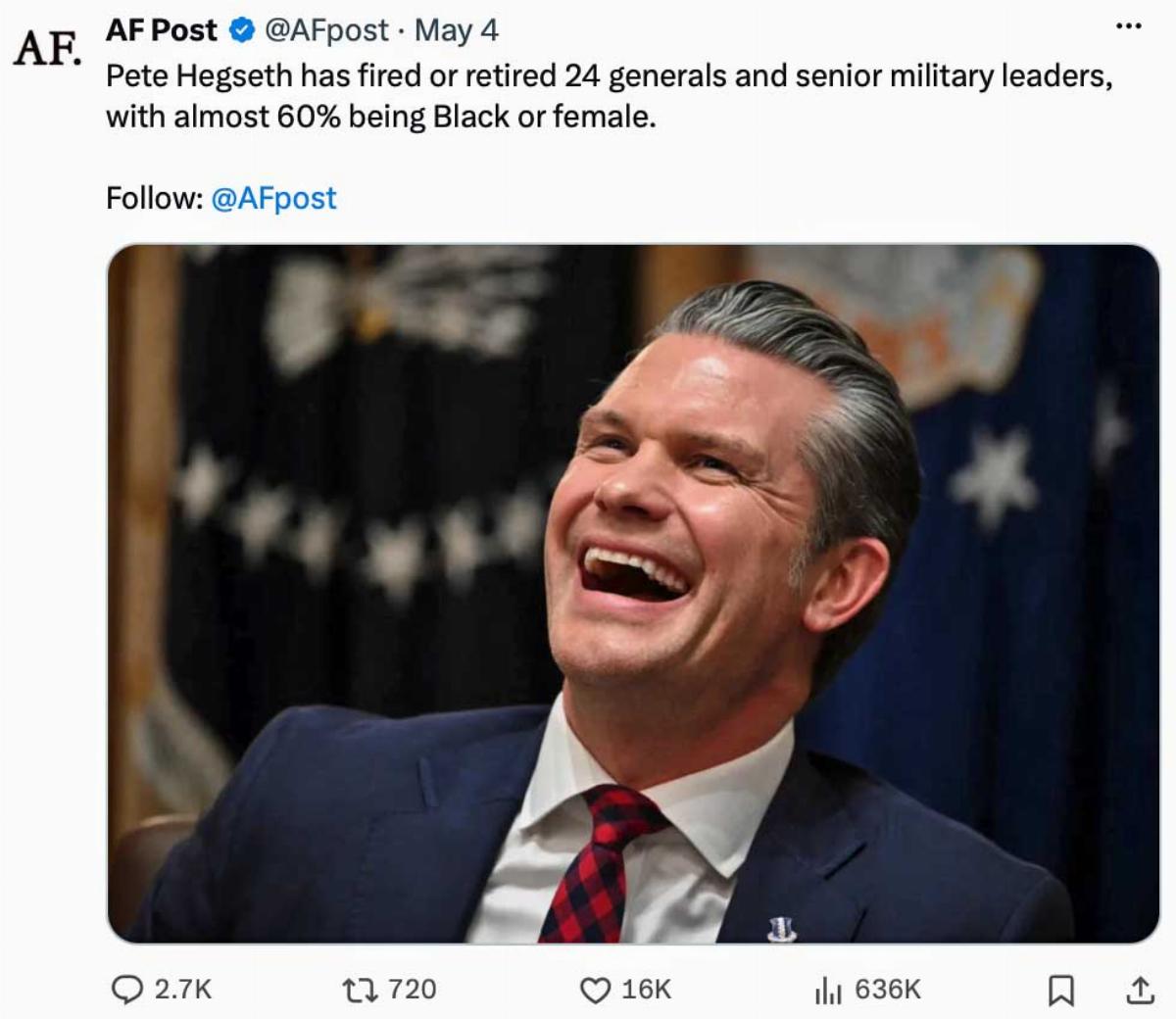
The mainstream media has condemned Secretary Hegseth from the moment that President Trump selected him for the position; they insisted that his experience as a personality on Fox News disqualified him and frantically tried to defame his work with a non-profit organization. Although he brought some of the rancor on himself with his own behavior, that issue should be behind him by now.
Read more Run Rahm, run, but for whom?
It’s not.
The biggest issue seems to be the number of people that Hegseth has removed from their positions:
At least 20 generals, admirals, and civilian defense leaders have been fired or have departed their jobs since Pete Hegseth became defense secretary at the beginning of the second Trump administration.
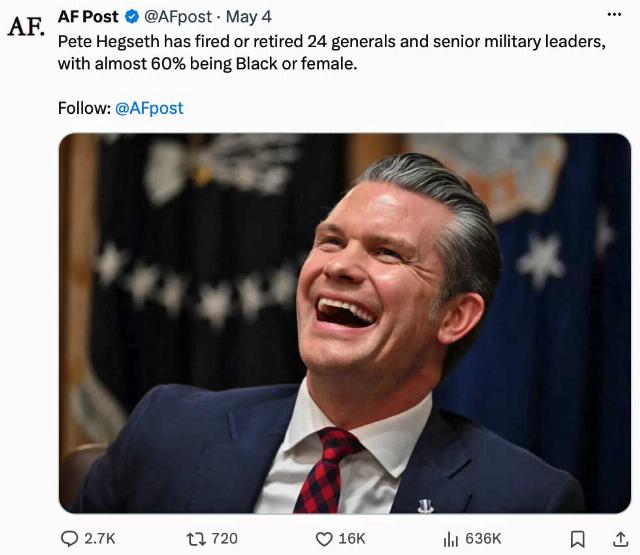
Graphic: AF Post
He has made his expectations clear: military leaders must support the President’s agenda; they must reject the Diversity, Equity and Inclusion agenda; they must not leak information to the media; they must be prepared to change the status quo in their departments; and they must demonstrate their qualifications for their positions. Many who have resigned or been fired appear to have violated one or more criteria.
The mainstream media believes it’s entitled to know why these people are leaving. They are wrong. The media likely won’t be satisfied with explanations, and giving explanations may further damage officers’ reputations and limit future job offers.
One example of an excellent decision was the removal of Air Force General Charles O. Brown:
Mr. Trump abruptly fired Brown in a February 2025 social media post thanking him for his service, 16 months into Brown’s four-year term as the top-ranking military officer.
Brown is a former fighter pilot with more than 3,100 flight hours, and was only the second Black general to serve as chairman in the history of the military. All Hegseth told Fox News about the ouster was that the president should be able to pick his adviser. He said Brown is ‘an honorable man, not the right man for the moment.’
Mr. Trump replaced him as chairman with Air Force Gen. Dan Caine.
General “Raisin’ Caine’s” performance during the Iran War has been nothing less than stellar.
Some officers have decided to resign on their own. Others have resigned at the request of Secretary Hegseth. On rare occasions, Hegseth believed an explanation was warranted:
Soon after Hegseth took office, he cleared out the top ranks of the military’s lawyers, terminating the judge advocates general of the Army and Air Force. The Navy JAG had already retired. In a February 2025 statement, he issued a call for nominations for the posts and also fired Berger and Plummer, though he did not identify them by name.
At the time, he told Fox News that he wanted lawyers who aren’t ‘roadblocks,’ and he referred to the JAG leadership as a ‘small group of insulated officers who perpetuate the status quo.’
Read more From military rule to military power: Pakistan under Asim Munir
‘The status quo hasn’t worked very well at the Pentagon,’ he added. ‘It’s time for fresh blood.
Hegseth has his critics and supporters, although most of their critiques are not based on facts about his decisions:
In July, Sen. Susan Collins (R-Maine), the chair of the Senate Appropriations Committee, slammed Hegseth for firing more than two dozen senior military officers since taking the helm at the Pentagon and blocking officer promotions.
‘The United States military is one of the greatest meritocracies in the free world,’ Collins said in late July. ‘We need to make sure that it stays that way.’
Other GOP members have sided with Hegseth.
‘From what I understand, there was concern over them being political. We serve at the goodwill of the president,’ Rep. Rich McCormick (R-Ga.), who sits on the House Armed Services Committee, told the Hill on Tuesday.
To complicate these assessments, there is confusion about who has the authority to remove officers from their positions or from lists for promotions. The following code–10 U.S. Code § 629 – Removal from a list of officers recommended for promotion– confirms the President’s authority to remove officers from the list, and also adds the following:
Under regulations prescribed by the Secretary concerned, if an officer on the active-duty list is discharged or dropped from the rolls or transferred to a retired status after having been recommended for promotion to a higher grade under this chapter, but before being promoted, the officer’s name shall be administratively removed from the list of officers recommended for promotion by a selection board.
One organization—Just Security–claims, however, that the Secretary has more limited authority regarding removal of officers, as well as removal from promotion lists:
This raises the question—did Hegseth recommend to the president that the selected officers be removed, or did he remove them unilaterally, contrary to the executive order and statute? If Hegseth removed these names without presidential direction or further delegation, that removal may be void on its face.
Second, while the Secretary of Defense has enormous leeway in firing officers from existing positions—an authority Hegseth has exercised with extraordinary frequency—that authority does not necessarily extend without limit to removing officers from a promotion list.
I discovered that although they describe themselves as independent and non-partisan, the organization is funded by the George Soros Open Society Foundation.
Read more Democratic Socialism: A Limited Appeal to Voters
Attacks on Hegseth will likely continue unabated.