
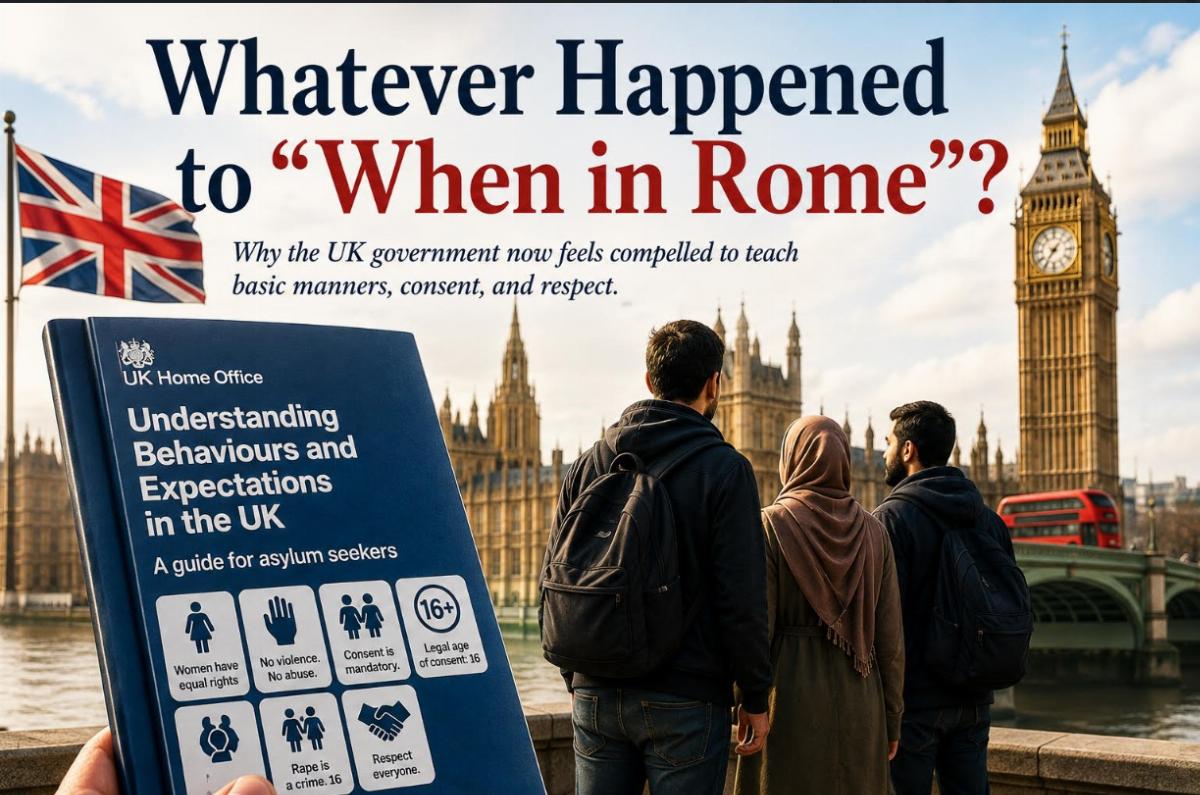
When visiting a new place, one should follow local rules and customs. Hence the old axiom, “When in Rome, do as the Romans do.”
Read more A Proper President List
Apparently, in modern Britain, that requires a nine-page government instruction manual.
Image created by ChatGPT
The U.K. Home Office recently published “Understanding Behaviours and Expectations in the UK: A Guide for Asylum Seekers.”
It begins by acknowledging the obvious:
We understand that coming to a new country can be difficult, and that laws and customs here may be different from your home country.
Fair enough. Every country has its own laws and customs.
But the British government’s instructions go well beyond reminders to queue politely, drive on the left, or know when to say “cheers.”
The booklet explains that women in Britain can work and earn their own money, attend university, travel freely, choose whom to marry — or whether to marry at all — and make their own decisions about their lives.
It specifically tells asylum seekers that women do not need permission from a husband, father, brother, or any other man to engage in these activities.
Men are instructed not to control what women wear, where they go, whom they see, or the decisions they make.
Then things get more basic.
The booklet explains that migrants must not physically or verbally abuse their spouses or family members. It also explains that sexual contact requires consent, including within marriage, and that someone who is asleep, drunk, or unable to respond cannot consent.
It explicitly states that nonconsensual sex is rape.
It further explains that the legal age of consent in Britain is 16 and that sex with anyone under 16 is a serious crime.
Stop and consider why a modern Western government believes it necessary to put these matters in writing. In a booklet.
Apparently, “Don’t beat women,” “Don’t rape people,” and “Don’t have sex with children” cannot be assumed to be universally understood by everyone seeking to enter the country.
I have visited nearly 100 countries. Depending on where I was traveling, I have been advised about dress, religious customs, photography, alcohol, public behavior, and other local sensitivities.
Yet I cannot recall ever being handed a booklet at immigration that reminded me not to beat, rape, molest, or otherwise abuse the locals.
I should not have needed one.
In some countries I have visited, women are covered almost completely from head to toe, while the men beside them may dress much as I do, in casual pants, jeans, or a T-shirt.
I would not choose those customs for my wife or daughter, but I recognize that I am visiting someone else’s country.
I respect its laws and customs while I am there. Then I return home to America, where I live by ours.
This isn’t rocket science.
And that is what makes the British booklet so revealing.
The issue isn’t simply immigration. It is immigration without assimilation.
My ancestors, like millions of others, came to America generations ago. They brought pieces of their homelands with them—language, food, holidays, family traditions, religion, and culture.
But they also learned English, adapted to American society, and became American citizens.
I never heard stories about my mother or grandparents being handed a booklet at Ellis Island that explained that American women could make their own decisions or that assaulting one’s neighbors was frowned upon.
Read more Socialist Promises, Promises
They watched. They learned. They adapted.
That was assimilation.
The question for Britain and the rest of Western Europe is whether governments still expect newcomers to assimilate—or whether the host society is expected to accommodate cultures and practices that are fundamentally at odds with its own, endlessly.
Most immigrants and refugees presumably want what immigrants have sought for generations: safety, opportunity, and a better life. Most presumably don’t need to be told not to rape or beat anyone.
But integration cannot be the sole responsibility of the country receiving them.
A host nation has every right to say: These are our laws. These are our civic expectations. Women have equal rights. Violence is unacceptable. Consent is mandatory. Children are protected. If you choose to live here, these principles are not optional.
That isn’t intolerance.
It is the minimum requirement for a functioning society.
Sweden offers an interesting cautionary example.
A BBC Reality Check noted that Malmö and other Swedish urban centers had some of the highest reported rape rates per capita in the European Union.
Sweden experienced an extraordinary influx of immigrants. According to the BBC, more than 162,000 people applied for asylum in Sweden in 2015 alone, most of them male.
Sweden illustrates the broader question facing European governments: How quickly can a country absorb large numbers of people from substantially different cultures without insisting on meaningful assimilation?
There is an expression, “When you bring there here, here becomes there.”
It’s crude, but it captures a legitimate concern.
Immigration changes the receiving country. Sometimes that change is immensely beneficial. America itself is proof of that.
But historically, successful immigration was a two-way bargain.
The immigrant gained the extraordinary opportunity to build a life in a new country. In return, the immigrant was expected to respect that country’s laws, adopt its basic civic norms, and become part of society rather than attempt to recreate the society left behind.
Western governments increasingly seem uncomfortable saying it.
America has wrestled with the same question. Immigration was central to Donald Trump’s 2016 presidential campaign and remains central to American politics today. His supporters view border enforcement, immigration restrictions, and the deportation of criminal illegal immigrants as fundamental responsibilities of government.
His opponents, particularly on the progressive left, generally favor a more permissive immigration policy and broader government assistance for migrants.
But beneath those political disagreements lies a more fundamental question that applies on both sides of the Atlantic:
What does a country have the right to expect from people it allows to enter and remain within its borders?
Britain’s Home Office apparently believes that asylum seekers need written instructions explaining that women can make their own decisions, that spouses cannot be beaten, that sexual activity requires consent, and that children under 16 cannot consent to sex.
Perhaps the booklet will help. Undoubtedly, many asylum seekers never needed such elementary instruction in the first place.
But its very existence raises an uncomfortable question.
If someone genuinely needs to be taught that women are autonomous human beings, that children are protected, and that rape and domestic violence are unacceptable, is handing that person a government pamphlet an adequate immigration and assimilation policy?
Imagine inviting someone into your home and discovering that you first need to provide written instructions explaining how to use the bathroom, not to abuse your pets, and to keep their hands off your children.
You might reconsider the invitation.
Countries have the same right to set conditions for entering their national home.
Immigrants need not abandon every food, holiday, religious practice, language, or tradition they brought with them. America has shown for generations that those traditions can enrich a country.
But some things are nonnegotiable.
If you choose Britain, respect its fundamental laws and civic norms.
If you choose America, respect America.
The burden should not fall on Rome to become more like the visitor’s homeland.
The visitor should remember where he is.
When in Rome, do as the Romans do.
Brian C. Joondeph, M.D., is a Colorado-based ophthalmologist who writes frequently about medicine, science, and public policy.
Read more Mind Viruses and America’s Irrational Obsessions
Follow Brian:
Twitter @retinaldoctor
Substack Dr. Brian’s Substack
Truth Social @BrianJoondeph
LinkedIn @Brian Joondeph
Email [email protected]