
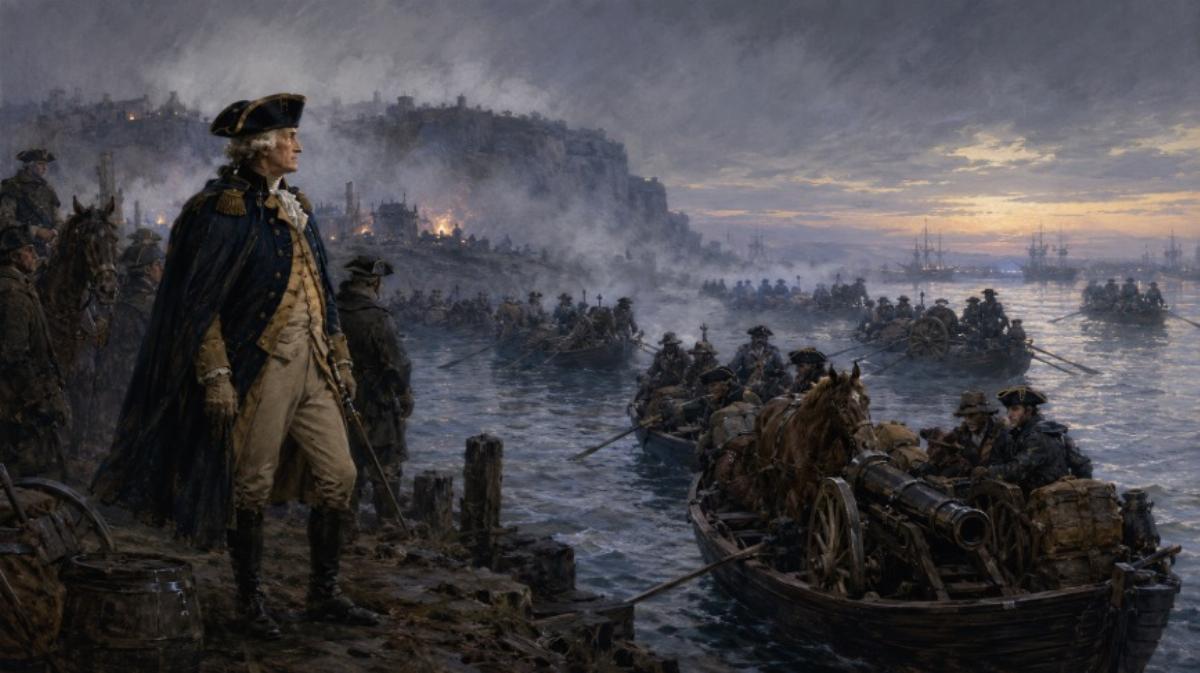
Tonight, August 29, is the anniversary of several stunning, Providential events in American history.
Read more The Big Secret about Teen Takeovers
The Battle of Brooklyn unfolded into a near military disaster for the Continental Army just weeks after the signing of the Declaration of Independence. Yet the events following the defeat produced one of the most remarkable escapes in American history. George Washington’s army had been beaten, surrounded, and pushed against the East River.
The British possessed overwhelming military strength and a powerful fleet. It seemed Washington and thousands of his soldiers should have been captured or destroyed. Instead, during the night of August 29–30, Washington evacuated approximately 9,000 men, together with artillery, horses, ammunition, and supplies, across the East River to Manhattan. The army that seemed trapped survived.
The circumstances surrounding that escape invite the word “miracle.” That word does not diminish the courage, preparation, seamanship, discipline, and strategic judgment of the people involved. Rather, it recognizes the extraordinary timing of events Washington could not control.
He could make plans, gather boats, and issue orders, but he could not command the wind, the river, or the fog.
The crisis began with the American defeat on Long Island. British forces under General William Howe had landed in overwhelming numbers and outflanked Washington’s defenses. On August 27, they drove the Americans back toward their fortifications at Brooklyn Heights.
Washington and approximately 9,000 soldiers were trapped with the East River behind them. The British controlled the land approaches, while their fleet could potentially enter the river and close the only remaining avenue of escape.
Washington faced a terrible choice. He could not hold Brooklyn indefinitely, but abandoning it meant risking an extremely dangerous river crossing. Remaining could mean the Continental Army’s destruction or capture. Retreat meant placing thousands of men in small boats and crossing under the eyes of the British Navy.
Washington chose the risky but necessary move: preserve the army.
The first extraordinary circumstance was the weather. Strong winds prevented British ships from moving up the East River and cutting off Washington’s retreat. Had British warships entered the river at the critical moment, they could have stopped the evacuation.
Washington could not control the wind, yet it left open the door through which his army had to escape.
Then came an extraordinary reversal. As the evacuation progressed, the wind died down, and conditions became calmer. The small boats could make repeated crossings. Weather that had hindered the British fleet now favored Washington’s boats.
Among Washington’s soldiers were the Marbleheaders of Massachusetts, experienced sailors and fishermen commanded by Colonel John Glover. These men understood boats, currents, tides, and difficult water. They repeatedly crossed the East River during the night, carrying soldiers, horses, cannon, ammunition, and supplies.
Fully loaded, the boats’ gunwales were just inches above the river’s surface. Their expertise was indispensable. Divine Providence did not eliminate human effort; it worked through men prepared for an extraordinary task by their ordinary experience.
The evacuation also required extraordinary discipline. Soldiers moved silently toward the boats. They avoided lights and muffled wagon wheels. Thousands of men had to move without creating enough noise to alert the British.
The army was not simply running away; it was conducting a carefully organized military withdrawal in which a single mistake could expose the operation.
As dawn approached, however, the evacuation remained unfinished. Daylight would reveal the boats and the Americans still on Brooklyn Heights. British artillery and troops could then attack the retreat.
Washington needed more time—but he could not create more darkness.
Then came perhaps the most famous providential circumstance of the escape: a dense fog settled over Brooklyn. It concealed the American position and the final stages of the evacuation. Accounts describe the fog as particularly thick over the Brooklyn side of the river, while visibility was considerably better toward Manhattan.
The Americans could continue moving while the British could not clearly see what was happening.
The timing was extraordinary. The Americans needed the British fleet kept out of the river, and the winds prevented its advance. They needed calmer conditions for their boats, and the wind subsided. They needed concealment after daylight, and fog covered their retreat.
Each event could be explained naturally on its own. What is remarkable is their combination and timing.
Read more Safety First, Comrade
Finally, the British entered the American fortifications and discovered that the enemy had disappeared. Fires still burned in the abandoned camp, creating the impression that the Americans remained there or had only recently left.
As the fog lifted, the British could see the river and the retreating boats—but Washington’s army was already beyond their effective reach.
Washington personally remained involved until the final stages of the evacuation. The image is powerful: a defeated army disappearing across the East River under cover of darkness and fog, with its commander among the last to leave.
The Americans had not won Brooklyn. They had lost the battlefield. But they had saved the army, and that was ultimately far more important.
Henry Knox also deserves recognition. Washington’s chief of artillery had already demonstrated remarkable logistical ability by bringing Fort Ticonderoga’s heavy guns to Boston earlier in 1776. Knox understood that armies require more than soldiers; they need artillery, ammunition, transportation, and supplies.
The Brooklyn evacuation preserved much of this military equipment along with the men, allowing the Continental Army to emerge from the trap as a functioning fighting force.
Washington’s own writings reveal that he interpreted extraordinary events through the lens of Divine Providence. In 1776, writing about the British evacuation of Boston, he referred to an “Interposition of Providence” and expressed confidence that such events occurred for purposes beyond what human beings could immediately understand.
His belief did not lead him to passivity. He planned, acted, took risks, and accepted responsibility, even as he recognized that events could turn on circumstances beyond human control.
The escape from Brooklyn offers several lessons. First, Providence does not eliminate courage. Washington had to decide to retreat, and his soldiers had to execute the order under harrowing conditions. Second, Providence often works through preparation.
The Marbleheaders were ready because their maritime skills had prepared them for precisely the work Washington suddenly needed. Knox’s logistical abilities likewise mattered. Third, wisdom sometimes means retreat. Washington lost Brooklyn and New York, but he preserved the army needed to continue the war.
There is also a lesson about the difference between defeat and disaster. Brooklyn was unquestionably a military defeat, but it did not destroy the American Revolution. Washington’s army survived to fight at Harlem Heights, White Plains, Trenton, Princeton, Saratoga, Monmouth, and ultimately Yorktown.
The escape transformed what could have ended the American cause into a temporary setback.
Finally, the story invites reflection on the relationship between human responsibility and Divine Providence. The soldiers rowed the boats. Glover’s Marbleheaders provided the seamanship. Washington made the critical decision.
Knox and other officers preserved the army’s military capability. Yet none of them controlled the wind or created the fog. They acted faithfully within the circumstances given to them.
That is why the night of August 29–30, 1776, remains so compelling. The Battle of Brooklyn was a defeat, but Washington’s escape was a triumph of leadership, courage, preparation, strategy, seamanship, timing—and an extraordinary example of God’s providential care.
Washington’s army had been trapped with the East River at its back. By morning, it was across the river and still alive.
The last boats leaving Brooklyn Heights carried more than soldiers and supplies. They carried the possibility of American independence. What could have been a tragic early end to the Revolution became an early chapter in the long struggle that ultimately produced an independent United States.
Let us keep at the fight today as we seek to see our Republic restored in this Third American Revolution.
Image created using AI.
Craig Seibert is the author of God’s Providence in the Affairs of Men and Nations and other books, as well as the director of Christian Civics Training, United States 250, and Declaration of Independence 250. All three sites provide abundant free resources and books. Also, Craig also serves as a Coach Mentor for Patriot Academy and Serve God – Defend Liberty Movement. Learn more about free Patriot Academy Courses at the Rebuilding Liberty Class.