
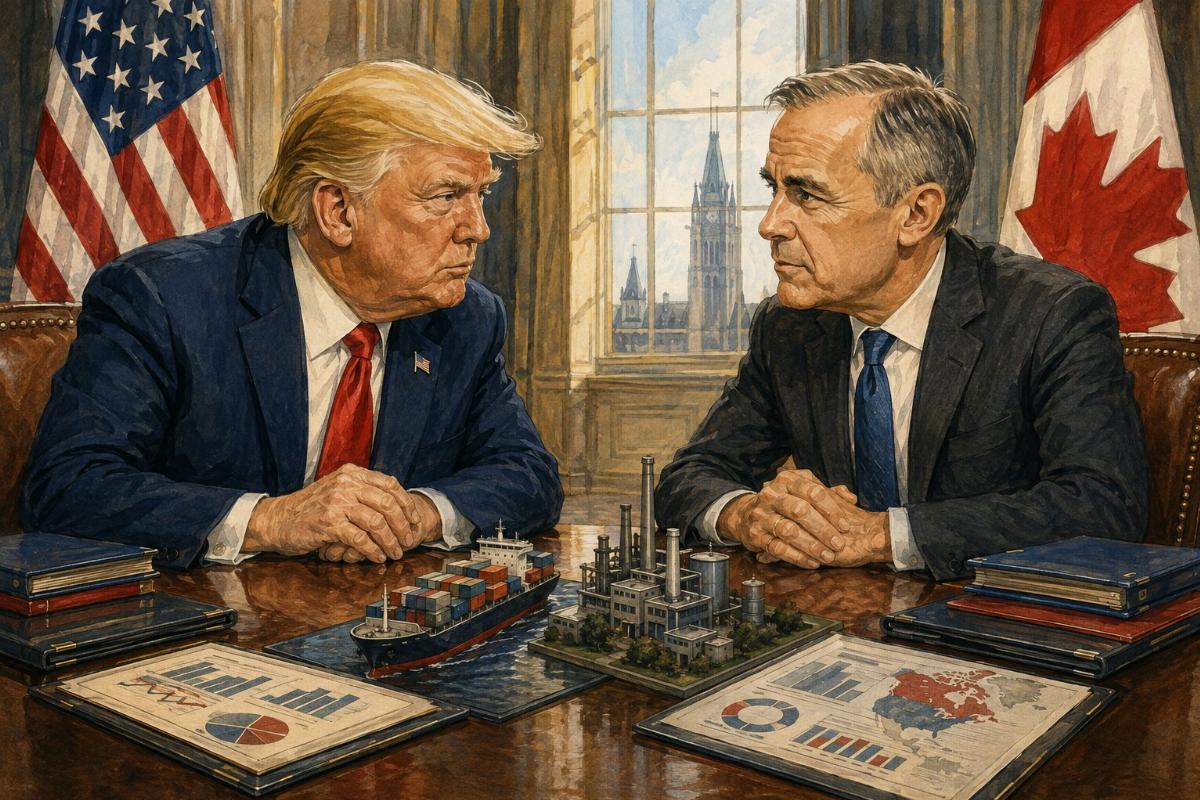
The latest failure in the trade talks between Canada and the United States has revealed a basic mismatch between political rhetoric and economic reality. Although Canadian officials, such as Prime Minister Mark Carney and the country’s trade negotiators, are still expressing confidence and maintaining that Canada has real leverage in arriving at a future agreement, the basic economic situation paints a completely different picture—one which Canadian businesses understand far better than the political leadership responsible for representing them.
Read more Breaking the American Bar Association’s stranglehold on law schools
The imbalance starts with a simple and inevitable fact: around 75% of Canada’s exports go directly to the United States, whereas only a small part of American exports go north. This imbalance is a fundamental characteristic of the Canadian economy. Since one country relies so heavily on access to the other’s market, the position of leverage becomes inherently unequal. Although Canada may be a worthwhile partner, it is not on an equal footing when it comes to bargaining power. The United States can endure trade tensions much more easily than Canada can, and Canadian companies know it.
Yet the Canadian government acts as if that imbalance does not exist. Political figures talk about staying firm, resisting pressure, and negotiating from a position of strength. While this approach might be acceptable within the country, it fails to account for businesses’ incentives, since they produce Canada’s economic output. The gap exists because politicians have no personal stake in the outcome. Whether trade improves or worsens, elected officials and bureaucratic negotiators do not see their income, investments, or market access suffer. The risk they face is political, not financial. At most, a wrong move could cost them the election several years in the future. For Canadian manufacturers, on the other hand, the effects are immediate, tangible, and possibly disastrous.
The gap between political posturing and economic reality is evident in the way companies are behaving. A recent report by The Globe and Mail on a survey carried out by KPMG found that almost 20% of Canadian manufacturers have already moved some of their production to the United States, and over 30% intend to do so in the coming years. Their reasons are clear: they want to avoid tariffs, gain access to a bigger and more stable consumer market, take advantage of favorable U.S. tax and regulatory conditions, and ensure their long-term competitiveness. These firms are not making ideological declarations; rather, they are reacting to incentives. They are acting rationally in a situation where the United States offers greater profits, more stability, and more opportunities than Canada does at present.
All companies that shift production south of the border decrease Canada’s manufacturing capacity, job opportunities, tax income, and its future ability to negotiate. At the same time, the United States gains jobs, investment, and control over its supply chains. The Canadian government’s continued emphasis on appearing tough has no effect on this trend; in fact, it accelerates it. If businesses think political leaders are disregarding economic realities, they will take action and move to places where incentives align with long-term survival.
Read more If you love someone, tell them—and be specific
Behavior, not political statements, determines leverage. Even though Canadian negotiators assert that they can set the terms, their companies are responding by moving production, limiting capital spending, and altering investment plans in ways that reveal the real balance of power. These actions prove what the market has always known: the United States has the stronger economic position, and Canada’s negotiating stance is becoming more dangerous.
It doesn’t mean Canada has no influence at all; rather, it means Canada should bargain from a basis of reality instead of relying on empty words. A mutually beneficial agreement is still possible and worthwhile, but only if Canadian leadership admits the structural dependence that shapes the relationship. Trying to impose terms on a partner that is ten times larger in size is not a sign of strength; it is damage to Canada itself. The companies moving from Canada to the United States are not disloyal to their country; they are reacting to incentives set up by a government unwilling to acknowledge the limits of its own influence.
In the end, the difference is clear: politicians can afford to have illusions, but businesses cannot. And as long as Canada’s leadership does not adjust its strategy to match the economic realities its companies already know, the country will continue to lose investment, jobs, and negotiating power—step by step, with each factory that is moved.
Read more Limousine Liberals and Country Club Conservatives are Destroying America’s Moderates
Image generated by ChatGPT.