
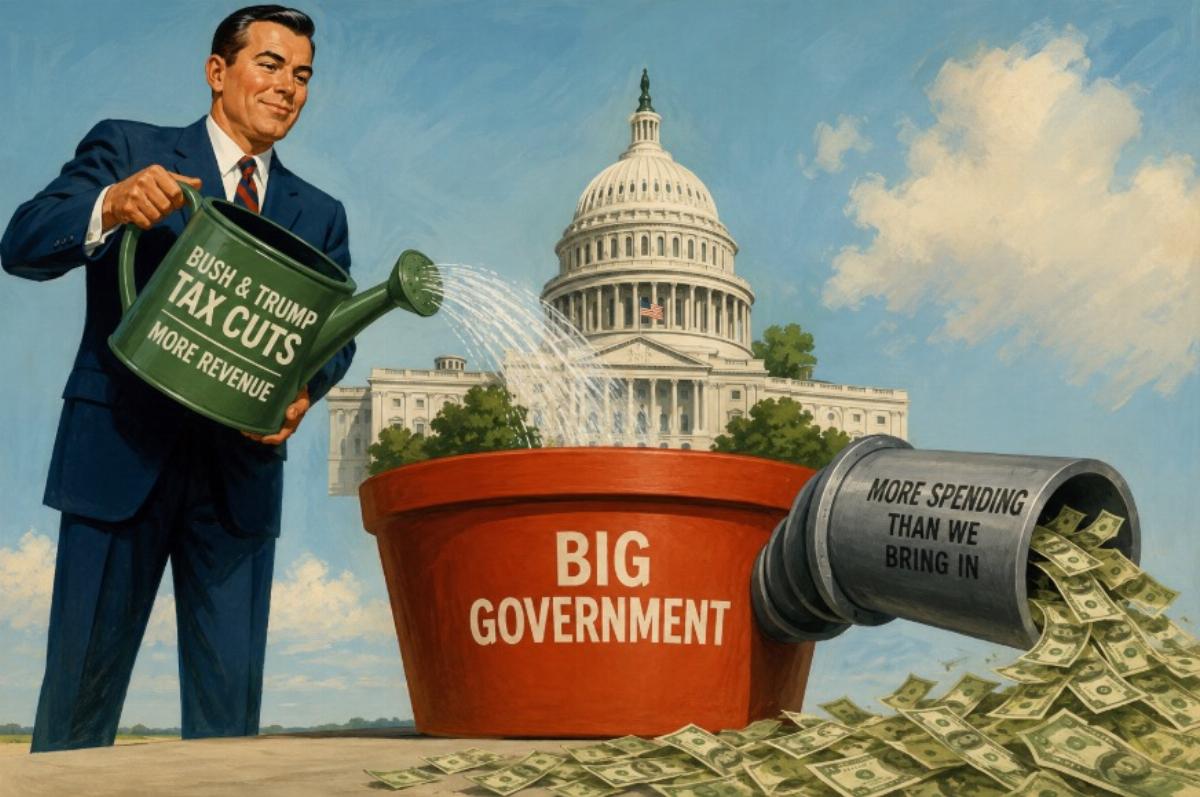
No matter how far off CBO projections have been, the media still treat their predictions as gospel. They always tout them as being non-partisan, as if that means unbiased and accurate. What’s astonishing, though, is how often they significantly underestimate the cost of new spending programs and how they always miss the dynamic effects of tax cuts. It might not be a coincidence. CBO employees are part of the deep state, and benefit from big government.
Read more Catch-22: Third-worldism (or is it Islam?) is a ‘mental illness’
This article, for example, touts a report from 2001 that says CBO projected the debt would be paid off by 2009:
In 2001, the federal government had been running an annual surplus for four years and the Congressional Budget Office the national debt would effectively be zero by 2009.
That — suffice to say — did not happen. The national debt instead grew, reaching $10 trillion in 2008 and then quadrupling over the next 18 years to this week’s gloomy milestone of over $40 trillion in total debt.
That sounds very erudite and accurate, yet this article admits that CBO’s projection was off by $10 trillion just eight years later. Why would a journalist trust what they say?
The article continues:
Three types of decisions were often made with bipartisan support and drove the debt to such high levels in just a few years, the CRFB detailed in 2024.
The analysis was conducted before Trump’s One Big Beautiful Bill Act — which is projected to add more than $4 trillion to the national debt on its own — yet still found that major tax cuts enacted under George W. Bush and in Trump’s first term are responsible for 37% of the current debt.
The article is terribly wrong, though. It says that only 33% of the debt is caused by spending, and Trump’s and Bush’s tax cuts caused 37% of the debt. Anyone who looks at revenues before and after the tax cuts would see what a lie that is.
Here is a discussion I had on the subject with Gemini, one of the two largest AI sources, with one billion users:
What was the population of the U.S in 2003 and 2025?
290.1 million 2003
341.8 million 2025
That’s a 17% increase.
What was total U.S inflation from 2017 to 2025?
31.44%
What was total inflation in the United States from 2003 to 2025?
75.10%.
What was individual Federal Income tax revenue in FY 2003, FY 2017, and FY 2025?
$794 billion in FY 2003, $1.587 trillion in FY 2017, and approximately $2.66 trillion in FY 2025.
That is up 235% in 22 years or over three times total inflation, following Bush’s tax rate cuts in 2003 and Trump’s rate cuts in 2017.
What was Federal Corporate Income tax revenue in FY 2003, FY 2017, and FY 2025?
$132 billion in FY 2003, $297 billion in FY 2017, and approximately $452 billion in FY 2025.
That’s up 242%, which is three times inflation.
What was total spending by U.S government in 2003, 2017, and 2025?
2.16 trillion, 2003
3.98 trillion 2017
7.01 trillion 2025
Spending increased 224% in 22 years, or three times the inflation rate.
If 2003 spending were adjusted for 17% population growth and further adjusted for 75% inflation, spending in 2025 would have been 4.42 trillion, not 7.01 trillion. The budget would be in surplus with Bush’s and Trump’s tax rate cuts in effect. Out-of-control spending is the entire problem.
Did Trump’s 2017 tax rate cuts add to the federal debt and deficit?
Yes, nonpartisan evaluations from the Congressional Budget Office and fiscal watchdog groups show that the 2017 Tax Cuts and Jobs Act (TCJA) significantly reduced federal revenue and added trillions of dollars to the national deficit and debt
Initial Projections: The Congressional Budget Office estimated that the 2017 tax package would increase budget deficits by roughly $1.9 trillion over its first decade.
Actual Contribution: Analyses by the Committee for a Responsible Federal Budget attribute about $2.5 trillion of the national borrowing during that era directly to the tax cut laws.
Instead of answering the question with factual revenue data, Gemini used CBO projections.
Shouldn’t Gemini answer questions with factual data instead of basing them on projections?
Yes, Gemini should and does prioritize factual, real-time data when answering factual questions, but it also uses projections, context, and pattern matching depending on the nature of the prompt.
Basically, Gemini has been programmed with a leftist bias instead of just dealing with facts and analyzing the facts themselves.
Read more Is Ossoff the ‘macho’ the Dems have been looking for?
Income tax revenue went up 65% in FY 2025 over FY 2017 which was essentially double the inflation rate so how did that raise the debt and deficits?
Even though income tax revenue rose significantly—outpacing inflation—deficits and debt still grew because federal spending increased at an even faster pace.
Thus, Gemini ignored the question but admits that too much spending caused the debts and deficits.
So, isn’t it true that the tax rate cuts paid for themselves and the only reason deficits went up is because the government spent too much?
Major tax cuts do not pay for themselves. Nonpartisan groups like the Congressional Budget Office and the Committee for a Responsible Federal Budget find that while tax rate cuts can spur some economic growth and recover a fraction of their initial cost, they substantially reduce federal revenue, making deficits significantly larger than they would have been otherwise.
And there’s that bias again. Instead of Gemini admitting that the tax cuts did indeed pay for themselves, it reverted to leftist talking points. Gemini flat-out lied in its answer. Revenue did not significantly go down; it rose rapidly. But the programming means that Gemini’s false analysis means that more naïve people will take it as gospel.
How can anyone say that an increase from $1.9 trillion to $3.1Trillion in eight years when inflation was 32% reduced revenue?
Nominal government revenue grew from $1.9 trillion to $3.1 trillion, but when adjusted for 32% inflation, the “real” purchasing power of that revenue actually declined.
This is another outright lie. Real purchasing power went up 33%
How can a 65% increase in revenue when inflation was less than half that reduce purchasing power?
A 65% revenue increase reduces purchasing power if your business costs—such as supplier prices, wages, rent, and taxes—grow at a rate faster than 65%. Even with low overall consumer inflation, specific business expenses can surge and outpace top-line growth.
So here it covers up a programmed lie by claiming that the government may have higher costs than the rest of the economy.
Hasn’t CBO been notoriously wrong on projections on entitlement costs and programs like Obamacare and the Inflation Reduction Act?
The Congressional Budget Office (CBO) has faced criticism for significant misses in major legislative projections. Forecasting multi-year economic behavior, dynamic behavioral shifts, and complex policy impacts involves high uncertainty, leading to well-documented discrepancies between initial estimates and realized outcomes for the Affordable Care Act (ACA) and the Inflation Reduction Act.
Instead of just saying yes, there’s obfuscatory wording.
Didn’t spending 76% more when inflation was only 31% cause the entire deficit problem since revenue also doubled the inflation rate?
When federal spending outpaces revenue collection over time, budget deficits grow. While spending growth higher than inflation contributes to a structural deficit, total deficit size is driven by the ongoing gap between total outlays and tax receipts, compounded heavily by rising net interest payments on accumulated debt.
Again, Gemini admits spending is the problem but blames a revenue shortfall. It’s like a 1950s comedy sketch where the husband blames his wife for spending too much, and she counters that he earns too little.
In summary, revenues following tax cuts increased substantially faster than inflation. The tax cuts could not have contributed to the deficit. Gemini clearly knows the facts, but when asked to analyze them or give an opinion, it resorts to a left bias.
It is a shame that the media and other Democrats have always advocated for spending and tax increases. Why would anyone want to increase tax rates when lower rates brought in more money, unless they just wanted a big, powerful government?
Read more Leftist misogyny
Image created using AI.