
The recent success of Democratic Socialists of America (DSA) candidates in several high-profile primary elections has reignited a debate over how far left the Democratic Party is moving.
Read more The Radical Stupidity Of Antisemitism: The Enemy Inside The Gates
These are not the Democrats of John F. Kennedy or even Bill Clinton. The DSA platform calls for Medicare for All, the Green New Deal, universal childcare, free public college, expanded government ownership of key industries, and a constitutional overhaul that would abolish the U.S. Senate, the Supreme Court, and Immigration and Customs Enforcement (ICE) and replace the presidency with congressional leadership.
On immigration, many progressive activists seek not only to reform ICE but to abolish it altogether. Congressman Shri Thanedar has introduced legislation to do exactly that. While few politicians openly call for eliminating America’s borders, many advocate policies that would significantly reduce immigration enforcement and expand legal status for those who enter illegally. In other words, amnesty.
If there is no meaningful enforcement, there is effectively no border.
The Biden administration offered a real-world glimpse into what reduced enforcement looks like. The Cato Institute estimates that nearly nine million illegal immigrants entered the United States during President Biden’s four years in office. Other estimates are even higher.
President Trump has largely reversed that trend through increased enforcement, deportations, and encouragement of voluntary departures. Yet many on the political left continue to portray border enforcement itself as morally suspect.
Rather than debating personalities or administrations, let’s examine the idea itself. What would an America without meaningful borders look like?
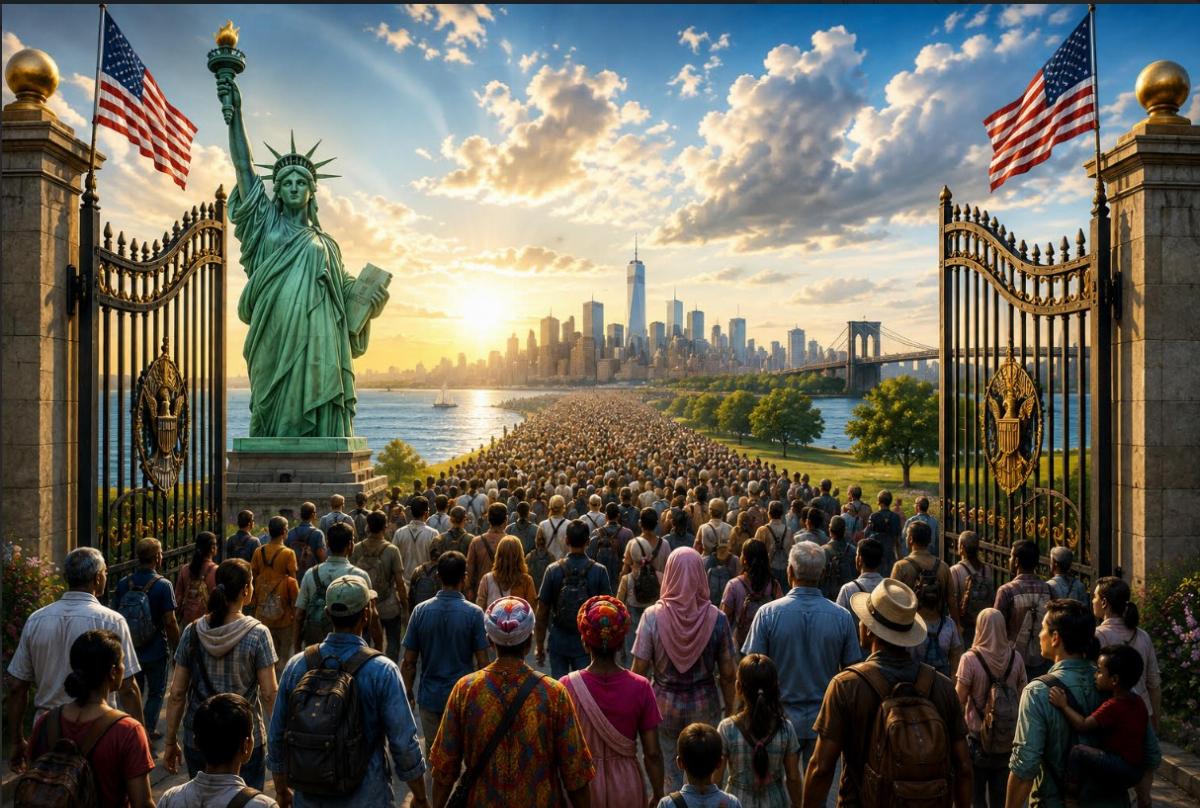
Image by ChatGPT ai-generated illustration
Suppose America truly embraced the philosophy that anyone who wished to come here should be allowed to do so. What would success look like in this scenario?
Obviously, no serious advocate of open borders proposes inviting every resident of Planet Earth to move to the United States tomorrow morning. Yet thought experiments have long been used in philosophy, economics, and law to test whether an idea remains coherent when carried to its logical conclusion.
If a principle collapses under its own weight, perhaps the principle — not the thought experiment — is the problem.
There are approximately 8.3 billion people on Earth. Excluding those already in America, it’s about 8 billion.
Could America physically accommodate an additional 8 billion people?
Surprisingly, at least mathematically, the answer is yes.
Texas covers about 269,000 square miles. Manhattan packs roughly 75,000 residents into each square mile. At that density, Texas could theoretically hold the entire world’s population.
The exercise is, of course, absurd.
No nation could provide enough food, fresh water, electricity, transportation, housing, schools, hospitals, or jobs for an additional eight billion people. Environmental degradation alone would be catastrophic. Society would collapse long before everyone found an apartment.
That is precisely the point.
Open-border advocates rarely explain where the limiting principle lies. If allowing millions of illegal immigrants to remain is compassionate, why not tens of millions? If tens of millions, why not hundreds of millions, or even billions?
Read more Who Benefits From America’s Political Bundles?
If national borders are fundamentally unjust, why should geography determine who gets to live in the world’s largest economy?
Why do most other countries have national borders and border enforcement, yet when the U.S. tries to do the same, it’s somehow racist, privileged, or supremacist?
Just because something is good does not mean that more is always better. Water is essential to life, yet drinking too much can be fatal. Legal immigration has always been part of the American story, but historically it has involved vetting, assimilation, and limits. A nation, like a person, can overdose on even a good thing.
Taken to its logical conclusion, the philosophy offers no clear stopping point.
For perspective, imagine distributing the world’s population across the entire United States rather than concentrating it in Texas. America’s average population density would rise from roughly 100 people per square mile today to about 2,400 people per square mile.
That’s comparable to suburban areas of northern New Jersey or metropolitan Phoenix — not an endless landscape of skyscrapers, yet hardly recognizable as the country Americans know today.
Again, the problem is not whether everyone could physically stand on American soil.
The problem is that nations are more than geography.
They are systems of laws, infrastructure, institutions, culture, and finite resources. Every nation on Earth recognizes this reality by maintaining borders and determining who may enter, under what conditions, and in what numbers. America is hardly unique in that regard.
At some point, “America the Beautiful” would become a landscape of traffic congestion, micro-apartments, strained infrastructure, rationed resources, and vanishing open space — a country fundamentally transformed from the one generations of Americans had inherited.
Compassion is a virtue. So is generosity. Yet neither abolishes arithmetic.
Rush Limbaugh often illustrated the absurd by following an idea to its logical conclusion. This essay is offered in that spirit. If open borders are a virtue, what is the limiting principle? If no limiting principle exists, perhaps the premise itself deserves reconsideration.
Every society has limits. Governments exist first to safeguard their citizens’ interests while extending immigration opportunities in ways that remain sustainable. A nation unwilling to distinguish between citizens and everyone else ultimately ceases to function as a nation.
Perhaps that’s why every sovereign nation on Earth — including those most critical of American immigration policy — still maintains its own borders.
Every country has a front door with a lock and a doorbell. Why not America?
Brian C. Joondeph, M.D., is a Colorado-based ophthalmologist who writes frequently about medicine, science, and public policy.
Read more Canada Chooses Climate Change, Censorship, and China
Follow Brian:
Twitter @retinaldoctor
Substack Dr. Brian’s Substack
Truth Social @BrianJoondeph
LinkedIn @Brian Joondeph
Email [email protected]