
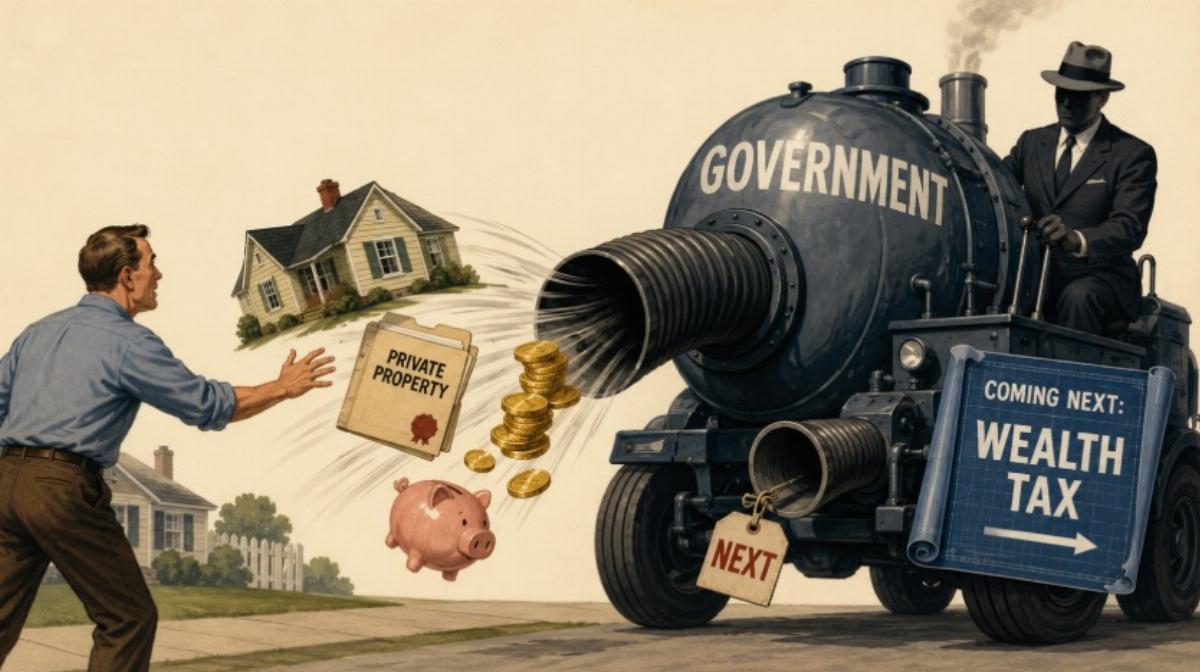
Americans traditionally understood that what they owned was theirs, not the government’s. Yet, over the last century, that principle has steadily eroded—from gold confiscation to civil asset forfeiture to proposed wealth taxes. The emerging principle is stark: Your property is yours only to the extent that the State allows you to keep it.
Read more Cuba: The Revolution That Needs Its Enemies
Preliminarily, what does it mean to own something? In America, the traditional answer was straightforward: it meant that the property was yours—not the government’s—and that the State had no claim to it unless you forfeited it through a criminal act or the government seized it through eminent domain for the public good.
Private property was understood as an extension of individual liberty, protected by right and law rather than being a privilege that the government granted at its discretion. That principle was deeply embedded in the American tradition and helped distinguish a free citizen from a subject of the State. That relationship changed dramatically in the 20th century.
Perhaps the most well-documented exercise of government power over private property occurred in 1933, when Franklin Roosevelt issued Executive Order 6102, requiring Americans to surrender most of their monetary gold to the government at the then-fixed price of $20.67 per ounce. Those who failed to comply faced criminal penalties.
The following year, the Gold Reserve Act of 1934 placed monetary gold under federal ownership and raised the official price of gold to $35 an ounce—a nearly 70 percent increase from the $20.67 price at which Americans had been required to surrender their gold. Whatever the legal justification, the episode demonstrated something deeply unsettling about the power of the State: It could declare lawful property impermissible to own, compel its sale to the government at a price it dictated, and then change the official value of that property after acquiring it. By any ordinary understanding, that is confiscation backed by the power of the State.
The next expansion came with the institutionalization of modern civil forfeiture. Civil forfeiture originated in an old maritime and customs doctrine and has become a powerful and controversial domestic instrument of government.
Federal forfeiture authority expanded significantly in 1978 and 1984, when Congress broadened the government’s ability to seize the proceeds of alleged drug crimes and property used to facilitate them. The Comprehensive Crime Control Act of 1984 also established the Department of Justice’s Assets Forfeiture Fund and authorized the Attorney General to share forfeited property with state and local law-enforcement agencies.
This created a profound change in the incentives driving police and regulatory agencies. Property could be seized and forfeited without the government necessarily obtaining a criminal conviction against its owner, and law-enforcement agencies could benefit from the property they seized, much as pirates did.
Owners who had not been convicted of—or even charged with—a crime could find themselves fighting to recover money, vehicles, homes, and other property in proceedings in which the government was pursuing the property rather than proving the owner’s criminal guilt.
America is a country of precedent. Once the government established the precedent that it could seize private property without first convicting—or even charging—the owner of a crime, and sometimes without even obtaining a warrant, the process felt like an illegal taking. Today, federal forfeiture alone is a multibillion-dollar enterprise. In fiscal 2025, the Justice Department’s Assets Forfeiture Fund received $2.287 billion in forfeiture proceeds, following $2.422 billion in 2024 and $3.339 billion in 2023.
It’s not just the Feds, either. States have developed their own civil asset forfeiture systems, allowing law enforcement agencies to seize property alleged to be connected to criminal activity and, after forfeiture, retain or spend the proceeds.
Florida provides a particularly revealing example. Its Contraband Forfeiture Act expressly authorizes law-enforcement agencies to use forfeiture proceeds as “supplemental funding.” State law directs forfeiture proceeds into law-enforcement trust funds, while federal asset-sharing programs provide another avenue for state agencies to receive proceeds from federal forfeitures. What began as an extraordinary power to take property associated with crime has evolved into a nationwide system in which government agencies have a vested financial interest in the property they seize.
Not every exercise of forfeiture or taxation is unconstitutional or illegitimate. The government has always possessed some authority to take property under the law. The question is where the boundary lies—and whether each expansion of that authority comes close to an extra-judicial taking.
Read more Blame Truth for Jason Arday’s Death
Even with all this hanky-panky, the government’s reach apparently isn’t broad enough. Now states and the federal government are contemplating the next rung up the ladder: outright wealth confiscation.
There is a fundamental difference between government taking property because it claims the property was involved in a crime and government taking property simply because someone possesses it. The former at least purports to rest on an allegation of wrongdoing. The latter rests on the government’s assertion that it has a legitimate claim to something you’ve earned.
Once government moves from taxing what we earn to taxing what we own, ownership itself becomes the taxable event. The government no longer must point to a transaction, an offense, or even a particular act that generated the property. The mere fact that you possess it is enough to establish a first lien on your wealth.
And this is no longer theoretical. In March 2026, Senator Bernie Sanders and Representative Ro Khanna introduced legislation imposing a 5 percent annual tax on billionaires’ wealth. California voters will also decide in November whether to impose a one-time five-percent tax on the net worth of qualifying billionaires. California’s Legislative Analyst describes the measure as a tax on wealth, defining wealth as the value of what a person owns, less his debts.
Remember our discussion of precedent earlier? We’ve now arrived at the heart of the matter.
Whether government takes 5 percent, 50 percent, or ultimately 100 percent, the amount is a question of degree. The underlying concept that property is only conditionally yours is the more important issue.
The fundamental question is whether government has a legitimate claim to property simply because a citizen possesses it. Once the answer becomes yes, the government—not the owner—ultimately determines how much of that property the “owner” is permitted to keep. Calling it a tax does not change the underlying assertion of power: the State is effectively placing a lien on property that you own.
And history suggests that the government rarely leaves a newly established power confined to its original boundaries. The justification will always be that the next confiscation is different, that the next group is different, or that the next need is greater.
The government does not have to begin by taking everything. It merely must establish the principle that it can take something that was previously understood to belong entirely to the individual and declare that a portion of it belongs to the State.
Once ownership is deemed conditional, private property ceases to be a protected right. That is the real issue. It is not how much wealth the government takes; it is whether we are willing to accept the proposition that the government has a claim to wealth simply because we possess it. Because once that principle is accepted, the question is no longer whether the government can take your property; it is how much of it the government will allow you to keep.
Did someone say “Communism”?
God Bless America.
Image created using AI.
Author, Businessman, Thinker, and Strategist. Read more about Allan, his background, and his ideas to create a better tomorrow at 1plus1equals2.com.
Read more When Lenin Lost An Election, He Abolished Democracy