
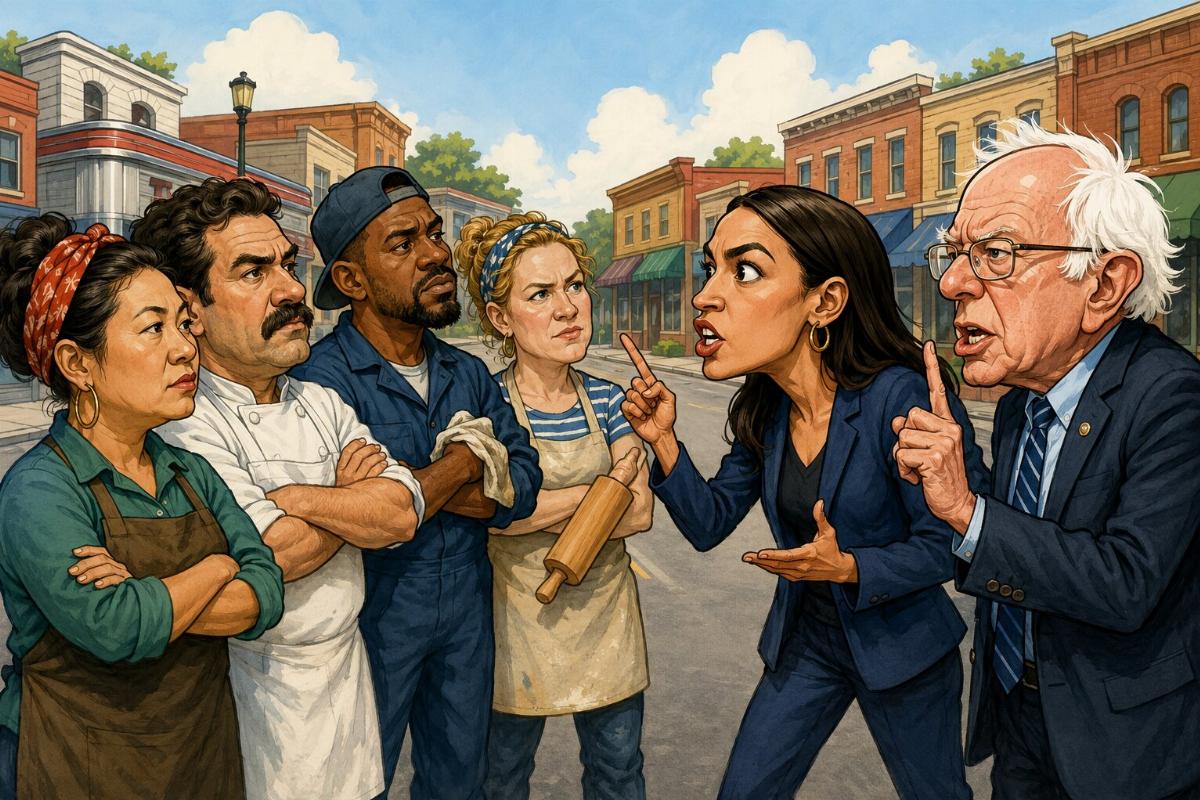
Every time a new proclamation arrives from AOC — the megastar of American socialism, whose three-letter moniker probably makes J-Lo envious — I find myself caught between amusement and genuine alarm. Amusement at the proposals. Alarm at how seriously the people making them believe they can win on them.
Read more Yes America has a leadership crisis—but it has a followership crisis too
I stay out of politics wherever I can. But when politics and business collide, there is no staying out. There is only dealing with what is. And what is, right now, is this: socialism is no longer a fringe position in the United States. It is growing. And business leaders who lie awake worrying about it should understand something uncomfortable — a good portion of that growth is their own doing.
Here is the argument in plain terms: socialism does not rise from strength. It fills a vacuum. And that vacuum was created, community by community, when business leaders stopped showing up.
The seats on local zoning boards, school boards, planning commissions — the unglamorous machinery of local governance — were once filled by the business community. Not out of altruism, but out of self-interest correctly understood. These were the people who knew what a payroll felt like, what it cost to open a storefront, what a bad decision by a committee of well-meaning amateurs could do to a downtown. When they stopped showing up, those seats did not stay empty. They were filled by what I call, the resume enhancement crowd. Qualifications? Rhymes with “fog a mirror.”
I had my own education in this years ago, when I owned a downtown business in a small town becoming an affluent bedroom community. The newly formed economic committee called me in to present before they would grant me the opportunity to open. The questions told me everything I needed to know about who I was dealing with.
It did not take long for the proof to arrive. Shortly after I opened, this same committee voted to hold a downtown parade and informed all of us (e.g., all the people with storefronts) that we were expected to close both Friday and Saturday so they could hold their event. These just so happened to be our two biggest sales days. Plus, we were also informed that we needed to contribute a sizable donation to fund it.
We stayed open. Their event went off without a hitch, however, they were not pleased.
Then came the second act; the political rally. A U.S. Senate candidate wanted to hold an event directly in front of our shops, on a weekend, guaranteeing that parking and traffic would chase every customer away. If you’ve ever owned a retail establishment, you understand just how important parking is to customers. If they even think there’s a chance there’ll be little to none, they go elsewhere, sometimes never to return.
So with this for context, this same committee decided their office was too small for the candidate’s staff and (with permission) commandeered the basement of one of the larger downtown businesses. Then, with a straight face, demanded suggested to said owner, they should close for the day, because the foot traffic generated above might be distracting to the people he had graciously accommodated below.
Hint: He did not close.
But the look on their faces from that moment forward told you exactly what they would have done if the power to compel him had been available to them. Something about behind a woodshed or something comes back to mind. But I digress.
That is not an isolated story. It is a pattern. And it explains, more than any ideological analysis could, how we arrived at a moment where elected officials proposed things such as the Green New Deal, COVID lockdowns, suspension of rent collections and more, much more.
Read more Barnard was aggravated by a fake photo, but not the exposure of its antisemitic faculty
Nevermind the politicians along with their gaggles of wannabes. What truly exposed the insanity here was defined by the adamant nodding along by the general electorate with complete seriousness. In some cases, zealotry is more the applicable term.
None of this happened because socialism suddenly became more persuasive. It is happening because the people who understood business — who could have made the counter-argument from a position of lived knowledge and community standing — were too busy running their businesses to bother. Decisions have consequences. Absence is a decision.
The small business owner was always the living proof that the system worked. Someone who came from nothing, built something of value, employed people, and planted roots in a community. That model is not dead, but it has been hollowed out — first by the box store, then by the financialization of everything, then by a culture that decided the only businesses worth celebrating were the ones burning venture capital at scale while chasing a celebrity CEO moment. Those ships have sailed, and a good number of them are running aground in plain sight.
What comes next, if the current trajectory holds, is that someone else decides how your business runs, how much you can earn, and how much you are permitted to keep. That is not a hypothetical. Read anything AOC and her growing list of ideological allies have put into print. They believe they can mandate it. And they think they can win the power to do so.
The answer is not complicated, even if it is inconvenient. Get back into your community. Not with a check and a wave from a distance, but with your presence and your knowledge in the rooms where local decisions get made. The argument against socialism is not won in cable news debates. It is won at the zoning board meeting, the school board hearing, the planning commission table — wherever the vacuum is, fill it.
Because if you won’t, someone else already has their hand up that probably favors a business structure anathema to anything resembling true business principles.
Think about it. While you still have the time to. And if you think my ideas aren’t rooted in the founding of this great nation, I’ll leave you with this quote:
The more people who own little businesses of their own, the safer our country will be, and the better off its cities and towns; for the people who have a stake in their country and their community are its best citizens.
— John Hancock First governor of Massachusetts, first signatory to the Declaration of Independence.
Read more The Dem ‘big tent party’ is doomed