
Six years ago, police in Aurora, CO, drew weapons on Brittney Gillian, a black woman, and four minors—her sister, daughter, and two nieces, ages 17 to six years—forced them to the hot asphalt in a parking lot, handcuffed them, and turned their “Sunday fun day” outing into a nightmare. The officers had misidentified Gillian’s SUV as stolen, matching the plates but not waiting to cross-check the description of the vehicle the Automated License Plate Reader (ALPR) network alerted them to: an out-of-state motorcycle.
Read more Los Angeles County DA Hochman Is Doing The Right Thing
The Aurora police apologized and, three years later, paid Gillian and the others $1.9 million in a civil rights settlement, but the officers were not charged. Their heavy-handed action, perhaps a genuine error, was found to be in keeping with standard procedure. That does not excuse the trauma Gillian and the children suffered. And compensation in one case does not lessen the extent to which ALPRs can be—and have been—used in violation of citizens’ privacy and liberty.
With free access to ALPR data, police officers are predictably the biggest abusers. At least 50 officers nationwide have faced charges for accessing ALPR networks for personal reasons—for example, to stalk romantic interests.
- A Milwaukee police officer used his department’s network to track a partner and one of her exes 179 times.
- A Florida officer was charged with stalking for running the plates of vehicles owned by his then-girlfriend and her family more than 100 times over seven months.
- Texas deputies scoured footage from 83,000 cameras nationwide to track a woman who had self-administered an abortion and consulted prosecutors about charging her under the state’s abortion ban. They claimed she was “missing” after her friend reported her and, having seen the aborted fetus, were concerned she might bleed to death. This was later disproved. But the larger question is whether police in a no-abortion state can use the network to locate an abortion suspect in states where abortion is a legal right.
There are serious ethical issues. As of early August, more than 128,900 ALRPs are in use across 49 states, a number that is rapidly growing, and the information they collect is shared with thousands of police departments and agencies nationwide. Citizens have no knowledge of or control over how that information is used.
Warrants are not required for ALPR tracking, and most courts have ruled that “mere observation” does not violate the Fourth Amendment, which protects against unreasonable searches and seizures. However, they also warn that prolonged warrantless surveillance can constitute an infringement. The law is evolving, and rights groups are leading the debate and protesting blatant infringements.
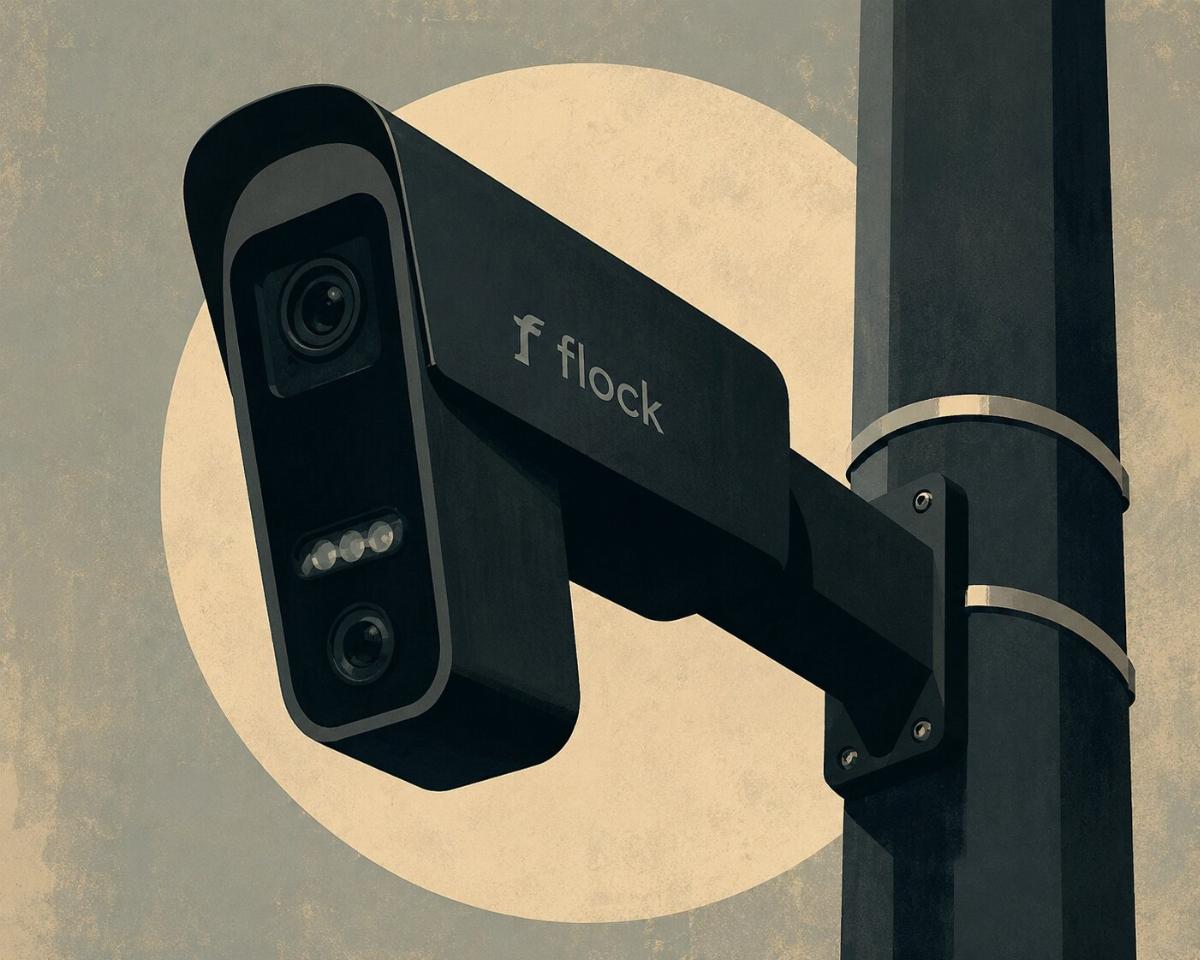
Another issue concerns corporate access to ALPR data. Eighty percent of fixed-pole ALPR cameras are from Flock Safety, now the face of the controversy. Vigilant Solutions, a Motorola subsidiary, dominates the squad-car setups and data-sharing equipment, but Flock is edging in. Flock also sells drone systems, gunshot and audio detectors, mobile security trailers, and data integration software. That means Flock can track almost every citizen.
Corporate tie-ups will only increase questionable data-sharing. Flock planned to partner with Nexar, a dashcam company, to expand its network to 350,000 vehicles across the fleets of Uber, Lyft, and similar services, turning them into surveillance units. BusPatrol, which uses AI to identify bus-safety violations, has installed cameras on thousands of school buses and plans to share access with law enforcement. The Flock-Nexar tie-up was abandoned after media exposure, but companies will keep trying and will lobby politicians for laws that will profit them.
There is also a serious problem with ALPR accuracy. Flock Safety claims 93% accuracy, but an independent police study found a 37% error rate. Police departments, of course, viewed this finding through the lens of legal liability and payouts. But imagine the risk to innocents: being pulled over and subjected to traumatic take-downs, as with Gillian and the children; being drawn into investigations as suspects; and even erroneous convictions.
ALPR use is typically justified by citing the need to respond to Amber alerts, trace stolen vehicles, and locate vehicles involved in accidents. But police haven’t refrained from straying into gray areas. In Georgia, they helped a school board determine whether students’ families lived in the district. Elsewhere, they’ve investigated complaints about loud music and used ALPR data for background checks of job applicants.
Read more The Navy and the Midterms
ALPR cameras were invented in Britain in 1976. They have advanced over the decades, with improvements in image resolution and character recognition. But recent technologies like AI and machine learning have greatly amplified their power. Video streams can be analyzed frame by frame at high speed. In addition to plate numbers, the make, model, color, and many other details of millions of cars can be determined and integrated for advanced analysis. Like cellphone location logs, they provide a remarkably accurate picture of a person’s life.
Because laws governing the use of such data haven’t been established, resistance to ALPR cameras—especially those from Flock—has been rising. The Washington Examiner recently reported that 54 cities had canceled Flock contracts as people became more concerned about privacy and civil rights violations. DeFlock, an open-source project, puts the number at 100.
Rights groups are protesting to draw attention to the use and misuse of ALPRs and the resulting privacy violations. They demand an end to the use of ALPRs until a legal framework of checks is in place. They are also filing lawsuits and lobbying against bills that would allow unbridled use of ALPR data. The following are some significant ALPR-related actions:
- The Institute of Justice is representing San Jose residents in a class action against the city, alleging Fourth Amendment violations.
- The Electronic Frontier Foundation (EFF)—which has been litigating against privacy threats since 2012—has successfully sued the Los Angeles Police Department to obtain ALPR data and the Marin County, CA, sheriff for sharing ALPR data with out-of-state and federal agencies.
- The EFF and the American Civil Liberties Union (ACLU) have filed amicus briefs in Virginia, Massachusetts, and urging that warrants be required to access ALPR databases.
- The EFF and ACLU have also sued San Jose over warrantless searches of vehicle location data.
- The ACLU is fighting to stop the Combating Organized Retail Crime Act (CORCA) bill, which would allow ALPRs and facial recognition software to be used on consumers, ostensibly to prevent shoplifting.
- DeFlock is holding a National Week of Action Against ALPRs from August 16 through 22.
- HaveIBeenFlocked.com allows people to check whether their car information has been acquired for use.
- Atlas of Surveillance, a collaboration between the EFF and the Reynolds School of Journalism in Reno, has created a free, searchable database of law enforcement surveillance.
- Technocracy.news has drafted a model after the Bill of Rights, emphasizing the right to freedom from “surveillance, manipulation, and behavioral control.”
As expected, law enforcement and intelligence agencies are unlikely to back down. DeFlock’s protest plans are already on their radar. Documents obtained by investigative reporter Dan Boguslaw and 404 Media show that intelligence agencies know where the protests are likely to be staged and have asked police to beef up security around ALPR cameras.
Last year, Flock CEO Garett Langley called DeFlock a “terroristic organization” but later apologized. However, security agencies appear to view DeFlock—which states that its mission is to raise awareness—as no different from vigilante groups that vandalize ALPR cameras.
Meanwhile, two bills stand out for protecting privacy and opposing unwarranted data collection, including that via ALPRs. The PRIVACY Act, introduced by Congressman Keith Self (TX-03), requires federal agencies to obtain warrants before accessing data collection systems. The other—the Protection Against Mass Surveillance Act, introduced by Rep. Tim Burchett (R-TN)—seeks to ban federal purchases and funding of ALPR cameras. Many states are pursuing regulation of the use of ALPR data.
Rep. Self rightly states, “Americans’ Fourth Amendment right to be secure in their privacy does not disappear because of new technology or AI. They have a constitutional right to be secure in their persons, houses, papers, and effects, and our government is supposed to get a warrant before invading that privacy.”
Read more Acknowledging Everything, Solving Nothing
Image generated by ChatGPT.