
I don’t have much interest in participating in an escape room event, intriguing as the game initially sounds. Seeking out clues and then puzzling out their meaning in coordination with a group of friends or family simply to exit said room sounds rather exhausting. I’m just not interested in exerting myself in this sort of situation. It is simply not a knot I would never feel compelled to untangle.
Read more No autopsy will help Democrats
I treat mystery novels in the same way. Although I prefer a good mystery to a romance novel any day of the week, I don’t pick them up for the pleasure of exercising my own little grey cells in an attempt to discover the murderer’s identity before the big reveal; I leave the ratiocination for Sherlock, Hercule, and Morse. As with the hypothetical escape room, I’m simply along for the ride.
The area where I do make an effort to exert myself and direct my modest powers of reasoning to the solution of a problem is writing, especially the composition of essays.
But this begs a question. Just what constitutes the problem that tantalizes me into making an effort that is so often rather taxing?

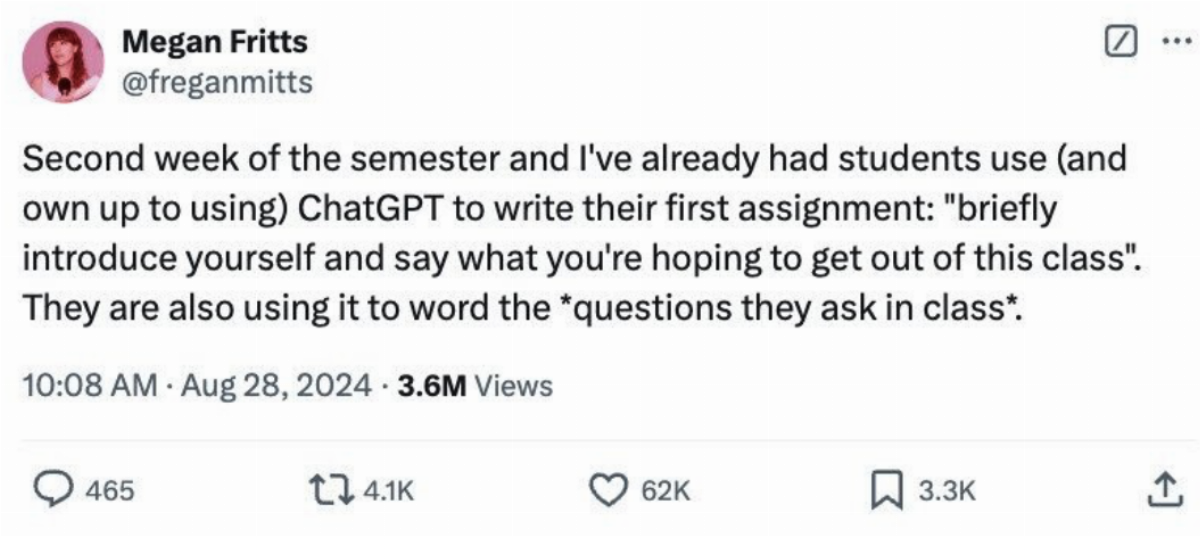
Graphic: X Post
Consider students taking college composition. For them, the “problem” at hand is the production of a piece of writing, ostensibly their own, of a certain length, in order to fulfill an assignment. Of course, no composition teacher worth their degree would subscribe to that definition. Doing so would make the piece of writing itself the goal, despite there being no value to this thing called “an essay” in and of itself, especially when created by novice practitioners.
After all, do composition teachers actually enjoy reading student essays? Of course not. We read them because they are a practice in a particular discipline, akin to the effort that goes into learning a musical instrument or playing a sport. No music teacher or athletic coach gets a kick out of the practice routines for their own sake, just as no writing teacher looks forward to reading student essays just for the experience. They are in no way edifying. What they are is a single instance in the progression toward something, which the teacher or coach is trying to move forward, and it is the question of what that destination is that AI is forcing us all to come to terms with.
Graphic: X Post
During the twentieth century, the goal of student writing classes changed from that of prodding young people to greater technical proficiency (and even elegance of expression) to encouraging students to come to a better understanding of their own thoughts and opinions through their writing. A further hoped-for lesson would be their discovery that, at times, through the process of articulating themselves on paper, those opinions may change. The old mantra from my student days, which still holds true in my own experience, is that it takes writing to know what it is you want to say. This is no mere pedagogical fashion. The truth is, the effort of refining one’s thoughts into greater clarity of expression forces greater clarity of thought.
If that makes a college composition class sound more like an archaeology dig, so be it. We all have inchoate thoughts which, despite being barely discernible to ourselves, motivate our actions. Thinking, and thinking hard about the “gut reactions” we have to events in the world, and forcing ourselves to express them with clarity is taking ownership of those ideas. Allowing AI to do the articulating for you is not thinking. It is allowing someone to come along and unravel the knot for you. What kind of practice is that? You might as well get a player piano instead of bothering to learn the piano yourself.
When Descartes pronounced that the one thing he could assert that he knew with certainty was that he existed (Cogito, ergo sum), he asserted this foundational truth because he thought. That’s it. Thought. We need to ask ourselves: without cogito, what are we?
Jocelynn Cordes has published two novels under the name Plum McCauley as well as a collection of her published essays under her own.
Read more The Constitution must be destroyed!