
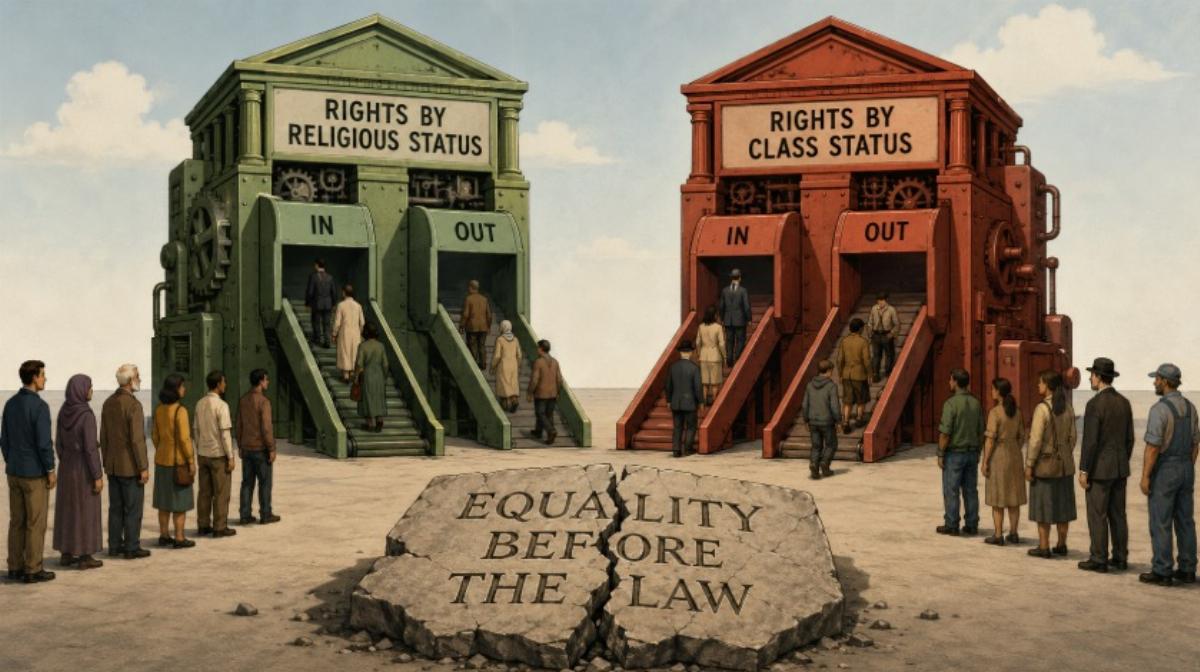
In revealing the commonalities of the Reds and the Greens in the Red-Green Axis, past essays have elucidated their shared goals of violence and wealth redistribution. Here we explore their legalization of inequality.
Read more ‘Trans ally’ insults WNBA star Sophie Cunningham by saying she looks like… a ‘trans’
Both classical Islamic political jurisprudence and Marxist-Leninist communism reject a fundamental constitutional premise of the United States: that individuals possess equal legal rights because they are persons, not because they belong to a favored religious, political, or social category. Instead, both systems construct political order by dividing society into privileged insiders and subordinate outsiders.
Membership in the preferred category—not equal personhood—determines legal rights, political authority, and social standing. Rights are therefore derivative. They flow from status rather than equal personhood and are embedded in the foundational texts and institutions of both systems. Although one defines membership by religion and the other by class, both organize political authority through the same mechanism: differential rights based upon categorical belonging rather than equal legal personhood.
In the Islamic political order, the distinction begins in the Qur’an itself. Qur’an 9:29 commands Muslims to fight those “who do not believe in Allah or in the Last Day” until they pay the jizyah “while they are humbled.” The verse establishes a permanent legal category of non-Muslims living under Muslim rule who retain life and property only through submission, payment, and acknowledged inferiority.
Classical jurists transformed this principle into the institution of the dhimmi. The protected non-Muslim receives aman—security of life and property—but not equal legal standing. His juridical personality differs from that of the Muslim. Testimony may carry less weight, public religious expression is restricted, political and military authority remain reserved to Muslims, and the Pact of Umar tradition further prescribes legal and social disabilities, including restrictions on places of worship, bearing arms, and public equality.
These rules are not exceptional wartime expedients. They define the ordinary legal condition of the outsider within the Dar al-Islam. Full juridical standing belongs to the Muslim. The non-Muslim exists within a graded legal order whose purpose is to preserve the supremacy of the insider community.
Marxist-Leninist communism constructs an analogous hierarchy, substituting class for religion while preserving the same logic. The Communist Manifesto declares that history is fundamentally the history of class struggle and identifies the bourgeoisie as the class whose domination must be destroyed.
Lenin makes the constitutional implications explicit in The State and Revolution, arguing that the dictatorship of the proletariat exists to “crush the resistance of the exploiters.” Political equality therefore does not survive the revolution. Instead, the proletariat, acting through its vanguard party, becomes the sole legitimate bearer of political authority.
Former property owners, counterrevolutionaries, and other officially designated enemies lost equal standing before the state. The 1918 Constitution formally excluded defined categories of “exploiters” from voting and public office. Property was confiscated, political participation restricted, and rights conditioned upon ideological reliability and class origin. Those outside the approved ideological community remained vulnerable to exclusion, imprisonment, exile, or liquidation.
The structural identity between these systems is not accidental but functional. Each begins by identifying a morally privileged collective whose interests supersede those of every competing group. Each defines outsiders not as equal citizens holding different beliefs, but as categories requiring management, subordination, or neutralization.
Once rights become functions of membership rather than attributes of personhood, unequal treatment no longer appears as an exception requiring justification. It becomes the ordinary operation of justice itself. Measures unlawful against equals become lawful when directed against an inferior legal category.
The hierarchy therefore serves several political purposes simultaneously. It mobilizes insiders through shared identity, legitimizes differential coercion, concentrates political authority, and transforms equality before the law into equality within the favored class alone. The law no longer asks whether two individuals possess the same rights. It first asks whether they belong to the same status.
History demonstrates that these hierarchies were not merely theoretical. Under successive Islamic polities, dhimmi communities lived for centuries under legal systems that differentiated rights according to religious identity. Their unequal status was administered by courts applying the classical schools of jurisprudence and reinforced by fiscal obligations, legal disabilities, and social restrictions. Conversion provided the path to full juridical equality, making religious conformity the gateway from outsider to insider.
Communist regimes implemented the same structural principle while substituting class for creed. The identities of the outsiders changed over time—kulaks, “former people,” Trotskyists, “rootless cosmopolitans,” and others—but the governing principle remained constant. Rights followed political classification rather than universal citizenship.
The boundary separating insider from outsider could be redrawn whenever the regime required a new enemy, but the existence of the boundary itself remained indispensable. In both systems, the hierarchy proved durable because it was not merely punitive. It was constitutive of the political order. The favored community did not simply enjoy greater privileges; it derived its identity from occupying a superior legal status.
This structural parallel explains why both systems repeatedly employed differential coercion without regarding it as inconsistent with justice. If the outsider does not possess the same juridical standing as the insider, unequal taxation, unequal political participation, unequal evidentiary weight, confiscation of property, restrictions on public activity, administrative exclusion, imprisonment, or physical coercion become matters of legal administration rather than violations of equal rights.
Read more Permanent Daylight Saving Time deja vu
The hierarchy itself supplies the justification. Rights no longer limit governmental power equally; they become instruments through which the state distinguishes between those who fully belong and those who exist only under conditional terms.
One common objection misunderstands the comparison. Critics frequently observe that classical Islamic law generally protected the lives and property of dhimmis, whereas communist governments often extended far less protection to designated class enemies.
That distinction concerns severity, not the nature of the structure. A hierarchy remains a hierarchy even when subordinate categories retain legal protections. The dhimmi’s security was contractual and conditional, not equal. Communist systems likewise permitted conditional survival through re-education, labor discipline, or ideological conformity.
In both systems, the decisive question is not whether outsiders possess some rights. It is whether they possess the same rights as insiders. They do not. Rights are calibrated according to status rather than shared personhood.
The constitutional premise of the United States proceeds from the opposite direction. It begins by asking what rights belong equally to every individual without considering religion, class, ancestry, wealth, or political allegiance.
Classical Islamic political jurisprudence and Marxist-Leninist communism reverse that inquiry. They first ask: To which category does this person belong? Only after that question is answered are legal standing, political authority, and civic rights determined.
Rights become functions of membership rather than attributes of personhood; equality becomes conditional rather than universal. The insider/outsider hierarchy is therefore not one institutional feature among many. It is the lawful architecture upon which both systems rest. It is the mechanism through which each transforms comprehensive ideology into durable political authority by replacing equal legal personhood with status-dependent rights.
Image created using AI.
Endnotes
1. The Qur’an, 9:29. Standard translations (including Sahih International and Yusuf Ali) render the command to fight those “who do not believe in Allah” until they pay the jizyah “while they are humbled.” Arabic text and multiple English translations are available through standard editions and at Quran.com.
2. On the legal status of dhimmis and the differential allocation of legal rights under classical Islamic law, see Ahmad ibn Naqib al-Misri, Reliance of the Traveller: A Classic Manual of Islamic Sacred Law (Umdat al-Salik), trans. Nuh Ha Mim Keller (Beltsville, MD: Amana Publications, 1994), especially Book O and the sections governing non-Muslims, legal capacity, testimony, and public status. See also al-Mawardi, Al-Ahkam al-Sultaniyyah (The Ordinances of Government), trans. Wafaa H. Wahba (Reading: Garnet Publishing, 1996); and Abu Yusuf, Kitab al-Kharaj, on the legal obligations and status of protected non-Muslim communities.
3. On the Pact (Covenant) of Umar and its incorporation into classical Islamic jurisprudence, see Milka Levy-Rubin, Non-Muslims in the Early Islamic Empire: From Surrender to Coexistence (Cambridge University Press, 2011); A. S. Tritton, The Caliphs and Their Non-Muslim Subjects: A Critical Study of the Covenant of Umar (London: Frank Cass, 1970); Mark R. Cohen, Under Crescent and Cross: The Jews in the Middle Ages (Princeton University Press, 1994); and Bat Ye’or, Islam and Dhimmitude: Where Civilizations Collide (Fairleigh Dickinson University Press, 2002). These works discuss the historical recensions of the Pact and its influence on restrictions concerning churches, public religious expression, distinctive dress, bearing arms, riding horses, and related legal disabilities imposed upon dhimmis.
4. Karl Marx and Friedrich Engels, Manifesto of the Communist Party (1848), Part I, “Bourgeois and Proletarians.” Primary text available through the Marx/Engels Internet Archive.
5. V. I. Lenin, The State and Revolution (1917), especially Chapters II and V discussing the dictatorship of the proletariat as the instrument for suppressing and “crushing the resistance of the exploiters.” Primary text available through the Marxists Internet Archive.
6. Constitution (Fundamental Law) of the Russian Socialist Federative Soviet Republic (1918), especially Articles 23 and 65, which conditioned political rights upon class status and excluded specified categories of “exploiters” from voting and public office. English translations appear in J. N. Hazard, The Soviet System of Government, and other standard collections of Soviet constitutional documents.
7. On the evolution of Soviet classifications of “class enemies,” “former people,” kulaks, and other politically excluded categories, see Sheila Fitzpatrick, The Russian Revolution (Oxford University Press, 2008); Sheila Fitzpatrick, Everyday Stalinism (Oxford University Press, 1999); J. Arch Getty and Oleg V. Naumov, The Road to Terror: Stalin and the Self-Destruction of the Bolsheviks, 1932–1939 (Yale University Press, 1999); Robert Conquest, The Great Terror: A Reassessment (Oxford University Press, 2008); and Anne Applebaum, Gulag: A History (Doubleday, 2003). For primary documentary evidence, see NKVD Order No. 00447 (30 July 1937) and related Soviet decrees concerning “anti-Soviet elements” and politically suspect classes.
8. On the constitutional premise of equal legal personhood in the United States, see the Declaration of Independence (1776) (“all men are created equal”); U.S. Constitution, Amendments V and XIV; and Yick Wo v. Hopkins, 118 U.S. 356 (1886), holding that the protections of the Constitution are universal protections of persons, not privileges confined to favored classes or groups.
Read more Medical Jihad