
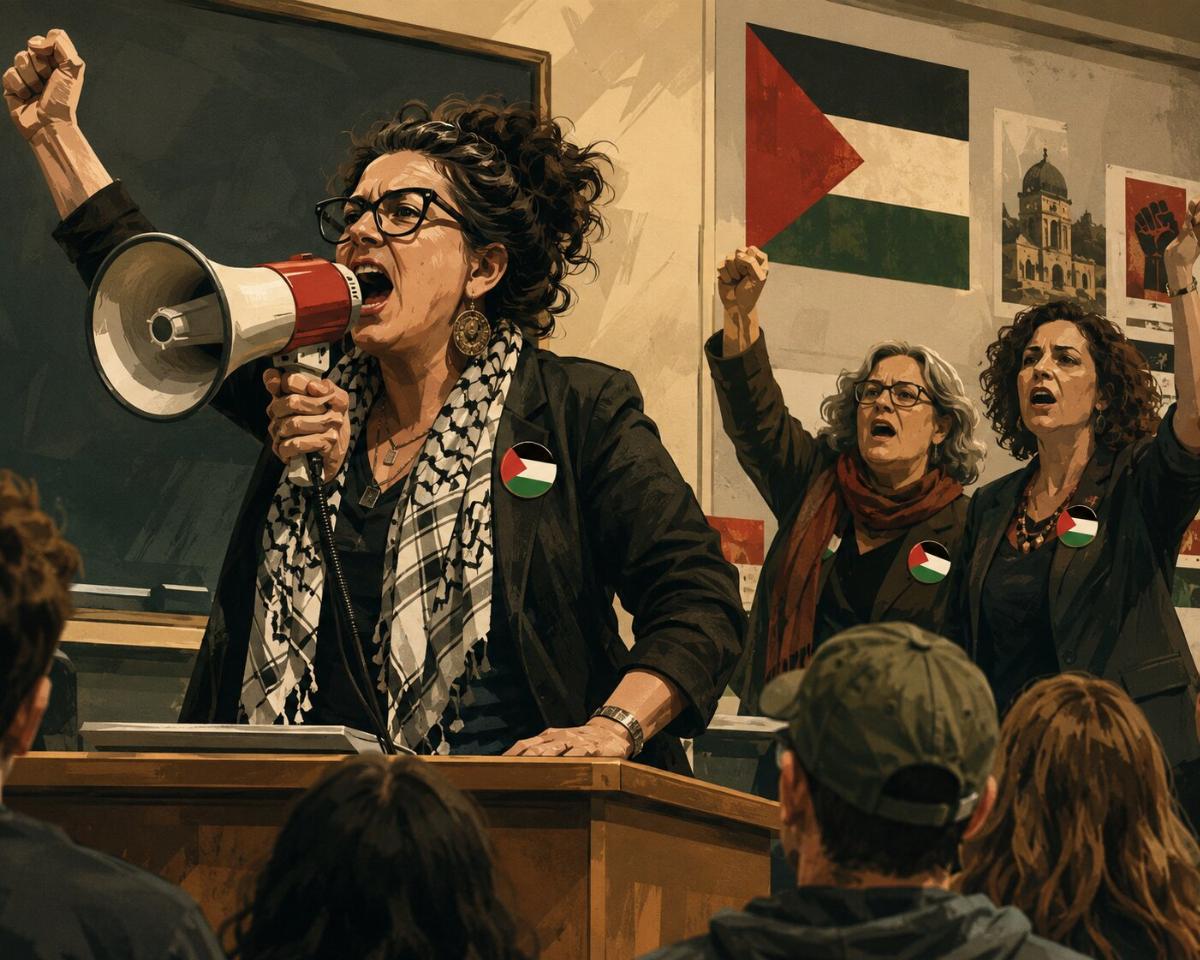
As students return to campus, professors who supported the protest movements that disrupted universities after October 7 are returning to the classroom with them.
Read more Cybercriminals already know what most Americans don’t
Shayoni Mitra at Barnard College and Nour Joudah at UCLA are two examples.
They teach at different institutions, but their records show a similar pattern: both used their positions to support student organizers, defend encampments, and lend academic credibility to disruptive activism.
Their cases raise a question universities have largely avoided: What responsibility do professors carry when they help legitimize disruptive movements involving their own students?
As a Barnard professor and member of Faculty and Staff for Justice in Palestine at Columbia, Barnard, and Teachers College (FSJP-CBT), Mitra opposed Columbia’s November 2023 suspension of Students for Justice in Palestine and Jewish Voice for Peace. The groups had repeatedly violated university event policies, culminating in an unauthorized demonstration that proceeded despite warnings and included what Columbia called threatening rhetoric and intimidation.
Mitra presented the suspensions as an attack on political expression and supported a faculty walkout.
During the Columbia encampment the following spring, she joined an April 22 faculty walkout supporting arrested protesters.
Eight days later, protesters occupied Hamilton Hall, barricaded entrances, and renamed it “Hind’s Hall.” Columbia eventually called in law enforcement to clear the building. Afterward, Mitra posted: “For 22 hours we had Hind’s Hall.”
The wording openly embraced the takeover. Students involved faced arrests and university discipline, yet there has been little public explanation of whether Barnard or Columbia reviewed faculty members such as Mitra who supported or celebrated the same action.
Mitra later helped organize the “People’s Graduation for Palestine,” an alternative ceremony supporting the protest movement. She also co-hosted an event at Columbia’s Middle East Institute commemorating Refaat Alareer, whose previous public commentary had included the statement: “Are most Jews evil? Of course they are.”
These actions show a professor using her academic identity and campus standing to reinforce one side of a charged movement.
At UCLA, Nour Joudah has followed a similar course.
She referred to the October 7 attack as a Palestinian “operation into the ’48 occupied lands.” She also criticized Ukrainian President Volodymyr Zelenskyy for condemning Hamas, comparing Palestine’s relationship to Israel with Ukraine’s relationship to Russia.
In 2025, she reposted commentary presenting Hamas’s staged return of murdered Israeli hostages, including members of the Bibas family, as an act of “respect.” She has also called for Israel to be “cut off at the knees” through an arms embargo. Against that background, her involvement with faculty and student activism carries greater significance.
Read more Nicole Collier had the right to protest
In December 2023, Joudah announced her affiliation with Faculty and Staff for Justice in Palestine and identified support for student organizers as a central purpose. Those organizers were part of a movement that established unauthorized encampments, disrupted university operations, defied directives, and contributed to an atmosphere many Jewish and Zionist students described as hostile.
She later praised campus encampments as communal, inclusive, and politically successful without addressing their disruption, rule violations, or effect on Jewish students.
Joudah also appeared in a 2024 Al-Shabaka discussion examining what the encampments had achieved and how activists could use them to strengthen the wider Palestine solidarity movement.
That goes beyond commenting on a current event. A professor analyzing a protest movement may be acting as a scholar. A professor discussing how activists can expand it is participating in its strategy.
Professors have the right to hold strong political views, criticize Israel, and advocate for Palestinian causes.
But a professor’s words and actions carry added weight, especially when they support movements associated with disruption, intimidation, antisemitic rhetoric, or the minimization of violence against Israeli civilians.
As in Barnard and Columbia’s case, students at UCLA were disciplined for trespassing, occupying buildings, disrupting classes, and violating protest rules. And as in Shayoni Mitra’s case, UCLA has been far less willing to explain what accountability applies to its faculty members who encouraged, defended, or celebrated the same conduct.
That disparity suggests professors may help drive disruptive activism without facing the scrutiny applied to the students they influence.
Universities should answer basic questions. Did administrators review professors who participated in or celebrated building occupations? Do faculty members have obligations when supporting groups engaged in repeated rule violations? Why are students disciplined for conduct that faculty members publicly defend?
As the new academic year begins, Mitra, Joudah, and other faculty activists remain in positions of influence. The encampments may no longer be standing, but the people who helped legitimize them are still teaching. The question is whether Barnard, Columbia, UCLA, and other universities will set clear standards before the same pattern repeats.
Read more Channelling the inner child for gun control
Image generated by ChatGPT.